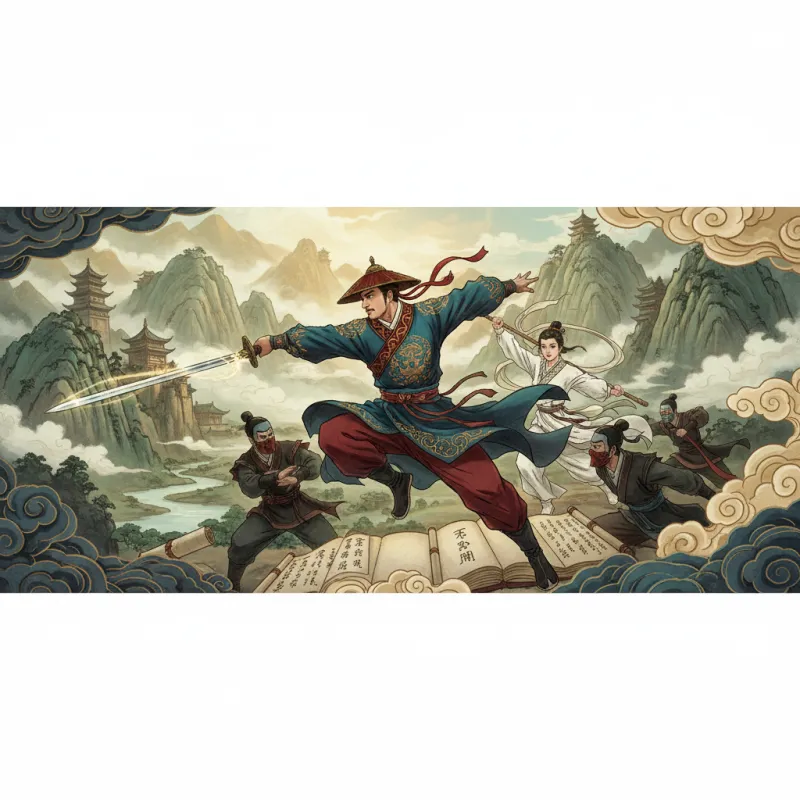
When Guo Jing stands atop the walls of Xiangyang, watching the Mongol hordes mass for their final assault, he knows the city will fall. Yet he stays. This moment from The Return of the Condor Heroes (射雕英雄传, Shèdiāo Yīngxióng Zhuàn) encapsulates everything that makes Jin Yong's wuxia novels endure across generations—not the fantasy of invincible heroes, but the tragedy of flawed humans choosing honor over survival. For over six decades, Louis Cha's fifteen novels have done something remarkable: they've convinced millions of readers that stories about flying swordsmen and mystical martial arts can reveal profound truths about loyalty, love, and the impossible choices that define us.
The Martial Arts That Feel Real
Jin Yong didn't invent wuxia, but he revolutionized how martial arts function in fiction. Before him, kung fu in popular novels was often pure spectacle—heroes could leap over buildings and defeat armies single-handedly with little explanation. Jin Yong kept the spectacle but added structure. His martial arts systems have internal logic, limitations, and consequences.
Take the Eighteen Dragon-Subduing Palms (降龙十八掌, Jiàng Lóng Shíbā Zhǎng), the signature technique of heroes like Guo Jing and Qiao Feng. It's not just powerful—it's specifically powerful, requiring immense internal energy and a straightforward, honest personality to master. Guo Jing, simple and sincere, excels at it. Yang Guo, clever and devious, never could. The martial art reflects character, and character determines destiny.
The Nine Yin Manual (九阴真经, Jiǔ Yīn Zhēnjīng) demonstrates Jin Yong's genius for making martial arts philosophically meaningful. This legendary text appears across multiple novels, and everyone who studies it interprets it differently. Huang Yaoshi uses it to develop unorthodox techniques. Zhou Botong discovers the principle of ambidextrous fighting. Mei Chaofeng and Chen Xuanfeng extract only the deadly techniques and go mad with power. The same knowledge, filtered through different personalities, produces entirely different results—a metaphor for how we all read the same world differently.
Characters Who Refuse to Be Heroes
Western fantasy often gives us chosen ones and prophesied saviors. Jin Yong gives us Linghu Chong, a drunk who stumbles into heroism while trying to avoid responsibility. Or Wei Xiaobao from The Deer and the Cauldron (鹿鼎记, Lù Dǐng Jì), a con artist and womanizer who becomes the Qing Emperor's closest confidant through luck, lies, and an instinct for survival that borders on cowardice.
This subversion of heroic expectations is Jin Yong's signature move. His most celebrated protagonist, Qiao Feng from Demi-Gods and Semi-Devils (天龙八部, Tiānlóng Bābù), spends the entire novel discovering that everything he believed about his identity is wrong. He's not Han Chinese but Khitan, not the righteous hero but the son of his people's enemies. His tragedy isn't that he fails—it's that he succeeds at everything except reconciling the irreconcilable demands of loyalty to two peoples at war.
The female characters break molds just as thoroughly. Huang Rong is brilliant and manipulative, using her intelligence as a weapon more effective than any sword. Zhao Min starts as a villain and never quite stops being one, even after becoming the romantic lead. Ren Yingying orchestrates political schemes while maintaining the facade of a gentle maiden. These women aren't waiting to be rescued—they're usually three steps ahead of the men around them.
Jin Yong's genius lies in making us love characters despite their flaws, or perhaps because of them. Yang Guo is arrogant, impulsive, and obsessed with a woman who raised him from childhood—a relationship that should be creepy but somehow becomes the most moving romance in the entire wuxia canon. We forgive him because Jin Yong shows us why he is the way he is, tracing every character trait back to specific wounds and choices.
Storylines That Span Generations
Most adventure novels follow a single hero through a single quest. Jin Yong thinks bigger. The Condor Trilogy spans three novels and nearly a century of history, following multiple generations as the Song Dynasty falls to the Mongols. Characters from the first novel become legends in the second, and their choices echo into the third. This scope gives Jin Yong room to explore how history shapes individuals and how individuals fail to shape history.
The structure of Demi-Gods and Semi-Devils is even more ambitious—three parallel protagonists whose stories interweave without any of them being "the" main character. Duan Yu seeks to avoid violence and ends up at the center of every conflict. Xuzhu, a Buddhist monk, accidentally becomes the leader of an assassin sect. Qiao Feng, as mentioned, discovers his entire identity is a lie. Their paths cross and diverge in patterns that feel both inevitable and surprising, like watching three rivers flow toward the same ocean through different valleys.
Jin Yong's plots operate on multiple timescales simultaneously. In the foreground, there's immediate action—fights, chases, romantic tension. In the middle distance, there are political machinations involving sects, kingdoms, and secret societies. In the background, there's the slow grinding of historical change that will eventually render all the foreground conflicts meaningless. The Mongols will conquer China regardless of who wins the tournament at Mount Hua. This layering creates a bittersweet tone unique to Jin Yong's work—his heroes matter intensely in the moment but are ultimately powerless against the tide of history.
The Philosophy Hidden in Fight Scenes
Jin Yong was deeply influenced by Buddhism, Taoism, and Confucianism, and he smuggled complex philosophical ideas into what appear to be simple adventure stories. The concept of wuwei (无为, wúwéi)—effortless action—appears throughout his martial arts systems. The highest level of swordsmanship in The Smiling, Proud Wanderer (笑傲江湖, Xiào'ào Jiānghú) is "no sword" (无剑, wú jiàn), where the practitioner transcends technique entirely.
Duan Yu's martial arts in Demi-Gods and Semi-Devils embody Buddhist principles of non-violence. His Lingbo Weibu (凌波微步, Língbō Wēibù) footwork lets him avoid attacks without counterattacking. His Six Meridians Divine Sword can kill but he refuses to use it lethally. He becomes powerful by refusing power—a paradox that Jin Yong explores with genuine philosophical sophistication.
The recurring theme of jianghu (江湖, jiānghú)—the martial arts world—functions as a metaphor for society itself. It has its own rules, hierarchies, and moral codes that often conflict with official law. Characters must navigate between the demands of jianghu loyalty and their personal ethics, between the reputation they've built and the person they want to become. This tension between social role and individual conscience drives nearly every major plot in Jin Yong's novels.
Why Jin Yong Still Matters
In 2024, a century after Jin Yong's birth, his novels remain bestsellers across Asia and increasingly in translation worldwide. This longevity isn't just nostalgia. Jin Yong's work endures because he understood something fundamental: genre fiction can be literature if you take it seriously enough.
He took wuxia seriously by grounding it in real history. His novels reference actual events—the fall of the Song Dynasty, the Qing conquest of China, the Taiping Rebellion. Characters interact with historical figures like Genghis Khan, Kublai Khan, and the Kangxi Emperor. This historical anchoring makes the fantasy elements feel earned rather than arbitrary.
He took his characters seriously by giving them psychological depth that rivals any literary novel. The relationship between Yang Guo and Xiaolongnü isn't just a romance—it's an exploration of how childhood trauma shapes adult attachment patterns. Linghu Chong's alcoholism isn't comic relief—it's a coping mechanism for someone who can't reconcile his loyalty to his master with his master's moral failures.
Most importantly, Jin Yong took his readers seriously by refusing to simplify. His novels don't offer easy answers about good and evil, loyalty and betrayal, love and duty. The "villains" often have compelling motivations. The heroes make terrible mistakes. The happy endings are tinged with loss. This moral complexity is why adults can reread these novels and find new layers each time.
The Influence That Never Ends
Jin Yong's impact on Chinese popular culture is difficult to overstate. His novels have been adapted into dozens of television series, films, video games, and comics. Phrases from his books have entered everyday Chinese language. His character archetypes—the naive but talented hero, the brilliant and manipulative heroine, the tragic villain—appear in countless works that followed.
But his influence extends beyond direct adaptation. The entire modern Chinese fantasy genre, from web novels to blockbuster films, exists in Jin Yong's shadow. Writers either imitate his style or deliberately subvert it, but they can't ignore it. Even works that seem to have nothing to do with wuxia often reveal Jin Yong's influence in their structure, their character dynamics, or their philosophical concerns.
The philosophical dimensions of martial arts in Jin Yong's work have influenced how subsequent generations think about the relationship between physical discipline and spiritual cultivation. His treatment of loyalty and betrayal in the jianghu established templates that writers still use today.
Reading Jin Yong in the 21st Century
For new readers approaching Jin Yong's work, the sheer volume can be intimidating—fifteen novels, millions of characters, dozens of interconnected storylines. Where do you start?
The Legend of the Condor Heroes is the traditional entry point, introducing the world of wuxia through Guo Jing's straightforward heroism before later novels complicate the formula. The Smiling, Proud Wanderer works as a standalone and showcases Jin Yong's mature style. Demi-Gods and Semi-Devils is the masterpiece but benefits from familiarity with wuxia conventions.
The novels reward rereading. First time through, you're caught up in the plot—will Guo Jing save Xiangyang? Will Yang Guo reunite with Xiaolongnü? Second time through, you notice the foreshadowing, the thematic parallels, the way seemingly minor characters from early chapters become crucial later. Third time through, you start seeing the philosophical arguments embedded in the action scenes, the historical commentary disguised as adventure.
Jin Yong revised his novels multiple times over his life, and the differences between versions reveal his evolving worldview. The early versions are more idealistic, the later revisions more cynical. Wei Xiaobao's ending changes significantly between editions, reflecting Jin Yong's changing thoughts about compromise and survival in an imperfect world.
The timeless appeal of Jin Yong's wuxia novels lies not in their martial arts spectacle, though that's undeniably fun, nor in their intricate plots, though those are masterfully constructed. The appeal lies in their humanity. These are stories about people trying to be good in a world that makes goodness complicated, trying to be loyal when loyalties conflict, trying to love when love requires sacrifice. The flying swordsmen and mystical techniques are just the delivery mechanism for questions that matter in any era: How do we live with integrity? What do we owe to others? When should we compromise, and when should we stand firm even if it costs us everything?
Guo Jing stays on the walls of Xiangyang because he's answered those questions for himself. The city will fall, but some things matter more than survival. Jin Yong spent his career exploring what those things might be, and his novels endure because we're still asking the same questions.
Related Reading
- Top 10 Martial Arts Schools in Jin Yong's Novels
- Understanding Jin Yong's Martial Arts Ranking System
- The Five Greats Explained: Understanding Jin Yong's Power Elite
- The Enduring Legacy of Jin Yong’s Wuxia Novels: Characters, Martial Arts, and Cultural Influence
- Six Meridian Divine Sword: Invisible Blade
- The Forbidden City in Jin Yong's Wuxia Fiction
- The Major Themes in Jin Yong's Novels
- The Definitive Jin Yong Martial Arts Power Ranking