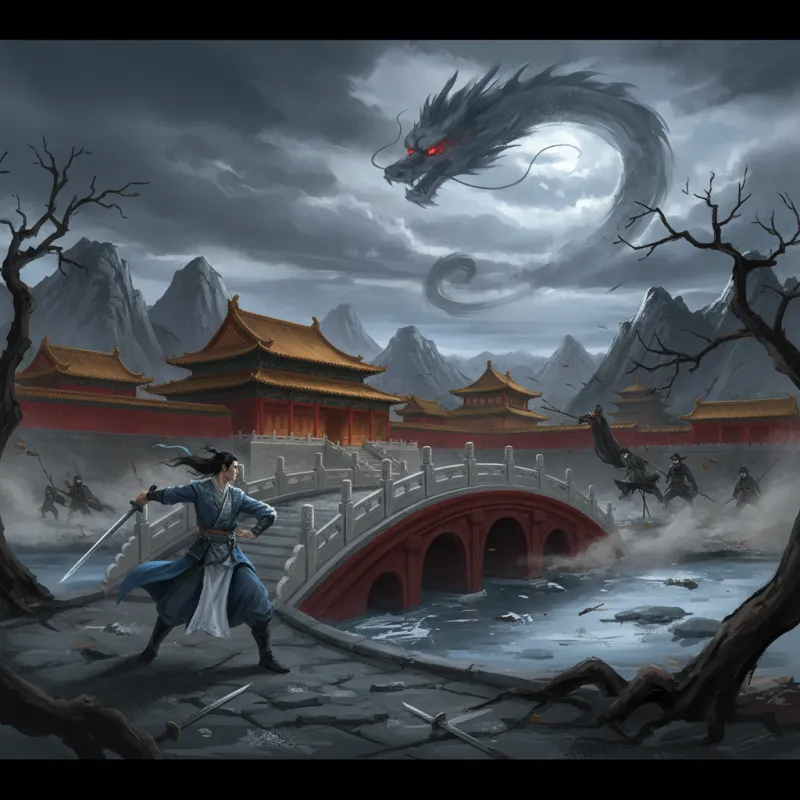
The moment Wei Xiaobao stumbles through the gates of the Forbidden City disguised as a eunuch, he's convinced he's going to die. And honestly? He probably should have. But Jin Yong's most irreverent novel, The Deer and the Cauldron (鹿鼎记 Lùdǐng Jì), isn't interested in what should happen—it's interested in what happens when a street-smart nobody infiltrates the most powerful address in the Qing Empire. The Forbidden City (紫禁城 Zǐjìnchéng) becomes more than just a setting here; it's a character in its own right, a labyrinth of power where martial arts skill matters far less than knowing which eunuch to bribe and which concubine to avoid.
The Palace as Political Battlefield
Most Jin Yong novels treat the jianghu (江湖 jiānghú)—the martial arts world—as separate from imperial politics. Heroes fight in remote mountains, hidden valleys, and secret islands, far from the emperor's gaze. The Forbidden City shatters that separation. Here, every corridor is a potential ambush site, every garden a meeting place for conspirators, and every throne room audience a test of survival.
Wei Xiaobao's relationship with the young Kangxi Emperor transforms the Forbidden City from an abstract symbol of power into an intimate space of friendship and danger. They wrestle in the imperial study, plot against the regent Oboi (鳌拜 Áobài) in hidden chambers, and navigate palace intrigue with a combination of luck, cunning, and genuine affection. Jin Yong shows us that the real martial arts in the palace aren't the flying kicks and sword techniques—they're the ability to read a room, tell a convincing lie, and know when to shut up.
The architecture itself becomes weaponized. The Hall of Mental Cultivation (养心殿 Yǎngxīn Diàn), where emperors conducted daily business, appears repeatedly as a space where Wei Xiaobao must perform loyalty while secretly serving multiple masters. The Imperial Garden, typically a place of leisure, becomes a surveillance zone where every conversation might be overheard. Even the palace's famous red walls—meant to project imperial majesty—become barriers that trap as much as they protect.
Eunuchs, Spies, and the Real Power Structure
Jin Yong's Forbidden City reveals an uncomfortable truth: the people who officially hold power and the people who actually wield it are rarely the same. Wei Xiaobao's fake eunuch identity gives him access to this shadow government. The eunuchs control information flow, manage the emperor's schedule, and know every secret passage in the palace complex.
This isn't just creative license—Jin Yong draws on real Qing Dynasty history, where eunuchs like Wei Zhongxian (魏忠贤) wielded more practical power than many princes. By making his protagonist a fake eunuch, Jin Yong positions him perfectly to observe how power actually works: through whispered conversations, strategic alliances, and knowing which doors to leave unlocked.
The novel also populates the Forbidden City with spies from every faction imaginable. The Heaven and Earth Society (天地会 Tiāndì Huì) has agents among the guards. The Mystic Dragon Cult (神龙教 Shénlóng Jiào) has infiltrated the imperial kitchens. Russian envoys wander the halls with their own agendas. The Forbidden City becomes less a fortress and more a permeable membrane, where the supposedly impenetrable walls can't keep out determined infiltrators—or their competing visions of China's future.
Martial Arts in Confined Spaces
When martial artists do fight in the Forbidden City, the combat takes on a different character than the sweeping battles in Jin Yong's other novels. There's no room for the Eighteen Dragon-Subduing Palms (降龙十八掌 Jiàng Lóng Shíbā Zhǎng) or the elaborate sword formations of Mount Hua. Instead, fights happen in cramped quarters: behind screens, in narrow corridors, inside the emperor's bedroom.
The most memorable martial arts sequence in the palace involves Oboi, whose brute strength and Iron Shirt technique (铁布衫 Tiěbùshān) make him nearly invincible in open combat. But Kangxi and Wei Xiaobao don't face him in a fair fight—they ambush him in a study, using hidden weapons, surprise, and sheer numbers. It's unheroic, undignified, and completely effective. Jin Yong seems to be saying: in the Forbidden City, honor is a luxury you can't afford.
This contrasts sharply with locations like Shaolin Temple, where martial arts prowess is respected and cultivated according to strict codes. The palace has no such codes. Here, the best martial artist isn't the one with the most refined technique—it's the one who survives.
The Emperor's Loneliness
Through Kangxi's character, Jin Yong explores what it means to live in the Forbidden City as its supposed master. The young emperor is surrounded by thousands of servants, guards, and officials, yet he's profoundly isolated. He can't trust his advisors, who have their own agendas. He can't trust his family, who might be plotting succession. He can't even trust his food, which might be poisoned.
Wei Xiaobao becomes valuable precisely because he's an outsider to palace politics—at least initially. Their friendship, conducted in the private spaces of the Forbidden City, offers Kangxi something rare: genuine human connection. They share meals, exchange crude jokes, and plan strategies together. The palace, usually depicted as a place of rigid hierarchy and formal ritual, briefly becomes a space of authentic relationship.
But Jin Yong doesn't romanticize this. As Wei Xiaobao gets drawn deeper into palace intrigue, even this friendship becomes complicated by competing loyalties. The Forbidden City's architecture—designed to separate the emperor from ordinary humanity—ultimately succeeds in its purpose. No matter how close Kangxi and Wei Xiaobao become, the palace itself enforces distance.
Historical Accuracy and Creative License
Jin Yong's Forbidden City blends historical research with narrative invention. The physical layout matches the actual Qing Dynasty palace: the Meridian Gate (午门 Wǔmén), the Hall of Supreme Harmony (太和殿 Tàihé Diàn), the Six Eastern Palaces where imperial concubines lived. Readers familiar with Beijing can mentally map Wei Xiaobao's adventures onto the real location.
But Jin Yong takes liberties with what happened inside those walls. The real Kangxi Emperor did face down the regent Oboi, but probably not with the help of a fake eunuch from Yangzhou. The palace did house political intrigue, but likely not quite as many secret societies and foreign spies as Jin Yong depicts. These inventions serve the story's larger purpose: using the Forbidden City as a lens to examine how power corrupts, how loyalty becomes complicated, and how even the most powerful people are trapped by the systems they supposedly control.
This approach differs from how Jin Yong treats other historical locations. Mount Hua in The Smiling, Proud Wanderer (笑傲江湖 Xiào'ào Jiānghú) is more symbolic than realistic, a place where martial arts philosophy matters more than historical accuracy. The Forbidden City demands more grounding in reality because it's so recognizable—readers know what it looks like, know its history, and would notice if Jin Yong strayed too far from documented fact.
The Palace as Prison
By the novel's end, Wei Xiaobao has achieved what most people in the Qing Empire could only dream of: wealth, titles, multiple wives, and the emperor's favor. But he chooses to leave the Forbidden City, recognizing that staying means becoming trapped in its endless political games. The palace, for all its luxury and power, is fundamentally a prison—not just for its residents, but for anyone who enters its orbit.
This theme resonates throughout Jin Yong's work. His heroes typically reject official positions and imperial favor, preferring the freedom of the jianghu. But The Deer and the Cauldron makes this rejection more explicit by showing us exactly what accepting imperial power entails. The Forbidden City's red walls don't just keep enemies out—they keep inhabitants in, bound by duty, protocol, and the constant threat of political destruction.
Kangxi himself, despite being emperor, can never leave. His entire life will be spent within these walls, making decisions that affect millions while personally experiencing almost nothing of the world beyond the palace gates. Wei Xiaobao's escape is also a rescue—he gets out before the Forbidden City can fully claim him.
Legacy and Influence
Jin Yong's portrayal of the Forbidden City influenced how subsequent Chinese fiction depicts imperial power. Before The Deer and the Cauldron, palace dramas tended toward either reverent historical recreation or pure fantasy. Jin Yong found a middle path: treating the palace as a real place with real politics, but viewing it through the eyes of an irreverent outsider who refuses to be impressed by imperial majesty.
This perspective—skeptical of power, sympathetic to those caught in its machinery, but ultimately committed to human connection over political loyalty—defines the novel's relationship with its setting. The Forbidden City isn't evil in The Deer and the Cauldron, but it's not glorious either. It's simply a place where power concentrates, and where that concentration inevitably corrupts and constrains everyone involved.
For readers visiting the actual Forbidden City in Beijing today, Jin Yong's novel offers an alternative tour guide. Yes, admire the architecture and imagine the imperial ceremonies. But also picture Wei Xiaobao sneaking through those corridors, Kangxi wrestling with loneliness in those vast halls, and all the unnamed servants, eunuchs, and guards whose labor maintained the illusion of effortless imperial power. The palace's beauty, Jin Yong reminds us, was built on countless invisible sacrifices—and its power was always more fragile than it appeared.
Related Reading
- Discovering the Enchanting Locations of Jin Yong's Wuxia Novels
- Jin Yong's Locations: The Real Places Behind the Fictional Battles
- Visiting Jin Yong Locations in Real Life
- A Map of the Jianghu: Geography in Jin Yong's Novels
- Peach Blossom Island: The Most Magical Location in Jin Yong's World
- Unveiling the Wisdom and Philosophy in Jin Yong's Wuxia Novels
- The Enigmatic Hidden Techniques in Jin Yong’s Wuxia Novels Explored
- The 10 Best Couples in Jin Yong's Novels