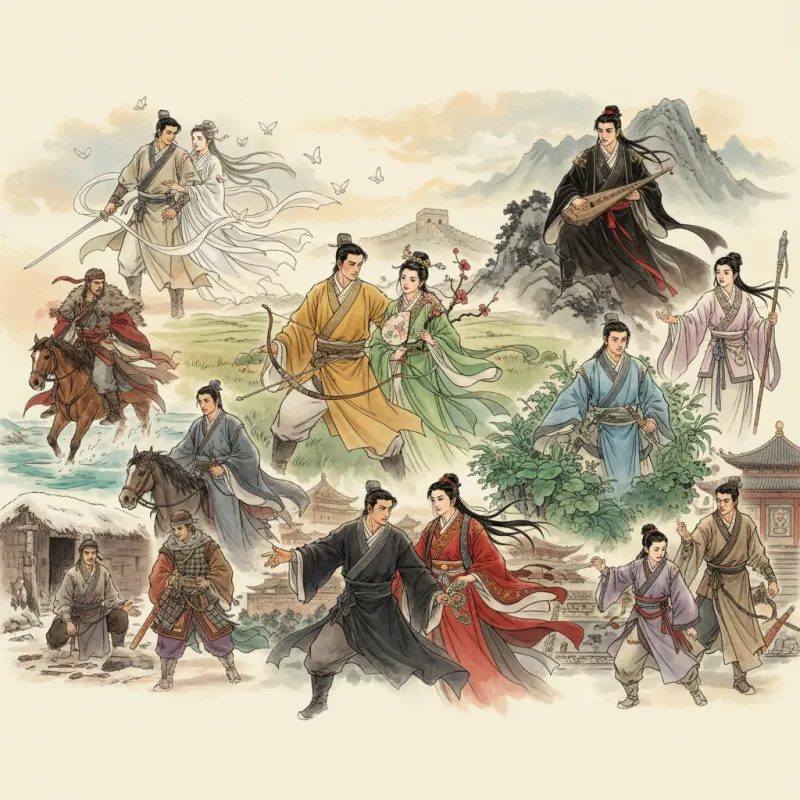
They say you can judge a martial arts novel by its fight scenes, but Jin Yong (金庸 Jīn Yōng) knew better — the real test is whether you're still thinking about the couples twenty years after closing the book. While Western readers debate whether Romeo and Juliet would've lasted past their honeymoon, Jin Yong gave us something harder to write: romances that survive not just tragedy, but Tuesday. These ten couples don't just fall in love spectacularly — they stay together through war, betrayal, and the soul-crushing realization that your spouse's morning habits will annoy you for the next forty years.
Guo Jing and Huang Rong — The Impossible Balance
From The Legend of the Condor Heroes (射雕英雄传 Shèdiāo Yīngxióng Zhuàn), Guo Jing (郭靖 Guō Jìng) and Huang Rong (黄蓉 Huáng Róng) shouldn't work on paper. He's so straightforward he makes a brick look subtle. She's so clever she's already three moves ahead in a conversation you haven't started yet. But that's precisely why they're the gold standard — they prove that compatibility isn't about similarity, it's about complementary dysfunction.
What makes them transcendent is that Jin Yong doesn't let them off easy. In The Return of the Condor Heroes (神雕侠侣 Shéndiāo Xiálǚ), we see them as middle-aged parents, and Huang Rong has become calculating, even manipulative, in ways that would horrify her younger self. Guo Jing remains stubbornly principled to the point of rigidity. They've grown into their flaws, not out of them. Yet when Xiangyang (襄阳 Xiāngyáng) falls in the historical epilogue, they die together defending a doomed city. That's the real romance — not that they never changed, but that they chose each other anyway, every single day, even when it would've been easier not to.
Yang Guo and Xiaolongnü — Love as Defiance
If Guo Jing and Huang Rong are the couple your parents approve of, Yang Guo (杨过 Yáng Guò) and Xiaolongnü (小龙女 Xiǎolóngnǚ) are the ones that make family dinners awkward. Their relationship in The Return of the Condor Heroes violates every social norm Jin Yong could think of — she's his teacher, she's significantly older, and the entire martial arts world loses its collective mind over their student-teacher romance.
But here's what's brilliant: Jin Yong makes you root for them anyway. Not because their love is pure or innocent — it's neither — but because it's theirs. Yang Guo spends sixteen years waiting for Xiaolongnü after she disappears, and when critics call it obsessive, they're missing the point. In a world that told him his love was wrong from day one, waiting becomes an act of rebellion. Their reunion at the Broken Heart Cliff (断肠崖 Duànchángyá) isn't just romantic — it's a middle finger to everyone who said they shouldn't exist.
The age gap and power dynamic make modern readers uncomfortable, and they should. Jin Yong wasn't writing a manual for healthy relationships; he was writing about people who loved each other in ways society couldn't accommodate. That's what makes them unforgettable.
Linghu Chong and Ren Yingying — The Meeting of Equals
In The Smiling, Proud Wanderer (笑傲江湖 Xiào'ào Jiānghú), Linghu Chong (令狐冲 Línghú Chōng) and Ren Yingying (任盈盈 Rèn Yíngyíng) represent something rare in Jin Yong's work: a couple with no significant power imbalance. She's the daughter of the Sun Moon Holy Cult (日月神教 Rìyuè Shénjiào) leader, he's a disgraced disciple, but when they're together, none of that matters.
What I love about them is how they handle Linghu Chong's obvious feelings for Yue Lingshan (岳灵珊 Yuè Língshān). Ren Yingying doesn't pretend it doesn't hurt, but she also doesn't make it his problem to fix. She simply becomes so undeniably herself that eventually, Linghu Chong realizes what he has. It's emotionally mature in a way that feels almost anachronistic for a wuxia novel — no dramatic confrontations, no ultimatums, just two people figuring out how to be together without losing themselves.
Their ending, retiring to the West Lake (西湖 Xīhú) to play music and drink wine, is the quietest happy ending in Jin Yong's corpus. After a novel full of political intrigue and sectarian violence, they choose irrelevance. That takes more courage than any sword technique.
Duan Yu and Wang Yuyan — The Tragedy of Getting What You Want
Demi-Gods and Semi-Devils (天龙八部 Tiānlóng Bābù) gives us Duan Yu (段誉 Duàn Yù), who spends the entire novel worshipping Wang Yuyan (王语嫣 Wáng Yǔyān) like she's a particularly attractive deity. He gets her in the end, and it feels... hollow. That's not a flaw in the writing — it's the point.
Wang Yuyan spends the novel in love with her cousin Murong Fu (慕容复 Mùróng Fù), a man so obsessed with restoring his family's kingdom that he barely notices she exists. When Murong Fu's ambitions finally destroy him, she turns to Duan Yu, who's been waiting in the wings like an understudy who finally gets his shot. But Jin Yong makes it clear: she's settling. Duan Yu is getting a woman who will never love him the way she loved someone else.
It's the most realistic romance in Jin Yong's work, and that's why it's devastating. Sometimes love isn't about passion or destiny — it's about two people who are tired of being alone, choosing the person who's there. Duan Yu and Wang Yuyan will probably have a fine marriage. They'll be kind to each other. They'll have children. And neither will ever quite be what the other wanted. That's more tragic than any death scene Jin Yong ever wrote.
Zhang Wuji and Zhao Min — Chaos Meets Chaos
In The Heaven Sword and Dragon Saber (倚天屠龙记 Yǐtiān Túlóngìjì), Zhang Wuji (张无忌 Zhāng Wújì) is so indecisive he makes Hamlet look like a man of action. Zhao Min (赵敏 Zhào Mǐn) is so aggressively forward she'd terrify a modern HR department. Together, they're a disaster, and it's glorious.
What makes them work is that Zhao Min doesn't wait for Zhang Wuji to figure out his feelings — she simply decides he's hers and proceeds accordingly. She kidnaps him, manipulates him, and generally behaves like someone who learned romance from a manual written by a particularly ambitious warlord. And somehow, it works, because Zhang Wuji needs someone who will make decisions for him.
The controversial part is how Jin Yong handles the other women in Zhang Wuji's life. Zhou Zhiruo (周芷若 Zhōu Zhǐruò) becomes a villain partly because Zhang Wuji can't commit. Xiao Zhao (小昭 Xiǎo Zhāo) disappears to Persia. Zhu'er (蛛儿 Zhū'ér) dies. It's a body count that makes you wonder if Zhang Wuji should've just stayed single. But Zhao Min survives because she refuses to be a victim of his indecision — she simply removes his ability to choose anyone else. It's not healthy, but it's effective, and in Jin Yong's world, that counts for something.
Wei Xiaobao and His Seven Wives — The Absurdist Masterpiece
The Deer and the Cauldron (鹿鼎记 Lùdǐngjì) is Jin Yong's comedy, and Wei Xiaobao (韦小宝 Wéi Xiǎobǎo) having seven wives is the punchline that keeps on giving. He's not a martial arts master — he's barely competent with a knife. He's not particularly handsome, smart, or principled. He's a con artist who stumbles into success through sheer audacity and luck.
And yet, his relationships work because he's honest about being dishonest. He never pretends to be a hero. His wives know exactly what they're getting: a charming scoundrel who will absolutely cheat at cards but will also risk his life for them in the stupidest ways possible. There's something refreshing about a protagonist whose greatest skill is making people like him despite themselves.
The seven wives — including Shuang'er (双儿 Shuāng'er), Zeng Rou (曾柔 Zēng Róu), and Princess Jianning (建宁公主 Jiànníng Gōngzhǔ) — represent different types of women, and Jin Yong uses them to satirize the very concept of the wuxia hero. Wei Xiaobao gets the harem ending that martial arts protagonists dream about, and Jin Yong makes it clear: it's exhausting, complicated, and requires more emotional labor than fighting the entire Qing army. It's the most subversive romance in Jin Yong's work, hidden inside a comedy.
Hu Fei and Yuan Ziyi — The Romance That Never Was
Sometimes the best love stories are the ones that don't happen. In Flying Fox of Snowy Mountain (雪山飞狐 Xuěshān Fēihú) and Flying Fox of the Martial Arts World (飞狐外传 Fēihú Wàizhuàn), Hu Fei (胡斐 Hú Fēi) and Yuan Ziyi (袁紫衣 Yuán Zǐyī) have everything: chemistry, mutual respect, and genuine affection. What they don't have is timing.
Yuan Ziyi is a nun, bound by vows she takes seriously. Hu Fei respects those vows, even as it destroys him. They spend the novels circling each other, helping each other, and never quite bridging the gap between what they want and what they can have. It's excruciating, and Jin Yong refuses to give us a clean resolution. They don't end up together. They don't dramatically renounce each other. They just... continue existing in each other's orbit, forever almost.
This is Jin Yong at his most restrained. No dramatic deaths, no last-minute rescues, just two people who love each other and can't be together because sometimes life is just like that. It's the kind of romance that stays with you precisely because it feels unfinished, like a song that ends on a dissonant chord.
Xiao Feng and A'Zhu — Love Cut Short
In Demi-Gods and Semi-Devils, Xiao Feng (萧峰 Xiāo Fēng) and A'Zhu (阿朱 Ā Zhū) get approximately five minutes of happiness before Jin Yong rips it away in the most brutal fashion possible. Xiao Feng accidentally kills A'Zhu while trying to avenge his parents, and it's the kind of tragedy that makes Greek dramatists look optimistic.
What makes their relationship powerful is how normal it is. A'Zhu doesn't have extraordinary martial arts skills or a complicated backstory — she's just a woman who sees Xiao Feng for who he is and loves him anyway. In a genre obsessed with exceptional people, their relationship is exceptional precisely because it's ordinary. They want the same thing every couple wants: a quiet life together, maybe a farm, definitely some peace.
Jin Yong doesn't let them have it. Xiao Feng spends the rest of the novel as a walking wound, and when he finally dies at the end, it feels like a mercy. Their relationship is a reminder that in Jin Yong's world, happiness is always temporary, and the more you want something simple, the less likely you are to get it. For a deeper look at how Jin Yong portrays tragic romance, see The Tragedy of Xiao Feng.
Shi Potian and Ding Dang — The Innocent Romance
Ode to Gallantry (侠客行 Xiákèxíng) gives us Shi Potian (石破天 Shí Pòtiān) and Ding Dang (丁珰 Dīng Dāng), and their relationship is so wholesome it almost doesn't belong in a Jin Yong novel. Shi Potian is essentially a golden retriever in human form — loyal, kind, and so naive he makes Guo Jing look like Machiavelli. Ding Dang is equally straightforward in her affections.
There's no angst here, no love triangles, no dramatic misunderstandings that last for three hundred pages. They like each other, they help each other, and they end up together. It's almost boring in its simplicity, and that's what makes it remarkable. After novels full of complicated, painful relationships, Jin Yong gives us two people who just... work.
It's the palate cleanser of Jin Yong romances, and sometimes that's exactly what you need. Not every love story needs to be a tragedy or a comedy of errors. Sometimes two people meet, fall in love, and live happily ever after, and Jin Yong proves he can write that just as well as he writes heartbreak.
Yuan Chengzhi and Wen Qingqing — The Forgotten Couple
Sword Stained with Royal Blood (碧血剑 Bìxuèjiàn) is one of Jin Yong's earlier novels, and it shows. Yuan Chengzhi (袁承志 Yuán Chéngzhì) and Wen Qingqing (温青青 Wēn Qīngqīng) have a perfectly serviceable romance that nobody remembers because it's sandwiched between more interesting couples in Jin Yong's other works.
But there's something to be said for serviceable. Wen Qingqing is prickly and difficult; Yuan Chengzhi is principled to a fault. They argue constantly, make up, and argue again. It's the kind of relationship that feels lived-in, even if it's not particularly dramatic. They end up leaving China for Southeast Asia, which is either romantic or depressing depending on your perspective.
What's interesting is how Jin Yong uses them to explore the question of what happens when your principles cost you everything. Yuan Chengzhi loses his chance to restore the Ming dynasty, loses his place in China, and ends up in exile. Wen Qingqing stays with him anyway, not because she agrees with his choices, but because she's chosen him. It's not the most exciting romance, but it might be one of the most realistic — sometimes love is just deciding that this person's bad decisions are ones you're willing to live with.
The Couples That Define Us
Jin Yong's couples work because they're not aspirational — they're recognizable. We've all been Duan Yu, loving someone who will never love us back the same way. We've all been Zhang Wuji, paralyzed by too many options. We've all been Xiao Feng, losing something precious through our own mistakes. And if we're lucky, we've been Guo Jing and Huang Rong, finding someone whose flaws fit with ours in a way that makes the whole thing work.
These ten couples aren't just characters in novels — they're templates for how Chinese readers think about romance. They've shaped expectations, started arguments, and inspired countless imitations. Some of them are healthy relationships; some are disasters. But all of them feel true, and in fiction, that's the only thing that matters. For more on how Jin Yong's characters navigate the complexities of love and duty, explore The Women of Jin Yong's Novels.
Related Reading
- The Couples of Jin Yong: Love Stories That Defined Chinese Romance
- Love Triangles in Jin Yong: When Heroes Can't Choose
- The Most Tragic Love Stories in Jin Yong's Novels
- The Couples of Jin Yong: Love Stories Hidden Inside Martial Arts Epics
- Exploring Legendary Weapons in Jin Yong’s Wuxia Novels: Symbolism and Martial Arts Mastery
- The Enduring Legacy of Jin Yong’s Wuxia Characters and Martial Arts
- A Map of the Jianghu: Geography in Jin Yong's Novels