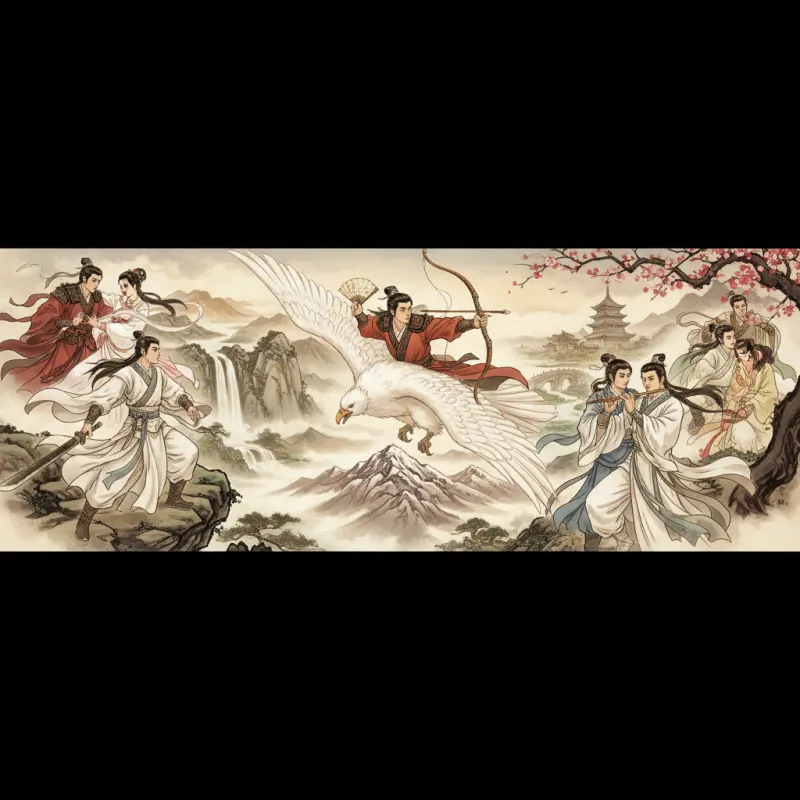
When Huang Rong first meets Guo Jing in The Legend of the Condor Heroes (射雕英雄传, Shèdiāo Yīngxióng Zhuàn), she's disguised as a filthy beggar boy, and he buys her a meal without hesitation. It's a small act of kindness, but it sets in motion one of the most influential love stories in modern Chinese literature. Jin Yong didn't just write martial arts novels — he wrote the blueprint for how an entire generation would think about romance.
The Revolutionary Idea: Love as Character Development
Before Jin Yong, wuxia fiction treated romance as decoration. The hero got the girl because he was the hero. Jin Yong flipped this formula. In his novels, love isn't a reward for martial prowess — it's a crucible that reveals who characters truly are. Yang Guo loses an arm and gains emotional depth. Linghu Chong's loyalty to Yue Lingshan exposes his capacity for self-sacrifice. Duan Yu's infatuation with Wang Yuyan drives him from naive prince to capable martial artist.
This wasn't just innovative storytelling. It was a radical reimagining of what Chinese popular fiction could do. Jin Yong took the conventions of wuxia — the fights, the secret manuals, the revenge plots — and used them as a framework to explore genuine human emotion. The result? Fourteen novels, each built around a completely different model of romantic love.
Guo Jing and Huang Rong: When Opposites Actually Attract
The phrase "opposites attract" gets thrown around carelessly, but Guo Jing and Huang Rong are the real thing. He's so honest he can't tell a lie. She's so clever she can't resist telling several. He's the son of patriots who died fighting the Jin invaders. She's the pampered daughter of Peach Blossom Island's eccentric master. He thinks in straight lines. She thinks in spirals.
What makes their relationship work isn't that they balance each other out — it's that they genuinely admire what the other has and they lack. Guo Jing never resents Huang Rong's intelligence; he's awed by it. Huang Rong never mocks Guo Jing's simplicity; she's moved by his moral clarity. This mutual respect becomes the foundation for one of Jin Yong's most enduring couples, and it set a template that Chinese romance has been following ever since.
Their relationship also introduces a key Jin Yong theme: love as a civilizing force. Huang Rong starts the novel as a spoiled runaway playing tricks on strangers. By the end, she's a leader willing to sacrifice for the greater good. Guo Jing's love doesn't change her personality — she's still clever and occasionally manipulative — but it gives her a reason to use those qualities for something beyond herself.
Yang Guo and Xiao Longnü: The Forbidden Love That Defined a Generation
If Guo Jing and Huang Rong are the respectable couple your parents approve of, Yang Guo and Xiao Longnü are the relationship that makes everyone uncomfortable. Student and teacher. Sixteen-year age gap. A romance that violates every Confucian principle about proper relationships.
Jin Yong knew exactly what he was doing. The Return of the Condor Heroes (神雕侠侣, Shéndiāo Xiálǚ) was published in the 1960s, when traditional Chinese values were being questioned and overturned. Yang Guo and Xiao Longnü's love story became a lightning rod for debates about individual desire versus social obligation, and it remains controversial today.
What makes their relationship compelling isn't the taboo — it's the absolute devotion. Yang Guo spends sixteen years waiting for Xiao Longnü to return from what he believes is certain death. No other woman interests him. He becomes one of the most powerful martial artists in the jianghu (江湖, jiānghú — the martial world), but none of it matters without her. This kind of single-minded romantic obsession was new to wuxia fiction, and it resonated with readers who were tired of practical, arranged marriages.
Linghu Chong and Ren Yingying: Love as Mutual Recognition
The Smiling, Proud Wanderer (笑傲江湖, Xiào'ào Jiānghú) gives us something different: two people who see each other clearly and choose each other anyway. Linghu Chong is a drunk, a troublemaker, and a man who refuses to play political games. Ren Yingying is the daughter of the Sun Moon Holy Cult's leader, raised in a world of manipulation and power struggles.
Their romance works because neither tries to change the other. Ren Yingying doesn't try to make Linghu Chong more ambitious. Linghu Chong doesn't ask Ren Yingying to abandon her father or her sect. They accept each other's flaws and loyalties as part of the package. This is mature love — not the passionate obsession of Yang Guo and Xiao Longnü, but something quieter and more sustainable.
The contrast with Linghu Chong's earlier infatuation with Yue Lingshan is deliberate. Yue Lingshan is the girl he grew up with, the one he thought he'd marry. But she doesn't really see him — she sees the senior disciple, the reliable friend, the safe choice. Ren Yingying sees the real Linghu Chong: the man who'd rather play the qin (琴, qín — a seven-stringed zither) and drink wine than accumulate power. For more on how Jin Yong uses music to express emotion, see The Role of Music in Jin Yong's Romances.
Duan Yu and Wang Yuyan: The Unrequited Love That Becomes Real
Duan Yu's pursuit of Wang Yuyan in Demi-Gods and Semi-Devils (天龙八部, Tiānlóng Bābù) starts as comedy and ends as something more complex. He falls in love with her portrait before meeting her. He follows her around like a puppy. He memorizes martial arts manuals just to impress her, even though he's a pacifist who refuses to fight.
For most of the novel, Wang Yuyan barely notices him. She's obsessed with her cousin Murong Fu, a man who sees her as a useful tool rather than a person. The tragedy is that Wang Yuyan has encyclopedic knowledge of martial arts but no sense of her own worth. She can analyze any fighting technique, but she can't see that Murong Fu will never love her back.
The resolution of their relationship is bittersweet. Wang Yuyan doesn't suddenly realize Duan Yu is perfect for her. She realizes Murong Fu is terrible for her, and Duan Yu is there, still devoted, still kind. It's not the fairy tale ending Duan Yu imagined, but it's real. Jin Yong is saying something important here: sometimes love isn't about finding your perfect match. Sometimes it's about finding someone who genuinely cares about your happiness.
Wei Xiaobao and His Seven Wives: The Subversion of Romance
Then there's Wei Xiaobao from The Deer and the Cauldron (鹿鼎记, Lùdǐng Jì), who breaks every rule. He's a con artist, a coward, and a shameless opportunist who ends up with seven wives. This shouldn't work as romance, but somehow it does.
Jin Yong uses Wei Xiaobao to interrogate the very idea of romantic love. Wei Xiaobao doesn't have a soulmate. He doesn't experience earth-shattering passion. He likes women, they like him (for reasons that aren't always clear), and he refuses to choose between them. It's the opposite of Yang Guo's devoted monogamy, and Jin Yong presents it without moral judgment.
What's fascinating is that Wei Xiaobao's relationships are, in their own way, more egalitarian than many of Jin Yong's other romances. He doesn't put any of his wives on a pedestal. He doesn't pretend to be a hero. He's honest about being a scoundrel, and they marry him anyway. For a deeper look at how Jin Yong evolved his portrayal of romance, see The Evolution of Female Characters in Jin Yong's Novels.
The Cultural Impact: Why These Couples Still Matter
Jin Yong's couples have become cultural shorthand. When Chinese readers describe a relationship as "like Guo Jing and Huang Rong," everyone knows what they mean: complementary partners who bring out the best in each other. "Like Yang Guo and Xiao Longnü" signals forbidden love and absolute devotion. "Like Linghu Chong and Ren Yingying" suggests mature acceptance and mutual respect.
This isn't just literary influence — it's shaped how people think about their own relationships. Jin Yong gave readers a vocabulary for different kinds of love, and he did it through stories that were exciting, funny, and emotionally honest. The martial arts were the hook, but the romances were what kept readers coming back.
The genius of Jin Yong's approach is that he never suggests there's one correct way to love. Guo Jing and Huang Rong's complementary partnership isn't better than Yang Guo and Xiao Longnü's obsessive devotion — they're just different. Some people need a partner who balances them out. Others need someone who understands their obsessions. Jin Yong understood that love is too complex and too individual to fit into a single template.
The Legacy: Romance in the Martial World
Modern Chinese romance, whether in novels, television, or film, still operates in Jin Yong's shadow. The tropes he established — the clever woman who civilizes the hero, the forbidden love that defies social convention, the unrequited love that becomes real — appear again and again. Sometimes creators follow his templates. Sometimes they subvert them. But they're always in conversation with what Jin Yong did first.
What makes Jin Yong's romances endure isn't that they're idealized or perfect. It's that they're specific and human. His couples argue, make mistakes, hurt each other, and have to figure out how to move forward. They're not just falling in love — they're learning how to be in love, which is messier and more interesting. That's why, decades after these novels were first published, readers still argue about which couple is the best, which relationship is the most romantic, and what Jin Yong was really saying about love. The conversations continue because the questions he raised don't have simple answers, and the emotions he captured still feel true.
Related Reading
- The Couples of Jin Yong: Love Stories Hidden Inside Martial Arts Epics
- The 10 Best Couples in Jin Yong's Novels
- The Most Tragic Love Stories in Jin Yong's Novels
- Love Triangles in Jin Yong: When Heroes Can't Choose
- The Five Greats Across All Generations: How the Rankings Changed
- Exploring the Rich Tapestry of Jin Yong's Wuxia Novels: Characters and Martial Arts
- The Art of Duels in Jin Yong's Wuxia Novels: A Journey Through Martial Valor