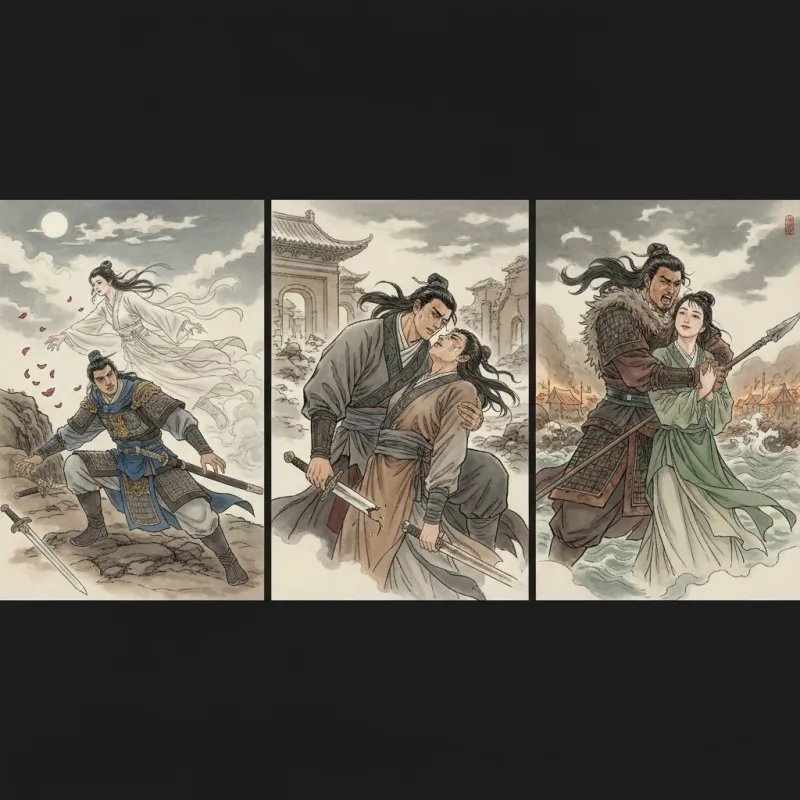
They say the saddest stories are the ones where love was real, but everything else was wrong. Jin Yong (金庸 Jīn Yōng) understood this better than almost any writer. His martial arts novels are famous for their intricate plots and legendary heroes, but what really destroys readers — what keeps us up at night years after finishing the books — are the love stories that go catastrophically, irreversibly wrong. Not because the lovers didn't care enough, but because they cared too much in a world that wouldn't let them be together.
Xiao Feng and A'Zhu: When One Mistake Destroys Everything
In 天龙八部 (Tiānlóng Bābù) — Demi-Gods and Semi-Devils — Xiao Feng (萧峰 Xiāo Fēng) is the most heroic character Jin Yong ever created. He's righteous, powerful, loyal to a fault. A'Zhu (阿朱 Ā Zhū) is clever, warm, devoted. They're perfect for each other. They plan to retire from the 江湖 (jiānghú, the martial arts world) and live quietly together, herding cattle and sheep beyond the Great Wall.
Then Xiao Feng kills her by accident.
He's hunting down the man who murdered his adoptive parents, consumed by rage and grief. A'Zhu, trying to protect her own father, disguises herself as him. Xiao Feng strikes before he realizes who she really is. She dies in his arms, still trying to comfort him, asking him not to seek revenge anymore.
What makes this unbearable isn't just the tragedy itself — it's the timing. They were this close to happiness. They'd already planned their future. A'Zhu's final words aren't angry or accusatory; she's worried about him, about what this will do to him. And she's right to worry. Xiao Feng never recovers. He goes on to save millions of lives and broker peace between nations, but the man who loved A'Zhu died with her on that bridge. Everything after is just momentum.
Yang Guo and Xiao Longnu: Sixteen Years of Waiting
The love story in 神雕侠侣 (Shéndiāo Xiálǚ) — The Return of the Condor Heroes — is tragic in a different way. Yang Guo (杨过 Yáng Guò) and Xiao Longnu (小龙女 Xiǎo Lóngnǚ) do get their happy ending, technically. But the cost is sixteen years of separation, and the psychological damage runs deep.
Xiao Longnu believes she's dying from poison. Rather than burden Yang Guo with watching her deteriorate, she leaves him a note saying they'll reunite in sixteen years at the bottom of Heartbreak Cliff. It's a lie — she expects to be dead. She's giving him a false hope so he won't follow her immediately.
Yang Guo waits. For sixteen years. He becomes one of the greatest heroes in the jianghu, but he's essentially a ghost going through the motions. He stands at that cliff every year on their anniversary. He raises someone else's daughter. He saves the nation from Mongol invasion. But none of it matters to him. He's just killing time until he can die.
The miracle is that Xiao Longnu survives and they do reunite. But think about what those sixteen years did to them. Yang Guo was in his twenties when she left — he's middle-aged when she returns. They lost the entire prime of their lives. And for what? Because she was too proud to let him see her weak, and he was too devoted to move on. It's a happy ending that feels like a scar.
Li Mochou: When Love Turns to Poison
Not all of Jin Yong's tragic love stories are about noble sacrifice. Some are about what happens when love curdles into something toxic and destructive. Li Mochou (李莫愁 Lǐ Mòchóu), the "Scarlet Serpent Fairy" from The Return of the Condor Heroes, is one of the most terrifying examples.
She was once a normal young woman who fell in love with Lu Zhanyuan (陆展元 Lù Zhǎnyuán). He loved her back — or said he did. Then he met someone gentler, more conventional, and he abandoned Li Mochou to marry her instead. The betrayal broke something fundamental in Li Mochou's psyche.
She becomes a serial killer. She murders Lu Zhanyuan's wife and hunts his family for years. She kills innocent people who happen to be in her way. She's so consumed by hatred that she can't see anything else. And the most disturbing part? She never stops loving him. Even decades later, even as she's dying, she's singing the love song they used to share: "Ask the world, what is love? That it binds life and death together."
Li Mochou is what happens when someone makes romantic love their entire identity, then has it ripped away. She's a cautionary tale about obsession, about the difference between love and possession. Jin Yong doesn't excuse her murders, but he makes you understand how she got there. That's somehow worse than if she were just evil.
Qiu Qianchi: Buried Alive by Love
In the same novel, there's Qiu Qianchi (裘千尺 Qiū Qiānchǐ), whose tragedy is even more visceral. She was a brilliant martial artist who married Gongsun Zhi (公孙止 Gōngsūn Zhǐ), the master of Passionless Valley. They had a daughter together. Then Gongsun Zhi fell for a younger woman.
His solution? He pushed Qiu Qianchi into a valley and left her to die.
She survived — barely. She spent years living at the bottom of that valley, eating whatever she could find, practicing a martial art that involved spitting date pits with enough force to kill. When we meet her, she's half-mad, consumed by thoughts of revenge. Her daughter doesn't recognize her. Her husband has moved on completely.
What's particularly cruel about Qiu Qianchi's story is the physical imprisonment. She's literally trapped in the place where her husband tried to murder her, unable to climb out, forced to relive that betrayal every single day. It's a metaphor made literal — she's stuck in her trauma, unable to move forward, slowly being consumed by it.
Mei Chaofeng: Love in the Darkness
Mei Chaofeng (梅超风 Méi Chāofēng) from 射雕英雄传 (Shèdiāo Yīngxióng Zhuàn) — The Legend of the Condor Heroes — is remembered as a villain, but her story is heartbreaking. She fell in love with her martial brother Chen Xuanfeng (陈玄风 Chén Xuánfēng), and they eloped together, stealing a forbidden martial arts manual from their master.
They were hunted for years. Chen Xuanfeng was killed. Mei Chaofeng, in her grief, practiced the most sinister techniques from that manual, including one that required digging out the skulls of living people. She went blind. She became known as one of the most feared figures in the jianghu.
But here's the thing: she never stopped loving Chen Xuanfeng. She carried his corpse with her for years. When she finally dies, it's while protecting her master's disciple — a moment of redemption, but also a reminder of what she could have been if love hadn't led her down such a dark path.
Mei Chaofeng's tragedy is about how grief can transform people into monsters. She didn't start out evil. She was just a woman who loved someone, lost him, and couldn't find her way back to who she was before.
A'Zi: The Most Disturbing Love Story
And then there's A'Zi (阿紫 Ā Zǐ) from Demi-Gods and Semi-Devils, whose obsession with Xiao Feng's sworn brother Murong Fu (慕容复 Mùróng Fù) is genuinely disturbing to read.
A'Zi is cruel, manipulative, and violent. She tortures people for fun. She gouges out her own sister's eyes and has them transplanted into her own sockets when she goes blind. She does all of this, in part, to make herself worthy of Murong Fu's attention.
He never loves her back. He barely notices her. At the end of the novel, when Murong Fu has gone completely insane, A'Zi leads him around like a child, pretending to be his empress in his delusions. Then she carries him to the edge of a cliff and jumps, killing them both.
It's not romantic. It's horrifying. A'Zi's "love" is really a form of self-destruction, a way of avoiding her own emptiness by fixating on someone who will never reciprocate. Jin Yong doesn't romanticize this — he shows it for what it is: a tragedy of wasted life and misdirected devotion.
Why These Stories Haunt Us
Jin Yong's tragic love stories work because they're not about external obstacles. Yes, there are villains and misunderstandings and bad timing. But the real tragedy is internal — it's about people whose love is real but whose circumstances, choices, or psychological damage make happiness impossible.
These aren't stories where love conquers all. They're stories where love isn't enough, where it can even make things worse. Xiao Feng's love for A'Zhu leads directly to her death. Yang Guo's devotion to Xiao Longnu costs him sixteen years of life. Li Mochou's obsession with Lu Zhanyuan turns her into a murderer. Qiu Qianchi's marriage nearly kills her. Mei Chaofeng's elopement destroys her life. A'Zi's fixation on Murong Fu ends in mutual suicide.
This is why these stories stay with readers long after the fight scenes and plot twists fade. They're not just entertainment — they're examinations of how love intersects with identity, trauma, obsession, and fate. They ask uncomfortable questions: What do you do when the person you love most is the source of your greatest pain? How do you move forward when moving forward means betraying your feelings? When does devotion become destruction?
Jin Yong never offers easy answers. His tragic lovers are trapped by their own natures as much as by external circumstances. And that's what makes them feel so real, so devastating, and so impossible to forget. In the jianghu, as in life, love doesn't guarantee a happy ending. Sometimes it guarantees the opposite.
For more on Jin Yong's complex romantic relationships, see The Evolution of Female Characters in Jin Yong's Novels and Forbidden Love and Social Boundaries in the Jianghu.
Related Reading
- The 10 Best Couples in Jin Yong's Novels
- The Couples of Jin Yong: Love Stories Hidden Inside Martial Arts Epics
- The Couples of Jin Yong: Love Stories That Defined Chinese Romance
- Love Triangles in Jin Yong: When Heroes Can't Choose
- Love and Sacrifice in Jin Yong's World
- The Literary Depth of Jin Yong's Martial Arts Fiction
- The Unsung Heroes of Jin Yong's Wuxia Novels: Side Characters That Steal the Spotlight