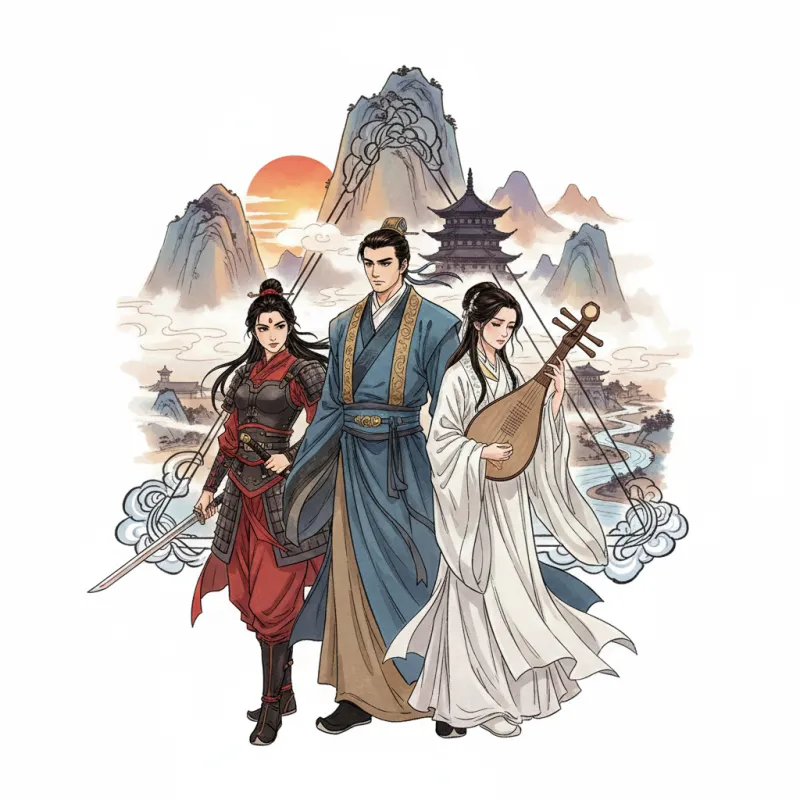
Zhang Wuji can't make up his mind. Four women love him, and he loves all of them back — or thinks he does — and by the end of The Heaven Sword and Dragon Saber (倚天屠龙记 Yǐtiān Túlóng Jì), readers are left wondering if he made the right choice at all. This is Jin Yong's (金庸 Jīn Yōng) genius at work: his heroes can master the most esoteric martial arts, topple corrupt dynasties, and unite warring factions, but put them in front of two women who genuinely care about them, and they fall apart like wet paper.
The Anatomy of a Jin Yong Love Triangle
Jin Yong's love triangles aren't just romantic subplots — they're moral laboratories. Each woman represents a different path, a different version of who the hero could become. The choice isn't just about love; it's about identity, loyalty, and what kind of man the protagonist wants to be.
Take Zhang Wuji (张无忌 Zhāng Wújì). Zhou Zhiruo (周芷若 Zhōu Zhǐruò) is his childhood companion, the girl he promised to marry. Zhao Min (赵敏 Zhào Mǐn) is the Mongol princess who challenges him, matches his wit, and refuses to play by wuxia romance rules. Yin Li (殷离 Yīn Lí) sacrificed everything for him when he was nobody. Xiao Zhao (小昭 Xiǎo Zhāo) served him quietly, asking for nothing. Each woman has a legitimate claim on his heart, and Zhang Wuji — bless his indecisive soul — can't bring himself to hurt any of them until circumstances force his hand.
The result? Zhou Zhiruo becomes a villain. Yin Li dies. Xiao Zhao sails away to Persia. And Zhang Wuji ends up with Zhao Min, the woman who arguably manipulated him the most skillfully. It's not a happy ending so much as a "well, I guess this is what we're doing now" ending.
Duan Yu's Accidental Harem
Duan Yu (段誉 Duàn Yù) from Demi-Gods and Semi-Devils (天龙八部 Tiānlóng Bābù) doesn't even try to collect women — they just happen to him. He falls in love with a statue (the jade statue of his "fairy sister"), then meets the real woman (Wang Yuyan 王语嫣 Wáng Yǔyān), then discovers she's obsessed with her cousin Murong Fu (慕容复 Mùróng Fù), who treats her like furniture.
Meanwhile, Zhong Ling (钟灵 Zhōng Líng) adores him. Mu Wanqing (木婉清 Mù Wǎnqīng) is bound to him by fate. A'Zhu (阿朱 Ā Zhū) and A'Zi (阿紫 Ā Zǐ) orbit his life in tragic ways. And the kicker? Most of these women turn out to be his half-sisters, because Duan Zhengchun (段正淳 Duàn Zhèngchún), Duan Yu's father, couldn't keep it in his pants for five consecutive minutes during his youth.
Duan Yu's love triangle is less about choice and more about cosmic joke. He wants Wang Yuyan, who wants Murong Fu, who wants the throne of a dynasty that no longer exists. By the time Wang Yuyan finally turns to Duan Yu, it feels less like love and more like settling. She's exhausted, Murong Fu has gone insane, and Duan Yu is... there. It's the literary equivalent of a participation trophy.
Yang Guo and the Age Gap That Launched a Thousand Debates
Yang Guo (杨过 Yáng Guò) from The Return of the Condor Heroes (神雕侠侣 Shéndiāo Xiálǚ) technically isn't in a love triangle — he's in a love triangle where he refuses to acknowledge the other points exist. Xiaolongnü (小龙女 Xiǎolóngnǚ) raised him, taught him martial arts, and then fell in love with him. Or he fell in love with her. Or they fell in love with each other simultaneously. The timeline is deliberately vague because Jin Yong knew this was narratively dicey.
The "triangle" comes from Guo Fu (郭芙 Guō Fú), who has complicated feelings about Yang Guo, and Lu Wushuang (陆无双 Lù Wúshuāng), and Cheng Ying (程英 Chéng Yīng), and Gongsun Lü'e (公孙绿萼 Gōngsūn Lǜ'è) — basically every woman who meets Yang Guo develops feelings for him, and he notices none of them because he's too busy pining for his teacher-turned-wife.
What makes this different from Zhang Wuji's mess is that Yang Guo never wavers. He loves Xiaolongnü, full stop. When she disappears, he waits sixteen years for her. Sixteen years. No rebound relationships, no "maybe I should move on," just pure, obsessive, arguably unhealthy devotion. It's romantic in a way that makes you slightly uncomfortable, which is very on-brand for Jin Yong. For more on their unconventional relationship, see Yang Guo and Xiaolongnü: Love Beyond Convention.
Linghu Chong's Emotional Density
Linghu Chong (令狐冲 Línghú Chōng) from The Smiling, Proud Wanderer (笑傲江湖 Xiàoào Jiānghú) is in love with his junior martial sister Yue Lingshan (岳灵珊 Yuè Língshān), who is in love with Lin Pingzhi (林平之 Lín Píngzhī), who is in love with revenge. Meanwhile, Ren Yingying (任盈盈 Rèn Yíngyíng) is in love with Linghu Chong, who is too emotionally dense to notice because he's still hung up on Yue Lingshan.
This triangle resolves itself in the most Jin Yong way possible: Yue Lingshan marries Lin Pingzhi, who becomes a monster after castrating himself to learn the Evil-Resisting Sword Manual (辟邪剑谱 Bìxié Jiànpǔ). She realizes too late that Linghu Chong was the better choice, and she dies in his arms, finally admitting she loved him. Linghu Chong is devastated. Ren Yingying waits patiently. Eventually, Linghu Chong notices that Ren Yingying is perfect for him, and they end up together.
It's a more satisfying resolution than Zhang Wuji's because Linghu Chong actually grows. He learns to let go of an idealized past and embrace a woman who loves him for who he is, not who he used to be. Ren Yingying never tries to change him, never demands he conform to orthodox martial arts society, and never makes him choose between her and his principles. She's the anti-Zhao Min: patient instead of pushy, supportive instead of manipulative.
Wei Xiaobao: The Triangle Where Nobody Cares About Morality
Wei Xiaobao (韦小宝 Wéi Xiǎobǎo) from The Deer and the Cauldron (鹿鼎记 Lùdǐng Jì) doesn't have a love triangle. He has a love heptagon. Seven wives. And unlike every other Jin Yong protagonist, he doesn't agonize over it. He just... collects them. A'Ke (阿珂 Ā Kē), Shuang'er (双儿 Shuāng'er), Zeng Rou (曾柔 Zēng Róu), Princess Jianning (建宁公主 Jiànníng Gōngzhǔ), Mu Jianping (沐剑屏 Mù Jiànpíng), Fang Yi (方怡 Fāng Yí), and Su Quan (苏荃 Sū Quán) — all married to the same scoundrel, and somehow it works.
Wei Xiaobao is Jin Yong's commentary on his own genre. All those tortured heroes, all that hand-wringing over choosing the right woman — what if the protagonist just didn't care about traditional morality? What if he was a con artist, a liar, a coward, and a shameless opportunist who stumbled into success? The love "triangle" becomes a farce, and the farce becomes a mirror showing how absurd the whole wuxia romance convention is.
Why Jin Yong's Heroes Fail at Love
There's a pattern here. Jin Yong's heroes are paralyzed by their own virtue. They don't want to hurt anyone, so they hurt everyone by refusing to choose. They're so concerned with being honorable that they become passive, letting circumstances decide for them instead of making active choices.
Zhang Wuji doesn't choose Zhao Min — Zhou Zhiruo's betrayal and Yin Li's death choose for him. Duan Yu doesn't win Wang Yuyan — Murong Fu's madness loses her. Even Linghu Chong only ends up with Ren Yingying after Yue Lingshan is dead and gone.
The exception is Yang Guo, who chooses Xiaolongnü and never looks back, consequences be damned. And Wei Xiaobao, who chooses everyone because he has no shame. These are the only two protagonists who take control of their romantic destinies, and not coincidentally, they're the most controversial characters Jin Yong ever wrote.
The Women Who Deserve Better
Let's be honest: most of Jin Yong's female characters deserve better than the men they love. Zhou Zhiruo's descent into villainy is directly caused by Zhang Wuji's inability to commit. Yin Li dies loving a man who barely remembers her name. Xiao Zhao sails to Persia to become the leader of the Persian Ming Cult, which is arguably the best outcome for any woman in a Jin Yong love triangle — she gets power, purpose, and distance from Zhang Wuji's nonsense.
Wang Yuyan wastes years on Murong Fu, a man so obsessed with restoring his family's fallen kingdom that he can't see the woman in front of him. Yue Lingshan marries Lin Pingzhi and pays for it with her life. Even Ren Yingying, who gets her man in the end, spends most of The Smiling, Proud Wanderer watching Linghu Chong pine for someone else.
The love triangles in Jin Yong's novels are painful because they're realistic. People make bad choices. They love the wrong people. They wait too long, or choose too quickly, or let fear override their hearts. And sometimes, even when they make the "right" choice, it doesn't feel like victory — it feels like survival. For more on the complex women in these relationships, see Jin Yong's Female Characters: Beyond the Love Interest.
What the Triangles Reveal About Jin Yong
Jin Yong wrote love triangles because he understood that romance is where character is tested most severely. A hero can face down an army with courage, but facing the woman he's about to disappoint? That takes a different kind of bravery, one that most of his protagonists lack.
The triangles also reveal Jin Yong's evolution as a writer. Early novels like The Book and the Sword (书剑恩仇录 Shūjiàn Ēnchóu Lù) have simpler romantic plots. By the time he writes Demi-Gods and Semi-Devils and The Deer and the Cauldron, the love triangles have become labyrinths, reflecting a more complex understanding of human desire, loyalty, and self-deception.
And maybe that's the point. Jin Yong's heroes can't choose because choice itself is impossible when you're trying to be everything to everyone. The only way out is to accept that someone will be hurt, someone will be disappointed, and you'll have to live with that. Or, if you're Wei Xiaobao, you just marry everyone and call it a day.
Either way, the love triangles endure because they're not really about romance. They're about the impossible task of being a good person in a world that doesn't reward goodness, and the painful truth that sometimes, there is no right answer — only the answer you can live with.
Related Reading
- The Couples of Jin Yong: Love Stories Hidden Inside Martial Arts Epics
- The Couples of Jin Yong: Love Stories That Defined Chinese Romance
- The 10 Best Couples in Jin Yong's Novels
- The Most Tragic Love Stories in Jin Yong's Novels
- Discovering the Enchanting Locations of Jin Yong's Wuxia Novels
- The Art of Duels in Jin Yong's Wuxia Novels: A Journey Through Martial Valor
- Love and Sacrifice in Jin Yong's World