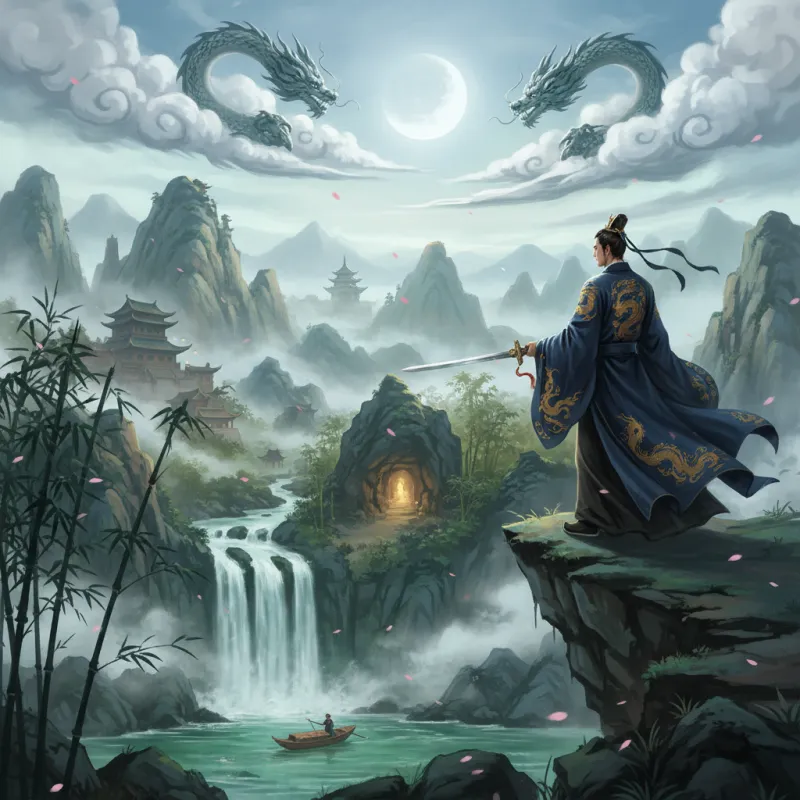
Picture this: A lone swordsman stands at the edge of Huashan's Thousand-Foot Precipice, wind whipping his robes as he gazes across a sea of clouds toward distant peaks where his enemies await. This isn't just scenery—in Jin Yong's novels, every mountain, temple, and hidden valley pulses with meaning, shaping destinies as surely as any blade.
Jin Yong (金庸, Jīn Yōng) didn't just set his stories in China—he transformed real geography into a mythic landscape where martial arts sects claim territories like feudal lords, where sacred peaks harbor ancient secrets, and where the very rocks remember centuries of bloodshed. For readers who've only experienced these tales in translation, understanding these locations unlocks a deeper appreciation of why certain confrontations happen where they do, and why a character's hometown tells you almost as much about them as their kung fu style.
Huashan: Where Swords Meet Sky
Mount Hua (华山, Huàshān) dominates Jin Yong's imagination like no other peak. In "The Smiling, Proud Wanderer" (笑傲江湖, Xiào Ào Jiāng Hú), it's home to the Huashan Sect, whose internal politics mirror the mountain's treacherous paths—one wrong step means death. But Jin Yong chose Huashan for reasons beyond dramatic cliffs. This is one of China's Five Great Mountains (五岳, Wǔ Yuè), sacred to Daoism since the Han Dynasty, and historically associated with martial training. When Linghu Chong fights on Huashan's peaks, he's walking ground where real swordsmen once trained.
The mountain appears again in "The Legend of the Condor Heroes" (射雕英雄传, Shè Diāo Yīng Xióng Zhuàn) as the site of the first Huashan Sword Contest, where the Five Greats battle for the Nine Yin Manual. Jin Yong's genius lies in making Huashan both a real place you could visit and a mythic arena where the jianghu's (江湖, jiānghú—the martial arts world) hierarchy gets decided. The mountain's five peaks become a natural tournament bracket, its isolation from civilization a guarantee that what happens there stays there—until the survivors descend to spread legends.
Peach Blossom Island: Paradise or Prison?
Huang Yaoshi's Peach Blossom Island (桃花岛, Táohuā Dǎo) represents Jin Yong's most audacious geographical invention—a place that probably never existed but feels more real than actual islands. Located somewhere in the East China Sea, this island serves as both sanctuary and trap for the eccentric "Eastern Heretic" and his daughter Huang Rong. Jin Yong drew inspiration from Tao Yuanming's classical tale "Peach Blossom Spring," where fishermen stumble upon a hidden utopia, but he twisted the concept: his Peach Blossom Island is beautiful and deadly, ringed by stone mazes that drown intruders and filled with Huang Yaoshi's musical traps.
The island's isolation matters narratively—it's where Huang Yaoshi can pursue his unconventional martial arts and musical studies without the jianghu's judgment, where Guo Jing trains in relative safety, and where secrets can be buried. But it also represents a philosophical stance. Unlike the martial arts sects that cluster on famous mountains, Huang Yaoshi rejects the establishment entirely, creating his own world. The island's very existence challenges the idea that martial artists must belong to recognized schools and sacred peaks.
The Mongol Steppes: Where China Meets Its Shadow
Jin Yong's northern settings—the vast grasslands of Mongolia and the deserts beyond—function as more than exotic backdrops. In "The Legend of the Condor Heroes," young Guo Jing grows up among Mongol tribes, and these steppes shape him as profoundly as any martial arts manual. The openness of the landscape mirrors Guo Jing's straightforward character, while the harsh climate forges his endurance. Jin Yong, writing in the 1950s-60s, was acutely aware of China's historical relationship with northern "barbarians"—the Mongols who conquered the Song Dynasty, the Manchus who established the Qing.
By setting crucial portions of his novels in Mongolia, Jin Yong forces readers to confront uncomfortable questions about Chinese identity. Is Guo Jing, raised by Mongols, still Chinese? When he eventually defends Xiangyang against Mongol invasion, is he betraying his adoptive family? The steppes become a liminal space where cultural boundaries blur, where the rigid hierarchies of Chinese martial arts sects give way to Mongol wrestling and horseback archery. The landscape itself—endless, borderless—refuses to recognize the distinctions that matter so much south of the Great Wall.
Shaolin Temple: The Gravitational Center
Every Jin Yong reader knows that all roads lead to Shaolin (少林寺, Shàolín Sì). Located on Mount Song (嵩山, Sōng Shān) in Henan Province, Shaolin Temple appears across multiple novels as the undisputed heavyweight of martial arts orthodoxy. In "Demi-Gods and Semi-Devils" (天龙八部, Tiān Lóng Bā Bù), the Shaolin abbot's moral authority can make or break reputations. In "The Heaven Sword and Dragon Saber" (倚天屠龙记, Yǐ Tiān Tú Lóng Jì), Shaolin's Sutra Library holds secrets that drive the plot.
Jin Yong's Shaolin draws power from its real-world counterpart—an actual Buddhist temple founded in 495 CE, genuinely associated with martial arts since at least the Tang Dynasty. But Jin Yong complicates the temple's righteousness. His Shaolin monks can be hypocritical, his abbots politically calculating. The temple's physical presence—massive, ancient, seemingly immovable—contrasts with the moral ambiguity of its inhabitants. It's a reminder that in Jin Yong's world, no institution, however sacred its location, escapes human corruption.
The temple's architecture matters too. Jin Yong frequently stages confrontations in specific halls—the Mahavira Hall, the Sutra Library, the Bodhidharma Cave. Each space carries symbolic weight. Fighting in the Mahavira Hall, before Buddha's statue, is sacrilege that reveals a character's desperation or villainy. Stealing from the Sutra Library is intellectual theft, violating the temple's role as guardian of knowledge. These aren't just rooms—they're moral territories with their own rules.
Dali Kingdom: The Forgotten South
While northern China and its borderlands dominate many wuxia novels, Jin Yong's attention to Dali (大理, Dàlǐ) in Yunnan Province reveals his historical sophistication. The Duan family of Dali, appearing prominently in "Demi-Gods and Semi-Devils," ruled an actual kingdom from 937 to 1253 CE—a sophisticated Buddhist state that most Chinese readers knew little about. By setting a major storyline in Dali, Jin Yong reminded readers that "China" was never monolithic, that the south had its own kingdoms, cultures, and martial traditions.
Dali's geography—mountainous, close to Southeast Asia, ethnically diverse—allows Jin Yong to introduce martial arts styles that differ from northern schools. The Duan family's Six Meridians Divine Sword (六脉神剑, Liù Mài Shén Jiàn) reflects Dali's Buddhist character, channeling internal energy rather than relying on external weapons. The kingdom's relative isolation from central China's politics gives characters like Duan Yu a different perspective on jianghu conflicts—they're simultaneously inside and outside the martial arts world's main currents.
Xiangyang: Where History Bleeds Into Fiction
No location in Jin Yong's novels carries more historical weight than Xiangyang (襄阳, Xiāngyáng), the fortress city in Hubei Province. In "The Legend of the Condor Heroes" and its sequel "The Return of the Condor Heroes" (神雕侠侣, Shén Diāo Xiá Lǚ), Xiangyang becomes the last stand of the Song Dynasty against Mongol invasion. Jin Yong based this on actual history—Xiangyang fell to the Mongols in 1273 after a brutal siege, hastening the Song Dynasty's collapse.
What makes Jin Yong's treatment of Xiangyang brilliant is how he weaves fictional martial artists into real historical events. Guo Jing and Huang Rong defend the city alongside historical generals. The legendary heroes of the jianghu throw themselves against Mongol siege engines. By anchoring his fantasy in a real place facing real historical catastrophe, Jin Yong gives his novels emotional weight that pure fantasy could never achieve. When Xiangyang falls (as readers know it must), it's not just a plot point—it's the death of an era, the end of Chinese sovereignty, a wound that wouldn't heal for generations.
The city's walls, its rivers, its strategic position at the gateway to southern China—all these geographical facts become narrative destiny. Characters can't save Xiangyang because history says they can't. The location itself becomes tragic, a place where courage and martial arts mastery prove insufficient against historical forces.
The Jianghu Beyond Geography
Here's what makes Jin Yong's locations truly enchanting: they exist in two places simultaneously. You can visit Huashan, tour Shaolin Temple, walk Xiangyang's reconstructed walls. But you'll never find the Huashan where Linghu Chong fought, the Shaolin that holds the Yi Jin Jing (易筋经, Yì Jīn Jīng), or the Xiangyang that Guo Jing died defending. Jin Yong's genius was creating a parallel China, geographically accurate enough to feel real, mythologically enhanced enough to contain his stories.
This dual existence explains why Chinese readers feel such ownership of these locations. They're not just settings—they're shared cultural property, places where history, legend, and fiction merge until the boundaries disappear. When you read Jin Yong, you're not just following characters through landscapes. You're walking through Chinese cultural memory itself, where every mountain has a story, every temple guards secrets, and every fortress wall remembers the heroes who defended it.
The next time you encounter a location in Jin Yong's novels, pause. Look it up. Understand its real history, its geographical significance, its cultural associations. Then return to the novel and watch how Jin Yong transforms fact into legend, how he makes geography into destiny. That's when these enchanting locations reveal their deepest magic—they're not just where the story happens, but why it happens, and what it means.
Related Reading
- A Map of the Jianghu: Geography in Jin Yong's Novels
- Visiting Jin Yong Locations in Real Life
- Jin Yong's Locations: The Real Places Behind the Fictional Battles
- The Forbidden City in Jin Yong's Wuxia Fiction
- Peach Blossom Island: The Most Magical Location in Jin Yong's World
- Qiao Feng / Xiao Feng: The Tragic Hero Who Defined Wuxia
- The Food and Drink of Jin Yong: What Heroes Eat Between Sword Fights
- The 20 Strongest Characters in Jin Yong's Universe: A Definitive Ranking