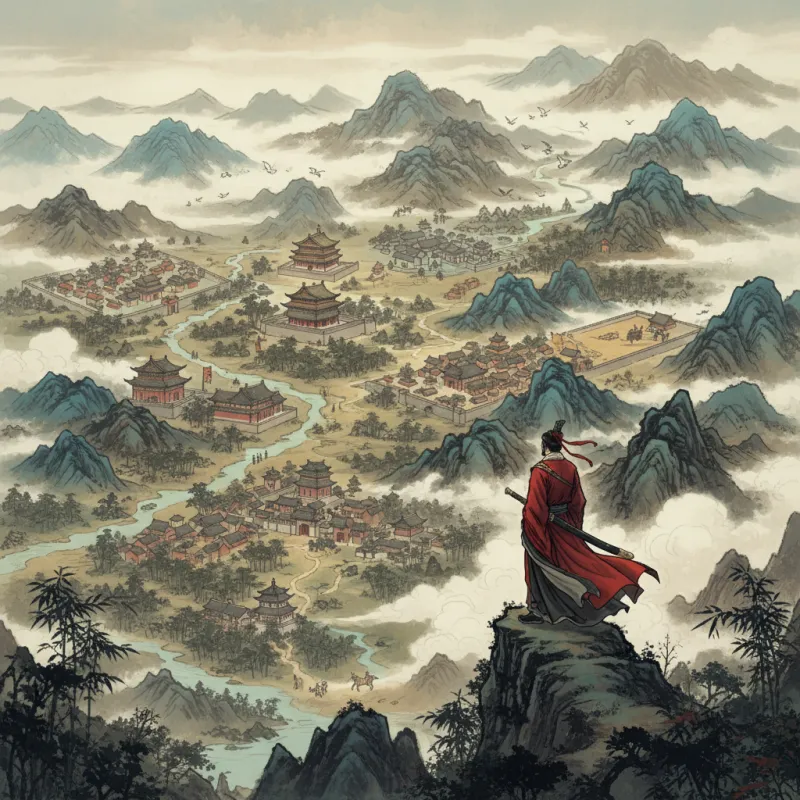
When Guo Jing rides south from the Mongolian steppes in The Legend of the Condor Heroes, he's not just traveling through vague "ancient China." He's crossing the Gobi Desert, skirting the Yellow River, and eventually reaching Lin'an (modern Hangzhou). Jin Yong gives you the route, the distances, even the weather patterns. This isn't fantasy geography where cities appear wherever the plot needs them. This is the real China of the Song and Ming dynasties, with martial artists hidden in its mountains and temples. The jianghu (江湖 jiānghú) — literally "rivers and lakes," the wandering world of martial artists — exists as a shadow layer over actual Chinese geography, and that's exactly what makes it feel so tangible.
The Central Plains: Where Everything Happens
The zhongyuan (中原 zhōngyuán), or Central Plains, is the gravitational center of Jin Yong's martial world. This is the Yellow River basin, the cradle of Han Chinese civilization, and in the novels it's where power concentrates. Henan Province sits at the heart of it all, which is why Shaolin Temple (少林寺 Shàolín Sì) on Song Mountain (嵩山 Sōng Shān) commands such respect. It's not just that Shaolin has the best kung fu — though it does — it's that Shaolin sits at the geographic and cultural center of everything that matters.
When characters talk about "going to the Central Plains," they're usually coming from somewhere peripheral: the Mongolian grasslands, the southwestern frontier, the Manchurian forests. The Central Plains represent civilization, orthodoxy, and legitimacy. This is where the imperial court sits, where the major sects have their headquarters, where martial arts tournaments happen. Even the Beggar Clan (丐帮 Gàibāng), which has branches everywhere, holds its most important meetings in Henan or nearby provinces.
Jin Yong understood that geography is power. The sects that control the Central Plains control the narrative of what "proper" martial arts should be. The further you get from this center, the weirder and more heterodox the martial arts become — which is exactly how the Chinese cultural imagination has always worked.
Mountains as Martial Headquarters
Almost every major sect in Jin Yong's novels is headquartered on a real mountain, and this isn't arbitrary. Mountains in Chinese culture are liminal spaces — neither fully part of the mundane world nor completely separate from it. They're where immortals live, where monks meditate, and apparently where martial artists perfect their deadly techniques away from imperial oversight.
Wudang Mountain (武当山 Wǔdāng Shān) in Hubei Province is home to the Wudang Sect, the great Taoist martial arts school that rivals Shaolin's Buddhist tradition. The real Wudang is a UNESCO World Heritage site now, famous for its Taoist temples and its association with internal martial arts like taijiquan. Jin Yong didn't invent this connection — he amplified it. In The Heaven Sword and Dragon Saber, Zhang Sanfeng (张三丰 Zhāng Sānfēng) founds the Wudang Sect on this mountain, and the novel's climactic battles happen on its peaks.
Hua Mountain (华山 Huà Shān) in Shaanxi Province hosts the Huashan Sect, known for its sword techniques. The real Hua Mountain is one of China's Five Great Mountains, famous for its terrifying cliff-side paths and Taoist temples. Jin Yong uses its reputation for danger and beauty to characterize the sect itself — elegant, deadly, and a bit obsessed with technical perfection.
Emei Mountain (峨眉山 Éméi Shān) in Sichuan becomes the headquarters of the Emei Sect, a Buddhist martial arts school led by women. The real Emei is one of the Four Sacred Buddhist Mountains of China, and Jin Yong's choice to place a female-dominated sect there plays with Buddhist ideas about gender and enlightenment in interesting ways.
What's clever about these choices is that Jin Yong picks mountains that already have martial or religious significance in Chinese culture. He's not making things up wholesale — he's working with the existing symbolic geography and pushing it in fictional directions. When readers encounter these locations, they bring their own cultural knowledge and associations, which makes the fictional world feel deeper and more resonant.
The Frontier as Freedom and Danger
The further you get from the Central Plains, the more freedom characters have — and the more danger they face. The frontier regions in Jin Yong's novels are where the rules of orthodox martial arts don't fully apply, where strange techniques flourish, and where Chinese characters encounter non-Han peoples and cultures.
Mongolia appears in multiple novels, most prominently in The Legend of the Condor Heroes where Guo Jing grows up among the Mongols. Jin Yong depicts the grasslands with genuine affection — the wide skies, the horse culture, the different social codes. But he's also writing during the Song-Yuan transition, when the Mongols conquered China, so there's always tension between admiration for Mongol martial prowess and anxiety about foreign invasion.
The southwestern frontier — Yunnan, Guizhou, Sichuan — is where Jin Yong places his most exotic and morally ambiguous martial arts groups. The Five Poison Cult (五毒教 Wǔdú Jiào) operates in these regions, using poisons and unorthodox techniques that would scandalize the Shaolin monks. Dali Kingdom (大理国 Dàlǐ Guó) in Yunnan, which really existed from 937 to 1253 CE, becomes in Demi-Gods and Semi-Devils the home of the Duan family and their Six Meridians Divine Sword technique. The real Dali was a Buddhist kingdom with its own distinct culture, and Jin Yong uses this historical fact to create a martial arts tradition that's powerful but separate from Central Plains orthodoxy.
The frontier is also where characters go to escape, to reinvent themselves, or to find techniques that the establishment has forgotten or suppressed. When Yang Guo (杨过 Yáng Guò) in The Return of the Condor Heroes needs to develop his own martial arts style outside the orthodox traditions, he ends up in the wilderness, learning from a giant eagle and eventually creating the Dismal Ecstasy Palm technique. Geography enables character development.
Water Routes and the Jianghu Network
The word jianghu literally means "rivers and lakes," and Jin Yong takes this seriously. His martial artists travel constantly, and they often travel by water. The Yangtze River, the Grand Canal, the countless lakes and waterways of southern China — these aren't just scenery, they're infrastructure.
The Beggar Clan's information network follows trade routes and waterways because that's where people and information flow. When the clan needs to spread news or gather intelligence, they use the same routes that merchants and officials use. This makes perfect sense: beggars go where people are, and people concentrate along transportation routes.
Lake Tai (太湖 Tài Hú) in Jiangsu Province appears in several novels as a location for secret meetings and hideouts. It's one of China's largest freshwater lakes, dotted with islands, and in Jin Yong's fiction it becomes a place where martial artists can disappear from official view while remaining connected to the broader jianghu network. The lake's geography — shallow, misty, full of hiding places — shapes how characters use it strategically.
The Grand Canal, which connected Beijing to Hangzhou and was one of imperial China's greatest engineering achievements, appears as a major travel route in the novels. Characters don't teleport between north and south — they take boats along the canal, and Jin Yong describes the journey with enough detail that you can follow along on a historical map.
Cities as Crossroads and Battlegrounds
While sects hide in mountains, the real action often happens in cities. Lin'an (临安 Lín'ān), the Southern Song capital (modern Hangzhou), is where The Legend of the Condor Heroes reaches its climax. The city's historical role as the last stand of the Song dynasty against Mongol invasion gives the novel's ending its emotional weight. When Guo Jing and Huang Rong (黄蓉 Huáng Róng) defend Xiangyang (襄阳 Xiāngyáng) in The Return of the Condor Heroes, they're defending a real city that really did fall to the Mongols in 1273, and Jin Yong's readers know this history.
Luoyang (洛阳 Luòyáng), one of China's ancient capitals, appears in multiple novels as a place where martial artists gather and conflicts erupt. Its historical significance as a political and cultural center makes it a natural location for martial arts politics. When sects meet to discuss who should lead the martial world, they often meet in or near Luoyang because it's symbolically central.
Dali city in Yunnan, as mentioned earlier, becomes in Demi-Gods and Semi-Devils the seat of a royal family with extraordinary martial arts. The real Dali Kingdom had its own Buddhist traditions and political structure distinct from the Song dynasty, and Jin Yong uses this historical reality to create a martial arts culture that's powerful but operates by different rules than the Central Plains sects.
Why Geography Matters
Jin Yong could have written his novels in a vague fantasy China where locations don't matter and distances are whatever the plot requires. Instead, he chose to ground his martial world in real geography, and this choice has profound effects.
First, it makes the fantasy believable. When characters travel from Beijing to Guangzhou, the journey takes weeks and involves specific routes and dangers. This attention to realistic detail makes the unrealistic parts — the flying, the internal energy, the superhuman combat — easier to accept. The world feels solid enough to support the fantasy elements.
Second, it connects the novels to Chinese cultural memory. Readers bring their own knowledge of these places, their own associations and feelings, and this enriches the reading experience. When Jin Yong places Shaolin on Song Mountain, he's not just picking a random location — he's invoking centuries of cultural significance that readers already understand.
Third, geography creates meaning. The tension between center and periphery, between orthodox and heterodox, between Chinese and non-Chinese — these aren't abstract themes, they're built into the landscape itself. Characters' relationships to geography reflect their relationships to power, tradition, and identity.
The jianghu isn't just a metaphor in Jin Yong's novels. It's a real place you could visit, with mountains you could climb and rivers you could follow. That's what makes it feel like more than fiction — it feels like a secret history of real places, a shadow world that might actually exist if you knew where to look. And maybe that's the ultimate achievement: Jin Yong made readers believe that if they traveled to Song Mountain or Hua Mountain, they might just encounter a martial artist practicing sword forms in the morning mist.
Related Reading
- The Forbidden City in Jin Yong's Wuxia Fiction
- Discovering the Enchanting Locations of Jin Yong's Wuxia Novels
- Visiting Jin Yong Locations in Real Life
- Jin Yong's Locations: The Real Places Behind the Fictional Battles
- Peach Blossom Island: The Most Magical Location in Jin Yong's World
- The Allure of Jin Yong's Wuxia: Exploring Martial Arts, Characters, and Legendary Storylines
- Buddhism and Martial Arts: Spiritual Themes
- Exploring the Intricate Sects within Jin Yong's Iconic Wuxia Novels