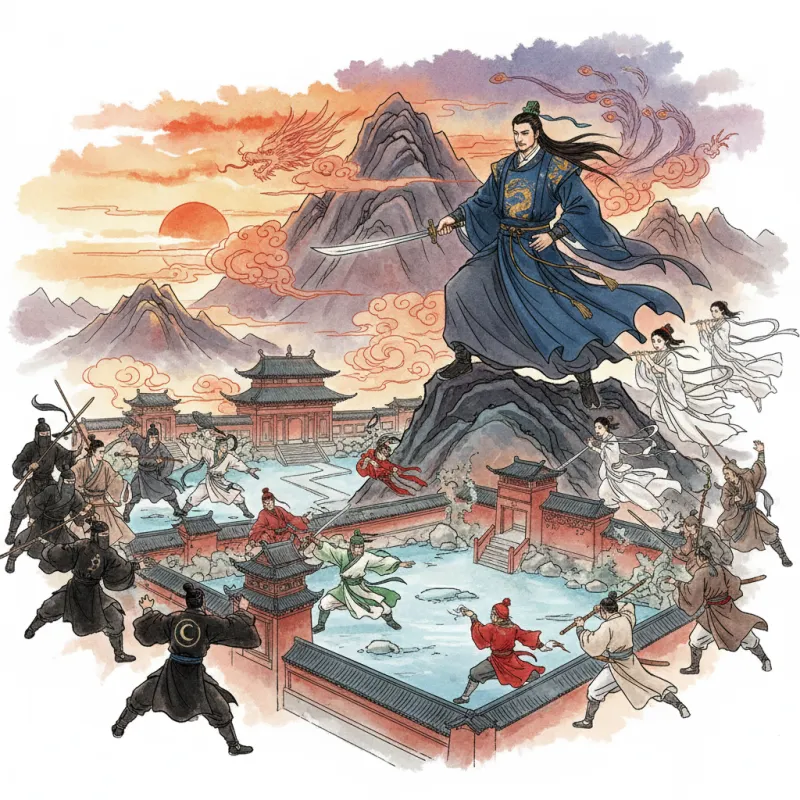
The Beggar's Clan leader raises his bamboo staff, and a hundred ragged warriors fall silent. Across the valley, Shaolin monks in saffron robes meditate before dawn practice. On Mount Hua, sword disciples trace patterns in morning mist. This isn't just colorful backdrop—in Jin Yong's fifteen wuxia novels, these sects (门派, ménpài) form the skeletal structure upon which entire worlds hang. Miss their significance, and you're reading adventure stories. Understand them, and you're witnessing Jin Yong's meditation on power, legitimacy, and what it means to belong.
Orthodox vs. Unorthodox: The Central Tension
Jin Yong inherited the traditional wuxia division between righteous sects (正派, zhèngpài) and demonic cults (魔教, mójiào), but he complicated it brilliantly. The so-called orthodox schools—Shaolin (少林, Shàolín), Wudang (武当, Wǔdāng), Emei (峨眉, Éméi), and the Beggar's Clan (丐帮, Gàibāng)—claim moral authority through Buddhist or Taoist philosophy. Yet in The Heaven Sword and Dragon Saber (倚天屠龙记, Yǐtiān Túlóng Jì), these "righteous" sects besiege Bright Peak, torturing prisoners and slaughtering families. Meanwhile, the supposedly evil Ming Cult (明教, Míngjiào) practices internal democracy and protects common people.
This reversal isn't accidental. Jin Yong, writing in 1960s Hong Kong, watched both Communist and Nationalist governments claim righteousness while committing atrocities. His sects mirror this: institutions that start with noble principles calcify into self-serving bureaucracies. The Huashan Sect (华山派, Huàshān Pài) in The Smiling, Proud Wanderer splits into Sword and Qi factions, spending decades murdering each other over doctrinal purity—a transparent allegory for ideological purges.
Shaolin: The Immovable Mountain
Every Jin Yong reader knows Shaolin Temple represents orthodox martial arts' apex. Founded (in wuxia mythology) by Bodhidharma in the 6th century, Shaolin appears in nearly every novel as the standard against which other schools measure themselves. But Jin Yong's Shaolin is fascinatingly inconsistent. In Demi-Gods and Semi-Devils (天龙八部, Tiānlóng Bābù), Abbot Xuanci fathers an illegitimate child and commits murder to hide it. In The Book and the Sword (书剑恩仇录, Shū Jiàn Ēnchóu Lù), Shaolin monks collaborate with Qing dynasty oppressors.
The temple's famous 72 unique skills (七十二绝技, qīshí'èr juéjì) symbolize accumulated knowledge—but also institutional ossification. Shaolin masters spend lifetimes perfecting techniques recorded in dusty manuals, while protagonists like Linghu Chong and Yang Guo innovate by breaking rules. Jin Yong seems to ask: when does preservation of tradition become worship of the past? The question resonates in any culture grappling with modernization.
The Beggar's Clan: Democracy in Rags
If Shaolin represents establishment power, the Beggar's Clan embodies populist legitimacy. With branches across China and members numbering in the hundreds of thousands, the Clan operates as a shadow government. Their leader wields the Dog-Beating Staff (打狗棒, dǎgǒu bàng) and commands respect from emperors and outlaws alike. What makes them fascinating is their meritocratic structure: any member can challenge for leadership, and the Clan's signature martial art—the Eighteen Dragon-Subduing Palms (降龙十八掌, Xiánglóng Shíbā Zhǎng)—passes to the worthy, not the well-born.
Hong Qigong in The Legend of the Condor Heroes (射雕英雄传, Shèdiāo Yīngxióng Zhuàn) embodies the Clan's ideals: he's gluttonous, irreverent, and utterly incorruptible. When he teaches Guo Jing, he doesn't demand kowtows or formal apprenticeship—he just likes the kid's honest nature. This casual transmission of supreme martial arts would be unthinkable in hierarchical sects like Kunlun or Kongtong. The Beggar's Clan suggests that legitimacy flows from character and capability, not institutional position—a radical notion in Confucian society.
Wudang: Taoist Flexibility vs. Shaolin Rigidity
Zhang Sanfeng founded Wudang in his nineties (according to The Heaven Sword and Dragon Saber), creating martial arts based on Taoist principles of yielding and internal cultivation. Where Shaolin emphasizes external strength and rigid forms, Wudang practices flow like water. This philosophical difference manifests practically: Shaolin monks train from childhood in fixed patterns, while Zhang Sanfeng invents Taiji Sword (太极剑, Tàijí Jiàn) spontaneously to counter a specific opponent.
Jin Yong clearly favors Wudang's adaptability. Zhang Sanfeng appears as a near-saint across multiple novels, while Shaolin abbots are frequently flawed or hypocritical. Yet Wudang has its own problems—in The Smiling, Proud Wanderer, the sect becomes so obsessed with maintaining its reputation that it nearly destroys itself. Even flexibility can calcify into dogma. The martial arts philosophies Jin Yong explores through these sects reflect deeper questions about how institutions balance tradition with innovation.
Minor Sects: The Texture of the Jianghu
The famous sects dominate, but Jin Yong's genius shows in the dozens of minor schools that populate his jianghu (江湖, jiānghú)—the martial arts world. The Huashan Sect's internal warfare, the Hengshan Sect's (恒山派, Héngshān Pài) Buddhist nuns, the Taishan Sect's (泰山派, Tàishān Pài) pompous mediocrity—each adds texture and realism. These smaller sects behave like minor nobles in feudal systems: constantly jockeying for position, forming alliances, nursing ancient grudges.
The Five Mountains Sword Alliance (五岳剑派, Wǔyuè Jiàn Pài) in The Smiling, Proud Wanderer perfectly illustrates sectarian politics. Formed to counter the Sun Moon Holy Cult, the alliance quickly becomes a vehicle for Songshan Sect's (嵩山派, Sōngshān Pài) leader Zuo Lengchan to dominate the others. He manipulates, threatens, and eventually tries to forcibly merge all five sects under his control—a transparent parallel to political consolidation in Chinese history. When protagonist Linghu Chong becomes Hengshan's leader, he refuses to play these power games, preferring to drink wine and play music. His rejection of sectarian ambition marks him as a true hero in Jin Yong's eyes.
Demonic Cults: Villains or Victims?
The Ming Cult, Sun Moon Holy Cult (日月神教, Rìyuè Shénjiào), and other "demonic" organizations occupy ambiguous moral space. Orthodox sects label them evil, but Jin Yong consistently shows these groups as more complex. The Ming Cult in The Heaven Sword and Dragon Saber practices Zoroastrianism (though Jin Yong fictionalizes it heavily) and fights against Mongol oppression. Their "demonic" reputation stems partly from religious difference and partly from orthodox sects' propaganda.
The Sun Moon Holy Cult in The Smiling, Proud Wanderer is genuinely tyrannical under Dongfang Bubai's rule, yet even here Jin Yong adds nuance. Dongfang Bubai, who castrates himself to practice the Sunflower Manual (葵花宝典, Kuíhuā Bǎodiǎn), becomes obsessed with embroidery and beauty rather than conquest. He's a monster, but a strangely sympathetic one—destroyed by his own ambition and the corrupting nature of absolute power. The cult's members aren't inherently evil; they're trapped in a system that rewards ruthlessness.
Sect Loyalty vs. Individual Conscience
Jin Yong's protagonists consistently face the same dilemma: when sect loyalty conflicts with personal morality, which wins? Guo Jing in The Return of the Condor Heroes (神雕侠侣, Shéndiāo Xiálǚ) must choose between his Mongolian upbringing and Chinese identity. Linghu Chong gets expelled from Huashan for refusing to betray friends. Zhang Wuji tries to reconcile Ming Cult leadership with his personal pacifism. In every case, Jin Yong sides with individual conscience over institutional loyalty.
This theme reflects Jin Yong's own experience. Born in mainland China, he fled to Hong Kong and built a media empire while watching friends and family suffer through political campaigns that demanded absolute loyalty to party and state. His novels argue that true morality requires the courage to stand apart from the group—even when that group is your sect, your family, or your nation. The character development in his novels consistently reinforces this message.
The Sect as Metaphor
Ultimately, Jin Yong's sects function as compressed models of human organization. They show how idealistic movements become corrupt institutions, how power concentrates in the hands of the ruthless, how reputation often diverges from reality. Shaolin's moral authority rests on past achievements, not present virtue. The Beggar's Clan's democracy works only when led by exceptional individuals like Hong Qigong. Wudang's flexibility can't prevent its disciples from becoming rigid.
These aren't just observations about martial arts schools in fantasy novels—they're insights into how all human institutions function. Governments, corporations, religions, families: all face the same tensions between principle and practice, tradition and innovation, collective good and individual conscience. Jin Yong embedded these universal themes in thrilling adventure stories, which is why his novels remain relevant decades after publication. The sects aren't just colorful backdrop; they're the lens through which Jin Yong examines the eternal question of how humans should organize themselves and what we owe to the groups we belong to.
When you next read about Shaolin monks or Beggar's Clan elders, look past the flying kicks and secret manuals. Jin Yong is showing you something true about power, legitimacy, and the price of belonging. That's why these novels endure, and why the sects within them feel more real than many actual historical institutions.
Related Reading
- A Map of the Jianghu: Geography in Jin Yong's Novels
- Exploring the Enigmatic Worlds of Jin Yong's Wuxia Novels
- Unveiling the Wisdom and Philosophy in Jin Yong's Wuxia Novels