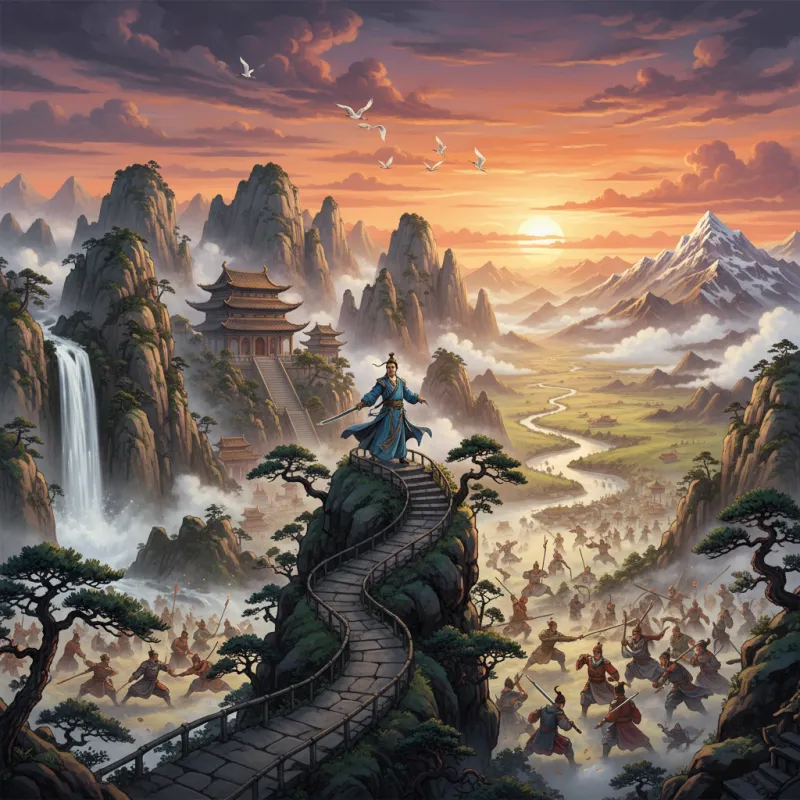
When Wang Chongyang stood atop Mount Hua's western peak in The Legend of the Condor Heroes, he wasn't just claiming the title of "Greatest Martial Artist Under Heaven" — he was cementing a mountain's place in Chinese popular imagination for the next thousand years. Jin Yong understood something that historians often miss: geography isn't just backdrop. It's character. And in his hands, real Chinese locations became as legendary as the heroes who fought there.
Mount Hua: The Peak That Launched a Thousand Pilgrimages
Mount Hua (华山, Huà Shān) existed long before Jin Yong wrote a single word. One of China's Five Great Mountains, it has been a Taoist sacred site since the Han Dynasty. But ask any Chinese person under fifty what they associate with Mount Hua, and they won't mention Taoism first. They'll mention the Sword Competition (华山论剑, Huàshān Lùnjiàn).
The genius of Jin Yong's Mount Hua isn't that he invented it — it's that he gave it narrative weight. In The Legend of the Condor Heroes, the mountain becomes the stage for determining martial supremacy. Wang Chongyang, Ouyang Feng, Huang Yaoshi, Duan Zhixing, and Hong Qigong gather there not once but twice, separated by decades. The first competition establishes the hierarchy of the martial world. The second, at the novel's climax, reshuffles it entirely.
Today, Mount Hua's tourism board has leaned into this connection shamelessly. The western peak where the fictional competition took place now features a stone inscription reading "华山论剑" in bold calligraphy. Hiking trails bear names like "Sword Qi Path" and "Martial Arts Ridge." The mountain receives over five million visitors annually, and while many come for the vertigo-inducing plank walk, a significant portion come because Jin Yong made them care about who stood where and why it mattered.
Shaolin Temple: When Fiction Rewrites History
Here's an uncomfortable truth: most of what the average person "knows" about Shaolin Temple (少林寺, Shàolín Sì) comes from fiction, not history. The real Shaolin Temple in Henan Province was indeed a Buddhist monastery with a martial tradition. But Jin Yong's version — the one that appears in Demi-Gods and Semi-Devils, The Smiling, Proud Wanderer, and The Heaven Sword and Dragon Saber — is something else entirely.
In Jin Yong's novels, Shaolin is the moral center of the martial world. It's where righteous monks practice 72 unique skills, where the易筋经 (Yijin Jing, Muscle-Tendon Change Classic) grants superhuman power, and where the abbot inevitably mediates conflicts between rival sects. This Shaolin is less historical institution and more narrative necessity — the Switzerland of wuxia, neutral but formidable.
The real Shaolin Temple has embraced this fictional identity with entrepreneurial enthusiasm. The gift shop sells "authentic" martial arts manuals (spoiler: they're not authentic). Monks perform choreographed kung fu demonstrations for tour groups. The temple even trademarked the Shaolin name and licenses it to martial arts schools worldwide. The line between the historical Shaolin and Jin Yong's Shaolin has been erased so thoroughly that even scholars struggle to separate them.
What's fascinating is that this isn't entirely cynical. Jin Yong's Shaolin, for all its fictional embellishments, captures something true about the temple's cultural role: it represents discipline, tradition, and the idea that martial skill should serve moral purpose. Whether that's historically accurate is almost beside the point. The fiction has become the reality that matters.
Wudang Mountain: Taoism's Fictional Renaissance
Wudang Mountain (武当山, Wǔdāng Shān) in Hubei Province was already famous before Jin Yong. It's been a Taoist sacred site since the Tang Dynasty, and the historical Zhang Sanfeng supposedly founded Wudang martial arts there in the 13th century. But Jin Yong did something clever: he made Wudang Shaolin's philosophical opposite.
In The Heaven Sword and Dragon Saber, Wudang represents Taoist principles — flexibility over rigidity, internal cultivation over external strength, yielding to overcome force. Zhang Sanfeng, reimagined as a centuries-old immortal, embodies this philosophy. His Taiji Sword technique defeats opponents not through power but through understanding the flow of energy. This isn't just martial arts; it's applied Taoist metaphysics.
The contrast with Shaolin is deliberate and brilliant. Where Shaolin monks are disciplined and orthodox, Wudang practitioners are individualistic and adaptable. Where Shaolin techniques emphasize hard external training, Wudang focuses on soft internal cultivation. Jin Yong took a real geographical and philosophical divide in Chinese martial arts and turned it into narrative structure. For more on how these philosophical differences play out in character development, see Jin Yong's Martial Arts Philosophy.
Modern Wudang has capitalized on this distinction. The mountain now hosts international Taiji and qigong festivals. Tourism materials explicitly reference Jin Yong's novels. And while the historical Zhang Sanfeng probably didn't live to 200 years old or invent Taiji in a dream, the legend has become inseparable from the place. Visitors come seeking not just history but the possibility of transformation that Jin Yong's fiction promises.
Peach Blossom Island: The Geography of Eccentricity
Unlike Mount Hua or Shaolin, Peach Blossom Island (桃花岛, Táohuā Dǎo) is Jin Yong's invention — sort of. The name references the Peach Blossom Spring (桃花源, Táohuā Yuán), a famous utopian tale by Tao Yuanming from the 4th century. But Jin Yong placed his version in the Zhoushan Archipelago off Zhejiang Province, and he made it the home of Huang Yaoshi, the "Eastern Heretic."
This is where Jin Yong's geographical imagination gets interesting. Peach Blossom Island isn't just a location; it's an externalization of Huang Yaoshi's personality. The island is beautiful but isolated, cultured but dangerous, filled with traps and illusions that reflect its master's brilliance and paranoia. When Guo Jing and Huang Rong visit in The Legend of the Condor Heroes, the island itself becomes a character — testing them, revealing them, shaping their relationship.
The real Zhoushan Archipelago now has multiple islands claiming to be "the" Peach Blossom Island. One has built an entire theme park around Jin Yong's novels, complete with recreated sets and costumed performers. It's pure fabrication, but it works because Jin Yong's geography was always more emotional than physical. The island represents the possibility of escape, of creating your own world according to your own rules. That's a powerful fantasy, and it doesn't require historical authenticity to resonate.
The Yangtze River: Where History and Fiction Converge
The Yangtze River (长江, Cháng Jiāng) appears in multiple Jin Yong novels, but its most memorable role is in The Smiling, Proud Wanderer. When Linghu Chong and his companions travel along the river, Jin Yong uses the geography to mark psychological transitions. The river represents freedom, danger, and the boundary between the orthodox martial world and the unorthodox.
What makes Jin Yong's use of the Yangtze effective is his specificity. He doesn't just say "they traveled along the river." He names specific gorges, describes particular currents, references historical battles fought on these waters. The Three Gorges (三峡, Sānxiá) become more than scenery; they become a test of character. Can you navigate treacherous waters? Can you adapt to changing conditions? These aren't just geographical questions — they're moral ones.
The Yangtze has always been central to Chinese civilization, but Jin Yong gave it a wuxia dimension. He showed how geography shapes not just where people go but who they become. For more on how Jin Yong uses journey narratives to develop characters, see Character Development Through Adventure.
Dali: The Kingdom That Fiction Remembered
The Dali Kingdom (大理国, Dàlǐ Guó) in Yunnan Province existed from 937 to 1253 CE. Most Chinese people had forgotten about it until Jin Yong made it central to Demi-Gods and Semi-Devils. By making Duan Yu a prince of Dali and giving the kingdom its own martial arts tradition (the Six Meridians Divine Sword), Jin Yong rescued an entire historical period from obscurity.
Modern Dali is now one of China's top tourist destinations, and Jin Yong's novels are explicitly part of the marketing. The old city features statues of Duan Yu and his companions. Tour guides reference the novels when explaining historical sites. A kingdom that was nearly forgotten has been revived through fiction.
This is Jin Yong's ultimate geographical achievement: he didn't just use real places as settings. He changed how people understand those places. He gave them new meanings, new associations, new reasons to care. Mount Hua isn't just a mountain anymore. Shaolin isn't just a temple. They're stages where the drama of Chinese identity — honor, loyalty, skill, wisdom — plays out in ways that feel both ancient and immediate.
The Blurred Line Between Real and Imagined
Stand at the western peak of Mount Hua today, and you'll see tourists posing for photos at the "Sword Competition" stone. Ask them if they know the competition was fictional, and most will shrug. Does it matter? The mountain is real. The history is real. The emotions Jin Yong's novels evoke are real. The distinction between historical geography and fictional geography has collapsed, and perhaps that's exactly as it should be.
Jin Yong understood that places become meaningful through stories. The physical landscape of China existed long before his novels, but he gave that landscape a narrative dimension that resonates across generations. He showed that geography isn't just about where things are — it's about what they mean, who fought there, what was at stake, and why we should care. In doing so, he didn't just write about China's geography. He rewrote it.
Related Reading
- Discovering the Enchanting Locations of Jin Yong's Wuxia Novels
- The Forbidden City in Jin Yong's Wuxia Fiction
- Visiting Jin Yong Locations in Real Life
- A Map of the Jianghu: Geography in Jin Yong's Novels
- Peach Blossom Island: The Most Magical Location in Jin Yong's World
- The Iconic Soundtracks of Jin Yong TV Adaptations
- Exploring Jin Yong's Wuxia Novels: Characters, Martial Arts, and Storylines
- Exploring the Enigmatic Worlds of Jin Yong's Wuxia Novels