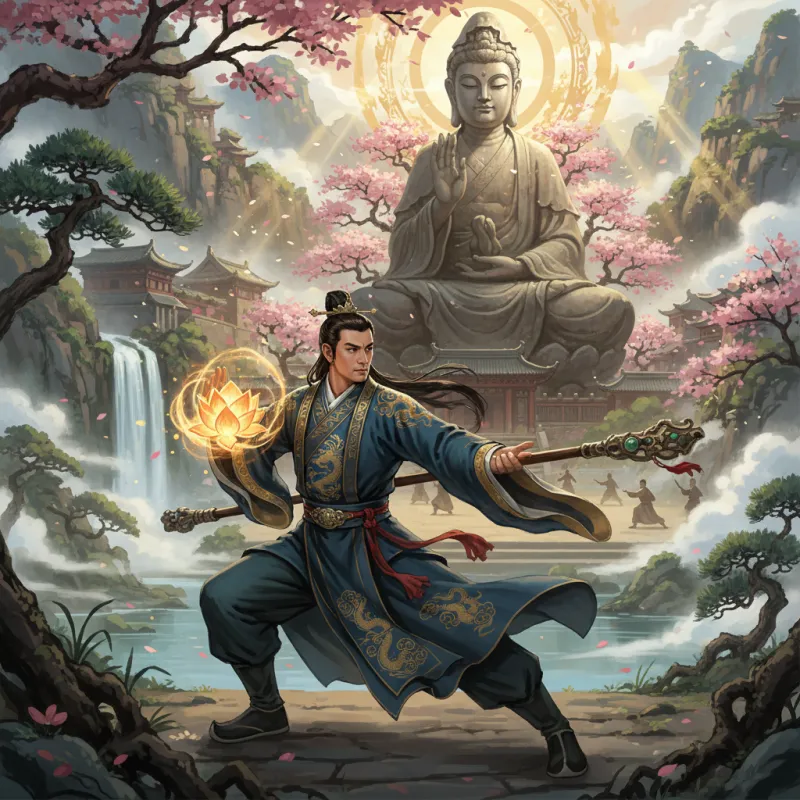
A monk sits in meditation, his body perfectly still, while assassins' blades slice through the air around him. He doesn't flinch. He doesn't fight back. Yet somehow, the weapons never touch him. This isn't magic—it's the culmination of decades spent mastering both Buddhist philosophy and martial arts, a paradox that Jin Yong explored more deeply than perhaps any other writer in Chinese literature.
The Warrior-Monk Paradox
Buddhism teaches non-violence. Martial arts, by definition, prepare one for combat. How do these contradictions coexist? Jin Yong didn't shy away from this tension—he made it the beating heart of some of his most memorable characters and storylines.
The Shaolin Temple (少林寺, Shàolín Sì) appears across Jin Yong's novels as the physical embodiment of this paradox. Founded in 495 CE during the Northern Wei Dynasty, the historical Shaolin became famous for its martial monks who defended the temple and, occasionally, the empire itself. Jin Yong takes this historical foundation and asks: can a Buddhist truly master the art of killing without corrupting his soul?
In Demi-Gods and Semi-Devils (天龙八部, Tiānlóng Bābù), the character Xuzhu (虚竹, Xūzhú) stumbles into martial arts mastery almost by accident. A simple-minded young monk who follows every precept to the letter, he's forced to break his vows one by one—drinking wine, eating meat, even taking a wife. Yet paradoxically, these "transgressions" lead him toward genuine enlightenment rather than away from it. Jin Yong seems to suggest that rigid adherence to rules can be its own form of attachment, the very thing Buddhism warns against.
The Concept of Wuxiang: Fighting Without Fighting
The Buddhist concept of wuxiang (无相, wúxiàng)—formlessness or non-appearance—manifests literally in Jin Yong's martial arts systems. The highest level of kung fu isn't about having the most powerful technique, but about transcending technique altogether.
Consider Dugu Qiubai (独孤求败, Dúgū Qiúbài), the legendary swordsman who never appears alive in Jin Yong's novels but whose philosophy echoes through multiple stories. His progression through five stages of swordsmanship mirrors the Buddhist path to enlightenment: from sharp sword to soft sword to wooden sword to no sword at all. The final stage—using no weapon, or even using a blade of grass as a weapon—represents the dissolution of the boundary between self and technique, fighter and fighting.
This isn't just philosophical window dressing. In The Return of the Condor Heroes (神雕侠侣, Shéndiāo Xiálǚ), Yang Guo (杨过, Yáng Guò) achieves his greatest martial breakthrough only after losing his arm. The physical limitation forces him to abandon conventional techniques and develop the Dismal Ecstasy Palm (黯然销魂掌, Ànrán Xiāohún Zhǎng), a martial art born from emotional suffering and Buddhist acceptance of impermanence. His disability becomes his greatest strength—a very Buddhist notion indeed.
Karma and Consequence in Combat
Jin Yong's novels operate on a karmic logic that Western readers might miss on first reading. Characters don't just win or lose fights based on skill—their moral choices echo forward and backward through time, creating intricate webs of cause and effect.
The most striking example appears in Demi-Gods and Semi-Devils, where Xiao Feng (萧峰, Xiāo Fēng), arguably Jin Yong's greatest tragic hero, discovers he's ethnically Khitan rather than Han Chinese. His entire identity crisis stems from the karmic consequences of his father's actions decades earlier. Every battle he fights, every person he kills, adds weight to his karmic burden. The novel's climax—Xiao Feng's suicide to prevent war between the Khitan and Song peoples—represents the ultimate Buddhist sacrifice: giving up one's life to break the cycle of violence and revenge.
This karmic structure appears throughout Jin Yong's work, but it's never simplistic. Good people suffer. Bad people sometimes prosper, at least temporarily. The Buddhist message isn't that virtue guarantees reward, but that actions have consequences that ripple outward in ways we can't always predict or control. The martial arts world (江湖, jiānghú) becomes a testing ground for these spiritual principles, where honor and righteousness must be balanced against survival and ambition.
The Four Noble Truths in Martial Arts Form
Buddhism's Four Noble Truths—that life involves suffering, suffering has a cause, suffering can end, and there's a path to end it—structure many of Jin Yong's character arcs in ways that feel organic rather than preachy.
Take Guo Jing (郭靖, Guō Jìng) from The Legend of the Condor Heroes (射雕英雄传, Shèdiāo Yīngxióng Zhuàn). He's not naturally talented, not particularly clever, and certainly not the strongest fighter when the story begins. His journey follows the Buddhist path almost exactly: recognizing his limitations (suffering), understanding that his weaknesses stem from attachment to quick results (cause), committing to patient practice (the path), and eventually achieving mastery through persistence and moral clarity (cessation of suffering).
Contrast this with Ouyang Feng (欧阳锋, Ōuyáng Fēng), who pursues martial arts supremacy through shortcuts, deception, and cruelty. His descent into madness—literally forgetting who he is—represents the Buddhist warning about ego-driven ambition. He becomes the most powerful martial artist in the world and loses himself in the process. What good is supreme kung fu if you can't remember your own name?
Meditation as Martial Training
Jin Yong frequently depicts meditation (打坐, dǎzuò) not as passive contemplation but as active martial arts training. Internal energy cultivation (内功, nèigōng) requires the same mental discipline as Buddhist meditation, and the two practices often blur together in his novels.
In The Smiling, Proud Wanderer (笑傲江湖, Xiào'ào Jiānghú), Linghu Chong (令狐冲, Línghú Chōng) learns the Yijin Jing (易筋经, Yìjīn Jīng), a legendary Shaolin text that's part martial arts manual, part Buddhist scripture. The technique requires him to empty his mind completely—a meditation practice—before he can absorb and redirect the chaotic internal energies threatening to kill him. The martial solution is a spiritual one.
This reflects actual Chinese Buddhist history, where meditation practices like Chan (禅, Chán, known as Zen in Japan) emphasized sudden enlightenment through direct experience rather than textual study. The martial arts become another form of meditation in motion, a way to achieve the same mental clarity through physical practice. It's no coincidence that the legendary Bodhidharma, who brought Chan Buddhism to China, is also credited with teaching martial arts to the Shaolin monks.
Compassion Versus Justice
Perhaps the deepest Buddhist theme in Jin Yong's work is the tension between compassion (慈悲, cíbēi) and justice. Buddhism teaches universal compassion, even toward enemies. But the martial arts world demands justice, often violent justice, for wrongs committed.
The character who embodies this struggle most completely is the monk Sweeping Monk (扫地僧, Sǎodì Sēng) from Demi-Gods and Semi-Devils. He's the most powerful martial artist in the entire novel, yet he spends his days sweeping floors in the Shaolin library. When he finally reveals himself, he doesn't fight to win—he fights to teach, to heal, to redirect violence toward understanding. He defeats opponents by showing them the karmic consequences of their martial arts practice, the spiritual damage they've done to themselves in pursuit of power.
This connects to the broader theme of revenge and redemption that runs through Jin Yong's novels. Characters who pursue revenge, even justified revenge, often find themselves trapped in cycles of violence that destroy them spiritually even as they achieve their goals physically. The Buddhist answer—forgiveness, compassion, letting go—is presented not as weakness but as the hardest and most heroic choice.
The Illusion of Supremacy
Jin Yong's novels repeatedly deconstruct the very concept they seem to celebrate: martial arts supremacy. The quest to become "number one under heaven" (天下第一, tiānxià dìyī) drives countless characters to betrayal, murder, and self-destruction. Yet the characters who actually achieve peace and fulfillment are often those who abandon this quest entirely.
In The Book and the Sword (书剑恩仇录, Shūjiàn Ēnchóu Lù), the protagonist Chen Jialuo (陈家洛, Chén Jiāluò) possesses both martial skill and political power, yet he ends the novel having failed in his primary mission and lost the woman he loves. His attachment to grand outcomes—restoring the Ming Dynasty, achieving perfect justice—blinds him to the smaller, more immediate opportunities for genuine good.
This reflects the Buddhist teaching about attachment (执着, zhízhuó) as the root of suffering. The martial artists who cling most desperately to their reputations, their techniques, their positions in the hierarchy, are the ones who suffer most. Those who hold their skills lightly, who can laugh at themselves and adapt, tend to survive and even thrive.
The Legacy of Buddhist Martial Arts
Jin Yong's synthesis of Buddhism and martial arts wasn't just literary invention—it reflected and shaped how Chinese readers understood both traditions. His novels, serialized in newspapers and read by millions, became a form of popular philosophy education, introducing Buddhist concepts through the accessible medium of martial arts adventure.
The genius lies in how he never lets the philosophy overwhelm the story. Readers can enjoy the sword fights and romance without engaging with the Buddhist themes at all. But for those who look deeper, the spiritual architecture is always there, supporting and enriching the narrative.
Modern martial arts films and novels continue to draw on the template Jin Yong established, where the highest martial arts are inseparable from spiritual cultivation. The warrior who has transcended ego, who fights without hatred, who can show mercy to enemies—this figure appears again and again in Chinese popular culture, a testament to Jin Yong's enduring influence.
In the end, Jin Yong suggests that Buddhism and martial arts aren't contradictory but complementary. Both require discipline, both demand that practitioners confront their own limitations and attachments, and both offer paths toward a kind of transcendence. The difference is that martial arts make the spiritual journey visible, dramatic, and thrilling—perfect material for a novelist who understood that the best way to teach philosophy is to wrap it in an unforgettable story.
Related Reading
- Nationalism and Identity in Jin Yong's Novels
- Love and Sacrifice in Jin Yong's World
- Jin Yong's Influence on Asian Pop Culture
- The Art of Duels in Jin Yong's Wuxia Novels: A Journey Through Martial Valor
- Love Triangles in Jin Yong: When Heroes Can't Choose