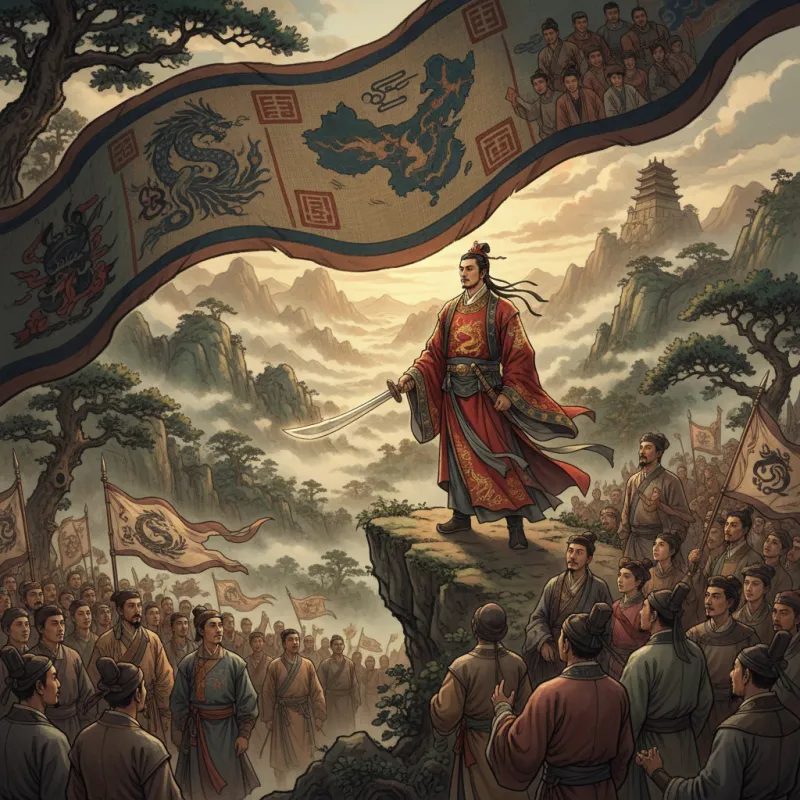
When Guo Jing stands atop the walls of Xiangyang, watching Mongol armies mass on the horizon, he faces a question that haunts every Jin Yong hero: what does it mean to be Chinese? This isn't just the dilemma of a fictional character in The Legend of the Condor Heroes (射雕英雄传, Shèdiāo Yīngxióng Zhuàn). It's the central tension running through Jin Yong's entire body of work—a meditation on identity, belonging, and loyalty written during one of the most transformative periods in Chinese history.
Jin Yong (金庸, Jīn Yōng), born Louis Cha in 1924, crafted his wuxia novels between 1955 and 1972, a period when China was redefining itself after centuries of imperial rule, foreign invasion, and civil war. His stories, set everywhere from the Song Dynasty to the Qing, became vehicles for exploring what "Chineseness" meant in an era of radical change. But here's what makes his approach remarkable: he never offers simple answers. Instead, his novels complicate nationalism at every turn, questioning the very boundaries they seem to defend.
The Han-Centric Worldview and Its Discontents
Most of Jin Yong's novels operate within what appears to be a straightforward framework: Han Chinese heroes defending their homeland against foreign invaders. The Legend of the Condor Heroes gives us Guo Jing, the earnest patriot who dedicates his life to resisting the Mongol conquest. Demi-Gods and Semi-Devils (天龙八部, Tiānlóng Bābù) features Xiao Feng, initially celebrated as a Han hero before his Khitan heritage is revealed. The Deer and the Cauldron (鹿鼎记, Lùdǐng Jì) centers on Wei Xiaobao's complicated relationship with the Manchu Qing court.
On the surface, this seems like straightforward nationalist literature. The jianghu (江湖, jiānghú)—the martial arts world—becomes a metaphor for Chinese civilization itself, constantly threatened by barbarians at the gates. But Jin Yong systematically undermines this binary throughout his work. His "foreign" characters are rarely simple villains. The Mongol princes in Condor Heroes display honor and strategic brilliance. The Khitan warriors in Demi-Gods possess their own codes of loyalty and righteousness.
More subversively, Jin Yong often makes his Han Chinese characters the real problem. The supposedly patriotic martial artists are frequently petty, corrupt, and self-serving. They invoke nationalism to justify personal vendettas, hoard power, and exclude outsiders. The "pure" Han identity they claim to defend turns out to be a convenient fiction masking less noble motivations.
Xiao Feng's Tragedy: When Identity Becomes Destiny
No character embodies Jin Yong's ambivalence about nationalism more powerfully than Xiao Feng from Demi-Gods and Semi-Devils. Raised as a Han Chinese, Xiao Feng becomes the leader of the Beggar's Sect and a celebrated hero. When his Khitan origins are exposed, everything collapses. The same people who praised his righteousness now call him a barbarian spy. His identity—which he believed was defined by his actions and values—turns out to be determined by bloodline alone.
The genius of Xiao Feng's arc is how it exposes the arbitrary nature of ethnic nationalism. He hasn't changed. His character, his loyalty to his friends, his sense of justice—all remain constant. Only the label has shifted. Yet this label proves more powerful than any martial arts technique. It destroys his position, his relationships, and ultimately his life.
Jin Yong pushes this further by having Xiao Feng discover genuine loyalty to his Khitan heritage. He doesn't simply reject his birth identity or embrace it uncritically. Instead, he finds himself torn between two peoples, both of whom have legitimate claims on his allegiance. When he stands between the Song and Liao armies, trying to prevent war, he represents Jin Yong's ideal: someone who transcends narrow nationalism without abandoning loyalty altogether. His suicide isn't just tragic—it's Jin Yong's statement that this kind of transcendence may be impossible in a world organized around ethnic boundaries.
The Manchu Question in The Deer and the Cauldron
If Demi-Gods presents nationalism as tragedy, The Deer and the Cauldron treats it as farce. Wei Xiaobao, Jin Yong's most controversial protagonist, serves both the Qing Emperor Kangxi and the anti-Manchu resistance movement simultaneously. He's a con artist, a womanizer, and a coward—everything a traditional wuxia hero isn't. Yet he's also the character who most clearly sees through nationalist rhetoric.
The anti-Manchu resistance in the novel, represented by groups like the Heaven and Earth Society (天地会, Tiāndì Huì), claims to fight for the restoration of Han Chinese rule. They invoke loyalty to the Ming Dynasty and resistance to foreign occupation. Wei Xiaobao joins them, but he never quite believes their propaganda. He notices that these "patriots" are often more interested in personal power than national liberation. Their vision of a restored Ming looks suspiciously like the Qing they claim to oppose—just with different people in charge.
Meanwhile, the Manchu Emperor Kangxi emerges as one of Jin Yong's most sympathetic rulers. He's intelligent, capable, and genuinely concerned with good governance. The novel suggests that ethnic identity matters far less than competence and character. This was explosive stuff when published in 1969, as China was in the midst of the Cultural Revolution's radical nationalism. Jin Yong was essentially arguing that a "foreign" dynasty could be legitimate if it ruled well—a position that challenged both traditional Han chauvinism and contemporary Communist ideology.
Regional Identity and the Jianghu
Beyond ethnic nationalism, Jin Yong explores regional identity within China itself. His characters often identify more strongly with their local communities than with abstract notions of Chinese unity. The martial arts sects in his novels—Shaolin, Wudang, Emei, Kunlun—represent different regions and philosophies, each with distinct cultures and loyalties.
This fragmentation reflects historical reality. For most of Chinese history, regional identities were often more meaningful than national ones. A merchant from Guangzhou might have more in common with traders from Southeast Asia than with farmers from Shaanxi. The jianghu in Jin Yong's novels operates as a parallel society with its own rules, hierarchies, and conflicts that often ignore official state boundaries.
The tension between regional and national identity appears most clearly in novels like The Smiling, Proud Wanderer (笑傲江湖, Xiào'ào Jiānghú), where martial arts sects compete for dominance while nominally serving the same empire. The novel suggests that these internal divisions pose as much threat to Chinese civilization as external enemies. Yet Jin Yong also celebrates regional diversity as a source of cultural richness. The solution isn't homogenization but finding ways to maintain distinct identities within a larger framework—a vision that resonates with contemporary debates about Chinese unity and diversity.
The Individual Against the Collective
At the heart of Jin Yong's exploration of nationalism lies a deeper question: what does the individual owe to the collective? His heroes constantly struggle between personal desires and national duty. Guo Jing sacrifices his happiness to defend Xiangyang. Yang Guo in The Return of the Condor Heroes (神雕侠侣, Shéndiāo Xiálǚ) rebels against social conventions to pursue his love for Xiaolongnü. Linghu Chong in The Smiling, Proud Wanderer refuses to lead his sect because he values personal freedom over institutional power.
Jin Yong's sympathies clearly lie with those who question blind loyalty to collective identities. His most admirable characters think for themselves, even when it means defying their communities. They recognize obligations to their people but refuse to let nationalism override their moral judgment. This individualism sets Jin Yong apart from both traditional Chinese literature, which emphasized collective harmony, and Communist ideology, which subordinated individual identity to class and nation.
Yet Jin Yong never fully endorses radical individualism either. His hermit characters who completely withdraw from society are portrayed as incomplete. The ideal, embodied in characters like Guo Jing and Xiao Feng, involves balancing personal integrity with social responsibility. They serve their communities without losing themselves. They defend their people without demonizing others. It's a difficult balance, and Jin Yong's novels acknowledge that maintaining it often requires sacrifice.
Historical Context and Contemporary Relevance
Jin Yong wrote during a period when Chinese identity was being radically reconstructed. The Communist revolution had overthrown traditional social structures. The Cultural Revolution was attacking Confucian values and historical continuity. Meanwhile, overseas Chinese communities were developing their own distinct identities, separate from mainland China. Jin Yong, writing from Hong Kong, occupied a unique position—Chinese but outside the People's Republic, connected to tradition but living in a modernizing British colony.
His novels reflect this liminal position. They're deeply rooted in Chinese history and culture, yet they question nationalist orthodoxies. They celebrate Chinese civilization while acknowledging its flaws and contradictions. This complexity made them controversial in mainland China, where they were banned until the 1980s, but enormously popular in Hong Kong, Taiwan, and Southeast Asian Chinese communities.
Today, as China reasserts itself on the world stage and debates about Chinese identity intensify, Jin Yong's novels remain remarkably relevant. They offer a vision of Chinese identity that's culturally rooted but not ethnically exclusive, proud but not chauvinistic, unified but respectful of diversity. Whether this vision can be realized in practice remains an open question—one that Jin Yong's tragic heroes suggest may be as difficult now as it was in the Song Dynasty.
Beyond Nationalism: Universal Themes
Ultimately, what makes Jin Yong's exploration of nationalism so powerful is that it transcends its specific cultural context. The questions his characters face—about belonging, loyalty, identity, and the tension between individual and collective—are universal. Readers from any background can recognize themselves in Xiao Feng's struggle to reconcile conflicting loyalties or Wei Xiaobao's skepticism about nationalist rhetoric.
This universality explains why Jin Yong's novels have found audiences far beyond the Chinese-speaking world. They speak to fundamental human experiences of identity formation and community belonging. They acknowledge the deep human need for roots and connection while warning against the dangers of rigid boundaries and exclusionary thinking. In an era of resurgent nationalism worldwide, these themes feel more urgent than ever.
Jin Yong never claimed to have answers to the questions he raised. His novels explore rather than resolve the tensions between different forms of identity and loyalty. But perhaps that's precisely their value. In a world that demands simple allegiances and clear boundaries, Jin Yong's work reminds us that identity is complex, loyalty is multifaceted, and the most important question isn't which group we belong to but what kind of person we choose to be. For readers interested in how these themes intersect with other aspects of Jin Yong's work, explore Confucian Values and Moral Philosophy and The Role of Women in Wuxia.
Related Reading
- Love and Sacrifice in Jin Yong's World
- Buddhism and Martial Arts: Spiritual Themes
- The Definitive Jin Yong Martial Arts Power Ranking
- Exploring the Rich Tapestry of Jin Yong's Wuxia Novels and Their Enduring Legacy
- Gu Long vs. Jin Yong: The Great Wuxia Debate