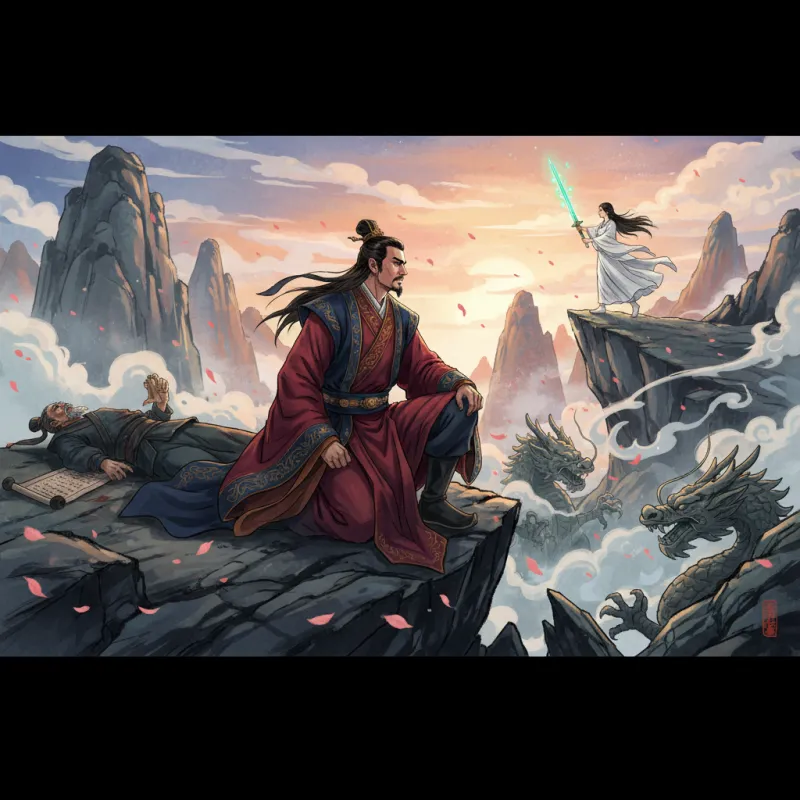
When Guo Jing stands atop the walls of Xiangyang, watching the Mongol army mass below while his wife Huang Rong tends to the city's defenses, he faces an impossible choice: abandon the city to save his family, or sacrifice everything for a nation that may not survive the night. This moment, from The Return of the Condor Heroes (神雕侠侣, Shédiāo Xiálǚ), crystallizes what makes Jin Yong's treatment of love so devastating — it's never just about two people finding happiness. In his martial world (江湖, jiānghú), love demands sacrifice, and sacrifice reveals the true measure of love.
The Price of Devotion: When Love Costs Everything
Jin Yong doesn't write fairy tales. His lovers don't ride off into sunsets — they bleed out on battlefields, throw themselves from cliffs, or spend decades separated by duty and circumstance. Take Yang Guo and Xiaolongnü from The Return of the Condor Heroes. Their sixteen-year separation isn't a plot device; it's a meditation on whether love can survive when everything else is stripped away. Xiaolongnü jumps into the Heartbreak Cliff believing she's saving Yang Guo from a poisoned future with her. Yang Guo spends sixteen years waiting at that cliff, refusing every comfort, every alternative, every reasonable suggestion that he move on.
This isn't romantic in the Western sense — it's almost pathological. But that's precisely Jin Yong's point. In the jiānghú, where survival itself is uncertain and loyalty can mean death, love becomes the one thing worth being unreasonable about. The sacrifice isn't noble because it's smart; it's noble because it's chosen freely, with full knowledge of the cost.
Compare this to Linghu Chong and Ren Yingying in The Smiling, Proud Wanderer (笑傲江湖, Xiào'ào Jiānghú). Linghu Chong spends most of the novel pining for Yue Lingshan, who marries someone else. When Ren Yingying — brilliant, powerful, devoted — offers him genuine love, he barely notices. His eventual acceptance of her love isn't a triumph; it's a surrender to reality. Jin Yong seems to ask: Is love that comes after disappointment less valuable? Or is the willingness to love again, after loss, its own form of sacrifice?
Duty Versus Desire: The Impossible Choice
The tension between personal happiness and social obligation runs through Jin Yong's work like a fault line. His characters constantly face the choice between love and duty, and Jin Yong rarely lets them have both. This reflects deep Confucian values about righteousness and moral duty, where personal desires must sometimes yield to greater responsibilities.
Guo Jing and Huang Rong's story arc across The Legend of the Condor Heroes (射雕英雄传, Shèdiāo Yīngxióng Zhuàn) and its sequel shows this evolution brutally. In the first novel, they're young lovers overcoming obstacles — his density, her mischief, various villains trying to kill them. Standard wuxia romance. But by The Return of the Condor Heroes, set years later, they're defending Xiangyang against the Mongol invasion. Their love hasn't diminished; it's been subsumed into something larger. They will die defending that city — Jin Yong tells us this explicitly in later novels. Their love story ends not with a wedding but with a shared martyrdom for a cause that history tells us was ultimately futile. The Song Dynasty fell. Xiangyang fell. They died for nothing, except they didn't, because the sacrifice itself was the point.
This is where Jin Yong diverges sharply from Western romantic traditions. Romeo and Juliet die because of miscommunication and bad timing — it's tragic because it's preventable. Guo Jing and Huang Rong die because they choose to, fully aware of what they're doing. The tragedy isn't in the waste; it's in the necessity.
The Feminine Sacrifice: Love as Self-Erasure
Jin Yong's female characters often express love through self-sacrifice that borders on self-destruction, and this is where his work becomes most problematic for modern readers. Xiaolongnü jumps off a cliff. A'Zhu in Demi-Gods and Semi-Devils (天龙八部, Tiānlóng Bābù) dies protecting Qiao Feng. Mu Nianci waits faithfully for Yang Kang even as he betrays everything she values. The pattern repeats: women in Jin Yong's novels prove their love by what they're willing to lose.
But Jin Yong isn't simply endorsing this dynamic — he's documenting it, and occasionally interrogating it. Huang Rong, arguably his most fully realized female character, refuses the passive role. She's brilliant, strategic, occasionally ruthless, and she loves Guo Jing without diminishing herself. Their partnership works because she doesn't sacrifice her intelligence or agency for him; instead, she deploys both in service of their shared goals. When she eventually dies at Xiangyang, it's not as Guo Jing's wife but as the city's defender in her own right.
Ren Yingying presents another model. She's the daughter of the Sun Moon Holy Cult's leader, powerful and feared in her own right. Her love for Linghu Chong doesn't require her to become less; if anything, she uses her power to protect him repeatedly. Jin Yong seems to be exploring different models of feminine love and sacrifice, asking which forms are noble and which are simply tragic.
The Unrequited and the Unworthy: Love's Cruelest Forms
Some of Jin Yong's most memorable characters love people who don't love them back, or who aren't worthy of that love. This is where sacrifice becomes almost unbearable to witness. Mei Chaofeng in The Legend of the Condor Heroes is disfigured, exiled, and hunted, but she never stops loving her senior martial brother Chen Xuanfeng — even after his death, even after everything. Her love is grotesque, obsessive, and completely sincere.
Or consider Qiu Qianchi in The Return of the Condor Heroes, imprisoned in a valley for decades by the man she loved, who chose another woman. She doesn't move on; she festers. Her love curdles into hatred, but the hatred itself is proof that the love was real. Jin Yong doesn't flinch from showing us what happens when sacrifice isn't reciprocated, when devotion is met with betrayal.
The most devastating example might be Ah Zi from Demi-Gods and Semi-Devils. She loves Qiao Feng with a fierce, selfish intensity, but he loves A'Zhu, her sister. When A'Zhu dies, Ah Zi gouges out her own eyes to give them to Qiao Feng (it's complicated), and even this horrific sacrifice doesn't win his love. She ends the novel blind and alone, having given everything for nothing. Jin Yong doesn't reward her sacrifice with meaning or redemption. Sometimes, he suggests, love just destroys you.
Sacrifice as Redemption: The Path to Heroism
Yet Jin Yong also shows us sacrifice as transformative, as the mechanism by which flawed people become heroes. Yang Guo begins The Return of the Condor Heroes as a bitter, resentful youth. His willingness to sacrifice everything for Xiaolongnü — his reputation, his safety, eventually his arm — gradually transforms him into the Divine Eagle Hero. The sacrifice doesn't just prove his love; it forges his character.
This connects to Buddhist concepts of self-cultivation and enlightenment that permeate Jin Yong's work. Sacrifice in his novels isn't just about giving something up; it's about transcending the self. When Duan Yu in Demi-Gods and Semi-Devils refuses to learn lethal martial arts because of his Buddhist principles, even when it means he can't protect the people he loves, he's sacrificing practical power for spiritual integrity. The novel eventually rewards this — his non-violent martial arts become formidable in their own way — but Jin Yong makes him suffer first.
The clearest example is Xiao Feng (Qiao Feng) from the same novel. He's a Khitan leading Chinese martial artists, caught between two peoples who both claim him and both reject him. His final sacrifice — forcing the Liao emperor to promise not to invade Song China, then killing himself to prevent future conflict — is simultaneously futile and magnificent. He can't actually stop the wars that are coming; history is bigger than any individual. But his willingness to die for peace, even knowing it won't last, elevates him to tragic hero status.
The Modern Reader's Dilemma: Admiring What We Can't Endorse
Reading Jin Yong in the 21st century means grappling with values that feel simultaneously admirable and toxic. The willingness to sacrifice everything for love or duty can look like nobility or pathology depending on your angle. When Yang Guo waits sixteen years for Xiaolongnü, is that romantic devotion or unhealthy obsession? When Guo Jing chooses duty over family, is that heroic or a failure of priorities?
Jin Yong wrote in mid-20th century Hong Kong, drawing on classical Chinese literature and philosophy, particularly the concept of yi (义, righteousness) that demands personal sacrifice for greater goods. His characters inhabit a world where individual happiness is less important than honor, duty, and loyalty. This isn't just cultural difference — it's a fundamentally different ethical framework.
But here's what makes Jin Yong endure: he doesn't simply endorse these sacrifices. He shows us their cost. When characters sacrifice love for duty, we see what they lose. When they sacrifice everything for unrequited love, we see the waste. He presents these choices with clear eyes, letting readers draw their own conclusions about whether the sacrifices were worth it.
The genius is that different readers, from different cultures and eras, can read the same scenes and come to opposite conclusions. Is Guo Jing a hero or a fool? Is Xiaolongnü's sacrifice noble or unnecessary? Jin Yong gives us enough complexity that these questions don't have easy answers.
The Legacy: Why These Sacrifices Still Matter
Jin Yong's novels have sold over 300 million copies worldwide. They've been adapted into countless films, TV series, video games, and comics. Generations of Chinese readers have grown up with these stories, and the characters' names are cultural touchstones. When someone in China references "waiting at Heartbreak Cliff," everyone knows what that means.
This endurance suggests that something in these stories of love and sacrifice resonates beyond their cultural moment. Maybe it's the recognition that love, real love, costs something. That choosing to love someone, to stay loyal to them, to sacrifice for them, is what gives the love meaning. In an era of easy connections and easier disconnections, there's something compelling about characters who commit absolutely, even when it destroys them.
Or maybe it's simpler: Jin Yong understood that the best stories aren't about people getting what they want. They're about people choosing what they value, then living with the consequences. His lovers sacrifice everything — their lives, their happiness, their futures — and in doing so, they become immortal. Not because the sacrifices were smart or even right, but because they were chosen freely, with full knowledge of the cost.
That's the heart of Jin Yong's world. Love isn't what makes you happy; it's what you're willing to suffer for. And sacrifice isn't noble because it succeeds; it's noble because you do it anyway, knowing it might not matter, knowing you might die for nothing, but choosing it nonetheless because some things are worth more than survival.
In the end, perhaps that's why these stories still grip us: they remind us that we're capable of caring about something more than ourselves, even in a world that constantly tells us not to.
Related Reading
- Nationalism and Identity in Jin Yong's Novels
- Exploring the Enigmatic Worlds of Jin Yong's Wuxia Novels
- Jin Yong's Writing Style: What Makes It Timeless
- Exploring the Intricate Sects within Jin Yong's Iconic Wuxia Novels