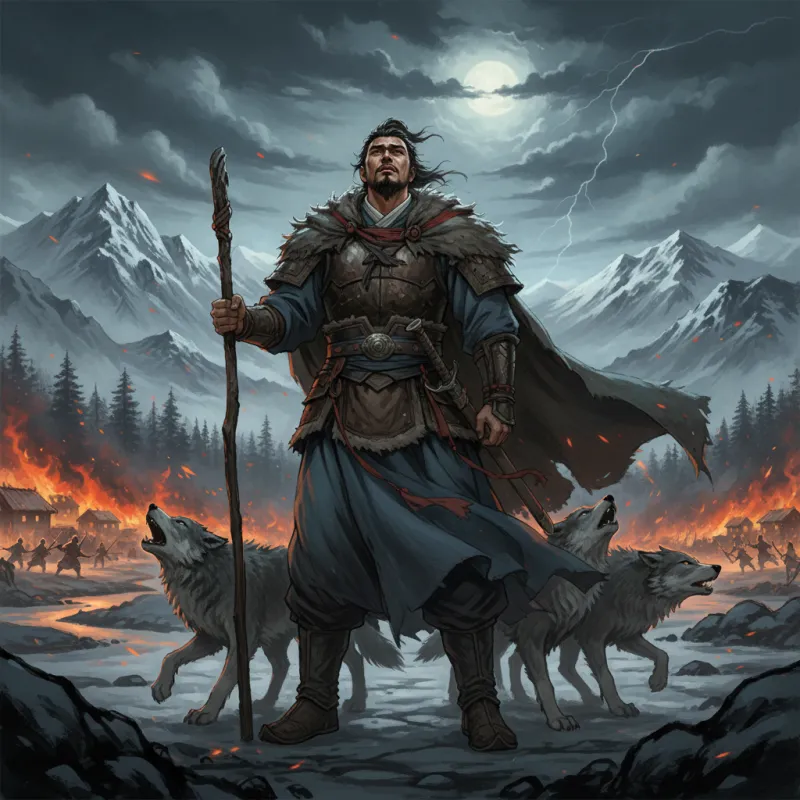
He stands at the edge of Yanmen Pass, the wind whipping his robes, a dagger pressed against his own chest. Below him, two armies wait — one Khitan, one Song Chinese. Behind him lies a trail of blood, betrayal, and shattered identity. This is how Qiao Feng's story ends, but it's also how the legend of wuxia's greatest tragic hero is immortalized. No character in Jin Yong's (金庸 Jīn Yōng) vast literary universe has inspired more tears, more debate, or more profound reflection on identity and loyalty than this man who was born Khitan but raised Han Chinese.
The Perfect Hero, Before the Fall
When readers first encounter Qiao Feng (乔峰 Qiáo Fēng) in Demi-Gods and Semi-Devils (天龙八部 Tiānlóng Bābù), he's already a legend. As chief of the Beggar Sect (丐帮 Gàibāng), he commands the largest martial arts organization in the jianghu (江湖 jiānghú). His Eighteen Dragon-Subduing Palms (降龙十八掌 Jiàng Lóng Shíbā Zhǎng) are considered the most powerful external martial art in existence. He's righteous, decisive, and charismatic — the kind of leader men would die for without hesitation.
Jin Yong spends the novel's opening chapters establishing Qiao Feng as essentially flawless. He resolves disputes with wisdom, fights with overwhelming power, and treats even his enemies with a certain magnanimity. This isn't accidental. Jin Yong needs us to see Qiao Feng at his peak because the fall will be so much more devastating. Unlike Guo Jing, whose heroism comes from earnest simplicity, or Yang Guo, whose path is one of rebellion and eventual redemption, Qiao Feng's tragedy is that he does everything right — and still loses everything.
The Revelation That Changes Everything
The turning point comes at the Apricot Forest gathering, when a mysterious figure reveals that Qiao Feng is actually Khitan — a member of the "barbarian" northern tribe that the Song Chinese consider their mortal enemy. His real name is Xiao Feng (萧峰 Xiāo Fēng). His parents were Khitan. Everything about his identity is a lie.
What makes this revelation so powerful isn't just the plot twist — it's how Jin Yong uses it to interrogate the very foundations of ethnic identity and loyalty. In 1960s Hong Kong, where Jin Yong was writing, questions of Chinese identity were fraught. Who counted as Chinese? What did loyalty to "China" even mean in a divided nation? Qiao Feng's crisis becomes a mirror for these larger questions.
The jianghu's response is swift and brutal. Former allies turn on him. The Beggar Sect, which he led with distinction, demands his resignation. People he saved now call him a spy and a traitor. And here's where Qiao Feng's tragedy deepens: he doesn't deny his heritage, but he also doesn't abandon his sense of justice. He's caught between two worlds, fully belonging to neither.
The Quest for Truth and the Weight of Blood Debt
Qiao Feng's journey to uncover his true origins becomes one of the most harrowing sequences in all of wuxia fiction. Every answer leads to more questions. Every step forward is paid for in blood — often the blood of people he cares about. The revelation that he killed his own adoptive parents while in a drunken rage, manipulated by the true villain, is almost unbearable. Jin Yong doesn't let his hero off easy. Qiao Feng must live with the knowledge that his hands are stained with the blood of innocents, regardless of intent.
This is where Qiao Feng diverges from typical wuxia heroes. Linghu Chong faces persecution but maintains his carefree spirit. Guo Jing faces impossible odds but has unwavering moral clarity. Qiao Feng has neither comfort. He's too honest to lie to himself, too principled to excuse his actions, and too aware of the complexity of his situation to find easy answers.
The relationship with A'Zhu (阿朱 Ā Zhū) offers a brief glimpse of happiness — a woman who loves him for who he is, not what ethnicity he belongs to. Their plans to retire to the grasslands, to leave behind the jianghu's endless conflicts, represent the life Qiao Feng might have had. But Jin Yong is writing tragedy, not romance. When Qiao Feng accidentally kills A'Zhu, mistaking her for his enemy, the emotional devastation is complete. He has now killed both his adoptive parents and the woman he loves. The hero has become the instrument of his own destruction.
The Impossible Choice at Yanmen Pass
The novel's climax forces Qiao Feng into an impossible position. He's risen to become a Khitan general, respected by his birth people. But when the Khitan emperor decides to invade Song China, Qiao Feng must choose: loyalty to his blood or loyalty to the land that raised him. This isn't a simple choice between good and evil — both sides have legitimate claims on his allegiance.
What Qiao Feng does next defines his character and cements his status as wuxia's greatest tragic hero. He can't betray the Khitan people — they're his family by birth. He can't allow the invasion of Song China — that's where he was raised, where his values were formed. So he chooses a third path: he forces the Khitan emperor to swear off invasion by threatening his life, then takes his own life to prevent future conflicts. It's a solution that satisfies no one and costs him everything, but it's the only choice his conscience will allow.
Why Qiao Feng Endures
Decades after Demi-Gods and Semi-Devils was first serialized, Qiao Feng remains Jin Yong's most discussed character. Why? Because his tragedy speaks to something universal and timeless. In an increasingly globalized world, questions of identity, belonging, and divided loyalties are more relevant than ever. What do you do when the groups you belong to come into conflict? How do you maintain integrity when every choice requires betrayal of some principle or person you hold dear?
Qiao Feng's answer — to choose principle over belonging, to sacrifice himself rather than compromise his values — is both inspiring and heartbreaking. He's not a perfect hero because he makes no mistakes. He's a perfect hero because he faces impossible situations with unflinching honesty and pays the full price for his choices.
Jin Yong himself reportedly said that Qiao Feng was the character closest to his ideal of a hero. Not the most powerful, not the most successful, but the one who best embodied the qualities of integrity, courage, and tragic nobility. In a genre often criticized for simplistic morality and power fantasies, Qiao Feng stands as proof that wuxia can achieve genuine literary depth.
The Legacy of a Tragic Hero
Qiao Feng's influence extends far beyond the pages of Demi-Gods and Semi-Devils. He's been portrayed in countless television and film adaptations, with actors like Tony Leung, Huang Rihua, and Hu Jun bringing different interpretations to the role. Each generation finds something new in his story — sometimes emphasizing the ethnic conflict, sometimes the personal tragedy, sometimes the impossible heroism.
But perhaps the most telling measure of Qiao Feng's impact is how often his name comes up in discussions that have nothing to do with wuxia. He's invoked in debates about identity politics, in discussions of tragic heroes across world literature, in conversations about the cost of integrity. He's become larger than his genre, a character who transcends the conventions of martial arts fiction to speak to fundamental human experiences.
When readers say they cried over Qiao Feng, they're not crying over plot mechanics or fight scenes. They're crying because Jin Yong created a character who embodies the terrible beauty of choosing principle over happiness, of maintaining integrity in a world that offers no good choices. Qiao Feng doesn't get a happy ending. He doesn't get redemption or peace. He gets only the cold comfort of knowing he stayed true to himself until the very end.
That's the essence of tragedy, and that's why Qiao Feng will always be remembered as wuxia's greatest hero — not despite his suffering, but because of how he bore it.
Related Reading
- Ouyang Feng: The Western Venom
- Jin Yong's Greatest Characters: The Heroes, Villains, and Everyone in Between
- Zhang Wuji: The Reluctant Leader
- Huang Rong: The Smartest Person in Jin Yong's Universe
- The Enduring Legacy of Jin Yong’s Wuxia Characters and Martial Arts
- The Enigmatic Hidden Techniques in Jin Yong’s Wuxia Novels Explored
- Exploring Jin Yong's Wuxia Novels: Characters, Martial Arts, and Storylines
- Villains of Jin Yong's Wuxia Novels: Complexity, Motives, and Legacy