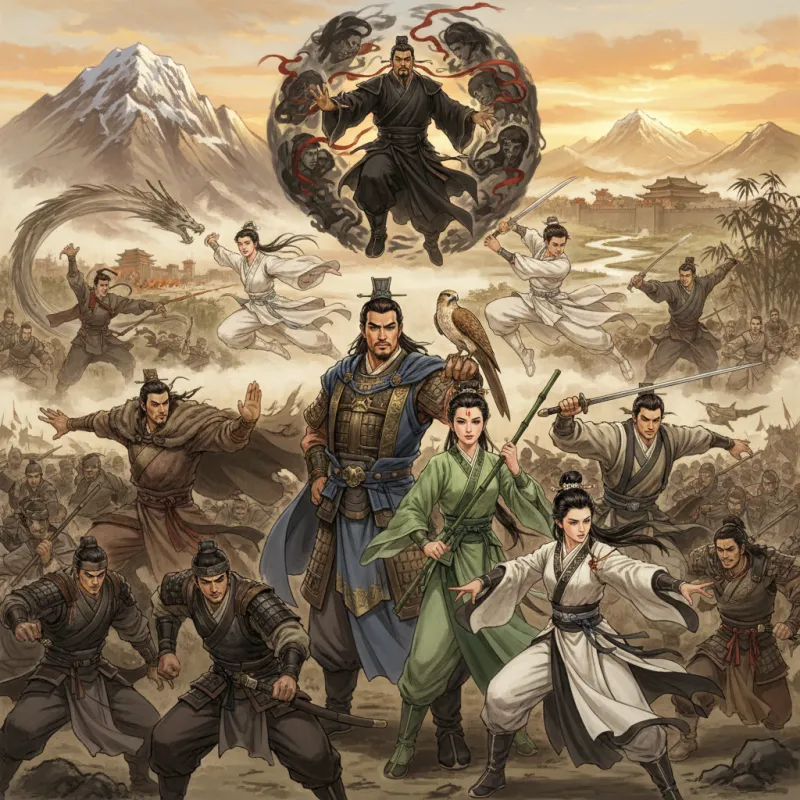
When Qiao Feng stands at Yanmen Pass, a dagger pressed against his own chest, you realize Jin Yong never wrote simple heroes. The greatest martial artist of his generation — beloved leader, righteous warrior, defender of the weak — chooses death not because he's defeated, but because victory itself has become impossible. He cannot fight for his Chinese brothers without betraying his Khitan blood. He cannot protect his Khitan father without destroying the people he loves. So he does the only thing a truly great character can do when faced with an unsolvable moral equation: he removes himself from it entirely.
That's the genius of Jin Yong's character work. His greatest creations aren't defined by their kung fu prowess or their noble deeds. They're defined by their contradictions — the unbridgeable gap between who they want to be and who they are, between their ideals and their reality, between their public face and their private torment.
The Weight of Identity: Qiao Feng's Impossible Choice
Qiao Feng (乔峰, Qiáo Fēng) from Demi-Gods and Semi-Devils (天龙八部, Tiānlóng Bābù) stands as Jin Yong's most perfectly realized tragic hero. When we first meet him, he's everything a wuxia protagonist should be: the young leader of the Beggars' Sect (丐帮, Gàibāng), unmatched in martial arts, respected across the jianghu (江湖, jiānghú — the martial world), and unfailingly righteous.
Then comes the revelation that shatters everything: he's not Han Chinese. He's Khitan (契丹, Qìdān) — a member of the "barbarian" people that Song Dynasty China fears and despises. Overnight, the man who embodied Chinese martial virtue becomes the enemy. His friends turn on him. His lover's family was murdered by his biological father. The sect he led wants him dead.
What makes Qiao Feng unforgettable isn't how he fights his way out of this situation — it's that he can't. There is no martial arts technique, no clever strategy, no act of heroism that can resolve his fundamental problem: he is genuinely, inescapably both Chinese and Khitan. He loves both peoples. And they are at war.
His suicide at Yanmen Pass isn't defeat. It's the only moral choice left to a man who refuses to choose between two identities that both define him. Jin Yong gives us a hero who dies not because he's weak, but because he's too principled to live in a world that demands he betray half of himself.
The Antihero Who Earned His Redemption: Wei Xiaobao
If Qiao Feng represents Jin Yong's most tragic creation, Wei Xiaobao (韦小宝, Wéi Xiǎobǎo) from The Deer and the Cauldron (鹿鼎记, Lùdǐng Jì) is his most subversive. Wei Xiaobao is everything a wuxia hero shouldn't be: he's a barely literate son of a prostitute, he can't do martial arts, he lies constantly, he's greedy, he's lecherous, and he has no principles whatsoever.
And yet he's utterly compelling. Why? Because Wei Xiaobao is honest about his dishonesty. He never pretends to be noble. He never claims to fight for justice or righteousness. He just wants to survive, get rich, and have a good time — and somehow, through sheer cunning and dumb luck, he ends up shaping the fate of the Qing Dynasty.
What Jin Yong understood is that a character doesn't need to be admirable to be great. Wei Xiaobao works because he's real in a way that traditional heroes often aren't. He's the id to Qiao Feng's superego — the part of us that would absolutely take the easy way out if we could get away with it. His journey through the Qing court becomes a sly commentary on how power actually works: not through noble sacrifice, but through compromise, manipulation, and knowing when to run away.
The Villain You Can't Quite Hate: Yue Buqun
The best villains believe they're heroes. Yue Buqun (岳不群, Yuè Bùqún) from The Smiling, Proud Wanderer (笑傲江湖, Xiào'ào Jiānghú) starts as the respectable leader of the Huashan Sect (华山派, Huáshān Pài), known as the "Gentleman Sword" (君子剑, Jūnzǐ Jiàn). He speaks of righteousness and proper conduct. He presents himself as the moral center of the martial world.
Slowly, Jin Yong peels back the layers. Yue Buqun's righteousness is performance. His gentlemanly conduct is calculation. Every moral stance is strategic positioning. And when he finally obtains the Sunflower Manual (葵花宝典, Kuíhuā Bǎodiǎn) — a forbidden martial arts text that requires self-castration to master — he doesn't hesitate. He mutilates himself in secret and continues playing the gentleman while plotting to dominate the jianghu.
What makes Yue Buqun terrifying isn't his martial arts or his cruelty. It's his self-deception. He genuinely believes his quest for power serves a higher purpose. He thinks he's the hero of his own story, that his sacrifices justify his methods. Jin Yong shows us that the most dangerous villains aren't the ones who embrace evil — they're the ones who commit atrocities while convinced they're doing good.
The Woman Who Refused to Be Saved: Huang Rong
Jin Yong's female characters often get reduced to love interests, but his best women are far more complex. Huang Rong (黄蓉, Huáng Róng) from The Legend of the Condor Heroes (射雕英雄传, Shèdiāo Yīngxióng Zhuàn) starts as a clever beggar girl who helps the naive Guo Jing. She could have been just the smart sidekick to the hero's brawn.
Instead, Jin Yong makes her the most intelligent character in the novel. She's the daughter of Huang Yaoshi (黄药师, Huáng Yàoshī), the eccentric master of Peach Blossom Island, and she inherited his genius. She solves problems Guo Jing can't even understand. She manipulates situations, outthinks enemies, and consistently proves herself the most capable person in any room.
But here's what makes her great: she chooses Guo Jing anyway. Not because she needs saving, but because she genuinely loves his simple integrity. Their relationship works because Jin Yong never dumbs her down or makes her dependent. She remains smarter than her husband throughout their lives, and that's fine. She doesn't need to be rescued — she needs to be respected.
By the time we see her in The Return of the Condor Heroes (神雕侠侣, Shéndiāo Xiálǚ), she's become the leader of the Beggars' Sect herself, defending Xiangyang against the Mongol invasion. She's not standing behind her hero husband — she's standing beside him, equally legendary.
The Monk Who Couldn't Let Go: Duan Yu
Duan Yu (段誉, Duàn Yù), another protagonist from Demi-Gods and Semi-Devils, represents Jin Yong's fascination with characters who reject their destiny. Born as the prince of Dali (大理, Dàlǐ), heir to a kingdom and a martial arts legacy, Duan Yu wants nothing to do with any of it. He's a Buddhist who refuses to learn martial arts because he won't harm living beings. He just wants to read, write poetry, and live peacefully.
Then fate forces martial arts upon him anyway. He accidentally learns the Lingbo Weibu (凌波微步, Língbō Wēibù) footwork technique. He absorbs decades of internal energy without trying. He becomes one of the most powerful martial artists in the world despite his pacifist principles.
The contradiction defines him: he has the power to kill but refuses to use it. He's constantly running away from fights he could win. And when he falls in love with multiple women who turn out to be his half-sisters (in a plot twist that's pure Jin Yong melodrama), he faces another impossible situation — his desires conflict with his morality, and there's no clean resolution.
Duan Yu works because Jin Yong never lets him off the hook. He doesn't get to be purely pacifist — circumstances force him to fight. He doesn't get simple romance — his love life becomes a nightmare of accidental incest. He's a character constantly compromising his ideals while trying desperately to hold onto them, and that tension makes him human.
The Genius of Contradiction
What unites Jin Yong's greatest characters is that they're all trapped by contradictions they can't resolve. Qiao Feng can't be both Chinese and Khitan. Yue Buqun can't be both righteous and power-hungry (though he tries). Huang Rong can't be both the smartest person in the room and the traditional submissive wife (so she refuses the latter). Duan Yu can't be both a pacifist and a martial arts master (but becomes one anyway).
Lesser writers would resolve these contradictions. The hero would choose one identity over another. The villain would be purely evil. The love interest would sacrifice her intelligence for romance. The pacifist would either embrace violence or remain powerless.
Jin Yong lets the contradictions stand. His characters live in the tension between incompatible truths, and that's what makes them feel real. We're all walking contradictions — we want security and freedom, we crave connection and independence, we hold principles we can't always follow. Jin Yong's characters reflect that reality back at us, dressed in the gorgeous costumes of wuxia adventure.
That's why, decades after these novels were written, readers still argue about whether Qiao Feng made the right choice, whether Wei Xiaobao is admirable or contemptible, whether Yue Buqun was always evil or became evil gradually. These aren't simple characters with obvious answers. They're complex human beings trapped in impossible situations, doing their best with the limited options available to them.
And sometimes, like Qiao Feng at Yanmen Pass, their best isn't enough to save them. But it's enough to make them unforgettable.
Related Reading
- Jin Yong's Greatest Characters: The Ones You Never Forget
- Guo Jing: The Hero Who Proved Heart Matters More Than Talent
- Unraveling the Heroes and Antiheroes of Jin Yong's Wuxia Novels
- Zhang Wuji: The Reluctant Leader
- Xiao Longnü: The Maiden Beyond the World
- Jin Yong's Writing Style: What Makes It Timeless
- The Allure of Jin Yong's Wuxia: Exploring Martial Arts, Characters, and Legendary Storylines
- Jin Yong Reading Order Guide: Where to Start