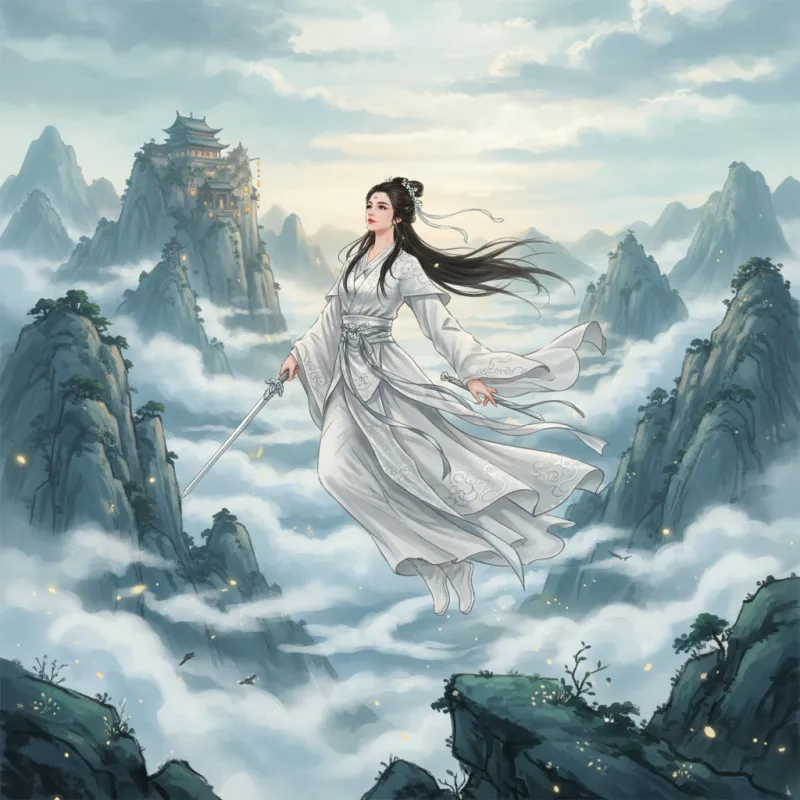
She doesn't smile when you expect her to. She doesn't cry when others would. When Yang Guo confesses his love, she tilts her head and asks, with genuine confusion, why he would want to marry her. Xiao Longnü (小龙女 Xiǎo Lóngnǚ) — the Little Dragon Maiden — is Jin Yong's most radical experiment in character design: a heroine who has never learned to perform being human.
Raised by Ice and Jade
The Ancient Tomb (古墓 Gǔmù) beneath Zhongnan Mountain isn't just isolated — it's a deliberate rejection of the world above. Founded by Lin Chaoying (林朝英 Lín Cháoyīng) after her heartbreak over Wang Chongyang, the tomb's entire philosophy centers on severing emotional attachments. The disciples sleep on cold jade beds to suppress desire. They practice martial arts that require emotional detachment. They never leave. When Xiao Longnü's master dies and leaves her alone with the teenage Yang Guo, she has spent her entire eighteen years in this environment. She has never seen a marketplace, never attended a festival, never witnessed a wedding or a funeral outside her master's death.
This isn't the typical wuxia backstory of a sheltered princess or a mountain-dwelling hermit. Those characters still understand human society — they've just been kept from it. Xiao Longnü doesn't understand it at all. She has no framework for interpreting social cues, no instinct for reading subtext, no concept that people often say one thing and mean another. When she speaks, it's with the directness of someone who has never learned that truth can be uncomfortable.
The Aesthetics of Absence
Jin Yong describes Xiao Longnü's beauty in terms of what's missing. She's pale because she's never seen the sun. Her movements are slow and deliberate because she's never been in a hurry. Her voice is soft because she's rarely needed to raise it. Even her martial arts — the Jade Maiden Heart Sutra (玉女心经 Yùnǚ Xīnjīng) and the Ancient Tomb Sect techniques — emphasize emptiness, stillness, and the absence of emotion.
This creates a fascinating contrast with other Jin Yong heroines. Huang Rong is defined by her abundance — of wit, schemes, energy, and charm. Ren Yingying radiates quiet competence and strategic thinking. But Xiao Longnü is defined by what she lacks: social conditioning, emotional volatility, worldly ambition. She doesn't want anything except to return to her tomb and continue her quiet existence. Even after she falls in love with Yang Guo, she doesn't want romance in any conventional sense — she just wants to be near him, in the same way she wants to be near the cold jade bed or the white silk cords of her sect.
The Scandal That Wasn't
The teacher-student romance between Xiao Longnü and Yang Guo should be scandalous. In the novel, it is — the jianghu is horrified, Guo Jing and Huang Rong disapprove, and even Yang Guo himself initially struggles with the impropriety. But Xiao Longnü doesn't understand why anyone cares. She raised Yang Guo for a few years, yes, but she was barely older than him, and the concept of a teacher-student boundary as a romantic barrier simply doesn't exist in her mental framework. She has no sense of social taboo because she was never socialized.
This is Jin Yong at his most subversive. He's not arguing that the relationship is morally acceptable by Song Dynasty standards — he's showing us a character who exists outside those standards entirely. Xiao Longnü's innocence isn't the coy, performative innocence of a sheltered maiden. It's the genuine incomprehension of someone who has never been taught the rules everyone else follows. When she suggests they become dao lu (道侣 dàolǚ) — Taoist cultivation partners — she means it literally, without any of the romantic or sexual implications Yang Guo reads into it.
Trauma and the Tomb
The assault by Yin Zhiping (later changed to Zhen Zhibing in revised editions) is the novel's most controversial scene, and it fundamentally changes Xiao Longnü's character arc. What makes it particularly devastating is her response: she doesn't rage, doesn't weep, doesn't seek revenge. She simply accepts that she's been "ruined" and must now marry her attacker, because that's what she's been told women must do. She has no framework for understanding consent, violation, or her own right to refuse.
This is where Jin Yong's portrayal becomes genuinely complex. Xiao Longnü's lack of socialization makes her vulnerable in ways that other heroines aren't. She can't recognize manipulation because she doesn't understand that people manipulate. She can't defend her own boundaries because she doesn't know she's allowed to have them. The tomb that protected her from the world's corruption also left her defenseless against its cruelty.
Her eventual decision to leave Yin Zhiping and return to Yang Guo isn't framed as a triumph of love over duty — it's framed as her slowly, painfully learning that she has the right to choose. That her feelings matter. That the rules she's been told about "ruined women" aren't natural laws but social constructs she can reject.
The Sixteen-Year Separation
When Xiao Longnü throws herself off the cliff and leaves Yang Guo the message to wait sixteen years, it's both heartbreaking and perfectly in character. She's not being dramatic or testing his devotion — she genuinely believes she's dying and wants to spare him the pain of watching. The sixteen years is a miscalculation based on her incomplete understanding of the Passionless Flower's (绝情花 Juéqíng Huā) poison. She's trying to be kind in the only way she knows how: by removing herself from his life cleanly.
The separation transforms both characters, but especially Yang Guo. He spends sixteen years becoming the legendary Divine Eagle Hero (神雕侠 Shén Diāo Xiá), while Xiao Longnü lives alone in the Valley of Unrequited Love, slowly healing and slowly learning about the world through the valley's previous inhabitants' writings. When they reunite, she's changed — not dramatically, but subtly. She smiles more. She understands jokes. She's learned, through isolation and reflection, some of what she missed by growing up in the tomb.
Beyond the World
The novel's ending is perfect for Xiao Longnü: she and Yang Guo disappear into the jianghu, occasionally appearing to help the righteous but never staying long. She never fully integrates into society, never becomes a conventional wife or martial arts master. She remains liminal, existing at the boundary between the human world and something else.
This is what makes her Jin Yong's most unusual heroine. Characters like Huang Rong or Zhao Min are exceptional women who navigate and ultimately master their social worlds. Xiao Longnü never masters hers — she just learns enough to survive it, then retreats back to the margins. She's not a fantasy of female empowerment through competence or cleverness. She's something stranger: a fantasy of existing outside the social contract entirely, of being so genuinely different that the normal rules simply don't apply.
The Legacy of Strangeness
Modern adaptations struggle with Xiao Longnü because they try to make her more relatable, more emotionally expressive, more conventionally romantic. They give her jealous moments, playful teasing, strategic thinking. But this misses what makes her compelling. She's not a manic pixie dream girl — she's genuinely alien, genuinely other. Her love for Yang Guo isn't passionate or dramatic; it's quiet, constant, and completely unperformed.
In a genre filled with clever schemers, righteous heroes, and tragic beauties, Xiao Longnü stands alone: a character who never learned to be a character, who moves through the story with the eerie grace of someone who doesn't quite understand what story she's in. She's Jin Yong's argument that sometimes the most radical thing a woman can be is simply, genuinely herself — even if that self is strange, unsocialized, and utterly unconcerned with what anyone else thinks.
The Little Dragon Maiden remains in her tomb, or beyond it, forever just outside our reach. And that's exactly where she belongs.
Related Reading
- Qiao Feng / Xiao Feng: The Tragic Hero Who Defined Wuxia
- The Enduring Legacy of Jin Yong’s Wuxia Characters and Martial Arts
- Ouyang Feng: The Western Venom
- Jin Yong's Greatest Characters: The Ones You Never Forget
- Unraveling the Heroes and Antiheroes of Jin Yong's Wuxia Novels
- Exploring the Rich Tapestry of Jin Yong's Wuxia Novels: Characters and Martial Arts
- The Iconic Soundtracks of Jin Yong TV Adaptations
- The Unsung Heroes of Jin Yong's Wuxia Novels: Side Characters That Steal the Spotlight