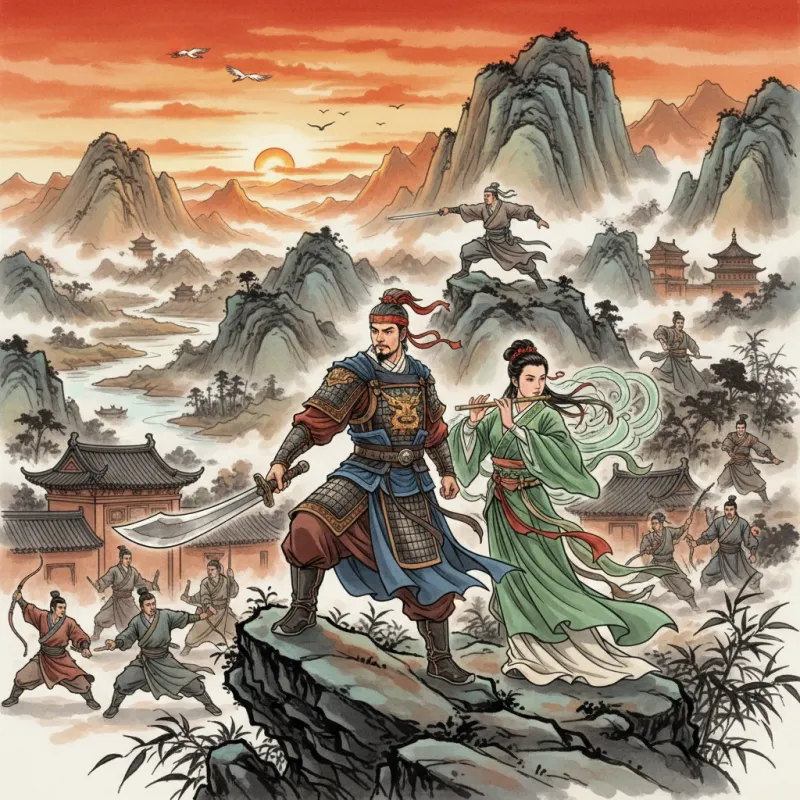
When Guo Jing stands atop the walls of Xiangyang, refusing to abandon the city even as Mongol armies mass below, he embodies something that transcends fiction—a moral clarity so absolute it feels almost alien in our compromised age. Yet Jin Yong (金庸, Jīn Yōng), the pen name of Louis Cha, never lets us forget that even his most righteous heroes are deeply, sometimes painfully, human. This tension between the ideal and the real is what makes his wuxia (武侠, wǔxiá) characters endure decades after their creation, speaking to readers across cultures who've never held a sword or practiced qinggong (轻功, qīnggōng—lightness skill).
The Architecture of Complexity
Jin Yong's genius lies in constructing characters who refuse simple categorization. Take Yang Guo from The Return of the Condor Heroes (神雕侠侣, Shéndiāo Xiálǚ)—orphaned, resentful, brilliant, and utterly devoted to his teacher-turned-lover Xiaolongnü. He's simultaneously the romantic hero and the troubled outsider, someone whose greatest strength (his unwavering love) is also his most dangerous vulnerability. Compare this to earlier wuxia heroes who were essentially virtuous warriors with swords. Jin Yong gives us people who make catastrophic mistakes, nurse grudges for decades, and sometimes choose personal loyalty over abstract justice.
This complexity extends to his antagonists. Ouyang Feng, the Western Venom, isn't evil for evil's sake—he's driven by pride, ambition, and a twisted love for his sister-in-law that warps his entire existence. Even Qiu Qianren, initially presented as irredeemably cruel in The Legend of the Condor Heroes (射雕英雄传, Shèdiāo Yīngxióng Zhuàn), receives a redemption arc that feels earned rather than convenient. Jin Yong understood that people contain multitudes, and his jianghu (江湖, jiānghú—the martial arts world) reflects this psychological realism.
Martial Arts as Character Expression
The martial arts systems in Jin Yong's novels aren't just fight choreography—they're extensions of personality and philosophy. The Eighteen Dragon-Subduing Palms (降龙十八掌, Jiànglóng Shíbā Zhǎng) that Guo Jing masters are straightforward, powerful, and honest, perfectly matching his character. Meanwhile, Huang Rong's techniques are clever, adaptable, and sometimes deceptive, reflecting her quick wit and strategic mind. This isn't accidental. Jin Yong spent considerable effort ensuring that fighting styles revealed inner truth.
Consider the contrast between the Shaolin Temple's external martial arts and the Wudang School's internal cultivation. Shaolin emphasizes discipline, repetition, and physical conditioning—values aligned with Buddhist monasticism. Wudang's taijiquan (太极拳, tàijíquán) and internal energy work reflect Daoist principles of yielding, flowing, and achieving strength through softness. When Zhang Wuji learns the Nine Yang Divine Skill (九阳神功, Jiǔyáng Shéngōng) in The Heaven Sword and Dragon Saber (倚天屠龙记, Yǐtiān Túlóng Jì), it's not just a power-up—it's a philosophical education in balance and restraint.
The most fascinating martial arts in Jin Yong's universe often come with terrible costs. The Sunflower Manual (葵花宝典, Kuíhuā Bǎodiǎn) requires self-castration, transforming practitioners like Dongfang Bubai into something beyond conventional gender and humanity. The Beiming Divine Art (北冥神功, Běimíng Shéngōng) absorbs others' internal energy, raising questions about whether power gained through theft can ever be righteous. These aren't just plot devices—they're moral thought experiments about the price of strength.
Women Who Refuse the Sidelines
Jin Yong's female characters deserve particular attention because they shatter the damsel-in-distress archetype that plagued earlier wuxia fiction. Huang Rong isn't just Guo Jing's love interest—she's often smarter than everyone else in the room, a master strategist who solves problems her more martially-gifted husband cannot. Zhao Min from The Heaven Sword and Dragon Saber pursues what she wants with a directness that would be considered masculine, yet never loses her femininity or becomes a mere gender-swapped male character.
Then there's Ren Yingying, who leads the Sun Moon Holy Cult with quiet competence while her father is imprisoned, or Mu Nianci, whose archery skills and moral integrity make her memorable despite limited page time. Even characters like Li Mochou, the Scarlet Serpent Fairy, are given tragic backstories that explain (though don't excuse) their villainy. Jin Yong wrote women as full participants in the jianghu, capable of both extraordinary martial prowess and complex emotional lives. For novels written between 1955 and 1972, this was quietly revolutionary.
The Weight of History
Unlike pure fantasy, Jin Yong's novels are deeply embedded in Chinese history. The Deer and the Cauldron (鹿鼎记, Lùdǐng Jì) unfolds during the early Qing Dynasty, with protagonist Wei Xiaobao interacting with the actual Kangxi Emperor. Demi-Gods and Semi-Devils (天龙八部, Tiānlóng Bābù) takes place during the Song Dynasty, incorporating real tensions between Han Chinese and various northern peoples. This historical grounding gives the stories weight—these aren't just adventure tales but meditations on Chinese identity, resistance, and cultural survival.
The Mongol invasion that forms the backdrop of The Legend of the Condor Heroes isn't just scenery. It raises genuine questions about loyalty, collaboration, and resistance that would have resonated powerfully with readers who lived through Japanese occupation and civil war. When Guo Jing chooses to defend Xiangyang knowing it's ultimately doomed, he's making a statement about the value of principled resistance even in the face of inevitable defeat. These themes gave Jin Yong's work a political dimension that transcended entertainment.
Philosophy Disguised as Action
Beneath the sword fights and romantic entanglements, Jin Yong's novels are deeply philosophical. Buddhist concepts of karma, attachment, and suffering permeate Demi-Gods and Semi-Devils, where nearly every major character is trapped by their desires and delusions. Duan Yu's Buddhist learning doesn't prevent him from falling hopelessly in love multiple times. Xiao Feng's tragedy stems from the collision between his personal identity and ethnic heritage—a meditation on the constructed nature of belonging.
Daoist ideas appear throughout, particularly the concept of wuwei (无为, wúwéi)—effortless action. The most powerful martial artists in Jin Yong's universe often achieve mastery by letting go of rigid technique and flowing naturally. Linghu Chong's Dugu Nine Swords (独孤九剑, Dúgū Jiǔjiàn) has no fixed forms, adapting spontaneously to any opponent. This isn't just cool fight choreography—it's applied Daoist philosophy about responding to circumstances rather than imposing predetermined patterns.
Confucian values of loyalty, filial piety, and righteousness create constant moral dilemmas. Characters must choose between personal desires and social obligations, between individual conscience and collective duty. These aren't abstract debates—they're lived through characters we've grown to care about, making the philosophy visceral rather than academic. Jin Yong understood that the best way to explore ideas is through people struggling with their implications.
Legacy Beyond Literature
Jin Yong's characters have transcended their original medium to become cultural touchstones. Multiple television and film adaptations have introduced them to audiences who've never read the novels. Video games let players embody these heroes, learning their martial arts and making their choices. The characters have become a shared language—calling someone a "Guo Jing" immediately conveys earnest righteousness, while "Yang Guo" suggests romantic intensity and individualism.
This cultural penetration extends beyond Chinese-speaking communities. Translations have brought Jin Yong to English readers, though something inevitably gets lost in the journey from Chinese to English, from cultural context to cultural context. Yet the core appeal remains: these are characters who feel real, who struggle with recognizable human problems despite their superhuman abilities. They remind us that heroism isn't about perfection but about choosing to act rightly despite our flaws and limitations.
The martial arts themselves have influenced how people think about Chinese martial culture, even if Jin Yong's versions are highly romanticized. The idea of internal energy cultivation, of martial arts as spiritual practice rather than mere fighting technique, has shaped popular understanding of kung fu worldwide. Whether this is historically accurate matters less than its cultural impact—Jin Yong created a vision of martial arts that people wanted to believe in.
Why They Still Matter
Sixty years after Jin Yong began writing, his characters endure because they address timeless questions through culturally specific stories. How do we balance personal desire against social responsibility? What does it mean to be loyal when loyalties conflict? Can love survive impossible circumstances? Is revenge ever justified? These aren't uniquely Chinese questions, even if Jin Yong explores them through distinctly Chinese cultural frameworks.
His characters also offer something increasingly rare: moral seriousness without moralism. They struggle with right and wrong, make mistakes, suffer consequences, and sometimes find redemption. They're allowed to be complicated without becoming cynical, to be heroic without being perfect. In an age of antiheroes and moral relativism, there's something refreshing about characters who genuinely try to do good, even when they fail.
The martial arts provide the spectacle, the historical settings provide the weight, but the characters provide the heart. That's why readers return to these novels, why new adaptations keep appearing, why Jin Yong's influence on modern Chinese culture remains profound. Guo Jing, Yang Guo, Zhang Wuji, Linghu Chong, Wei Xiaobao—these aren't just names in books. They're companions who've walked with readers through their own struggles, offering not answers but the comfort of shared humanity. In the end, that's what makes them immortal.
Related Reading
- The Top 10 Villains in Jin Yong's Novels
- Xiao Longnü: The Maiden Beyond the World
- Huang Rong: The Smartest Person in Jin Yong's Universe
- Jin Yong's Greatest Characters: The Heroes, Villains, and Everyone in Between
- Unraveling the Heroes and Antiheroes of Jin Yong's Wuxia Novels
- Jin Yong's Influence on Asian Pop Culture
- The Humor of Jin Yong: Comedy in the Martial World
- The Allure of Jin Yong's Wuxia: Exploring Martial Arts, Characters, and Legendary Storylines