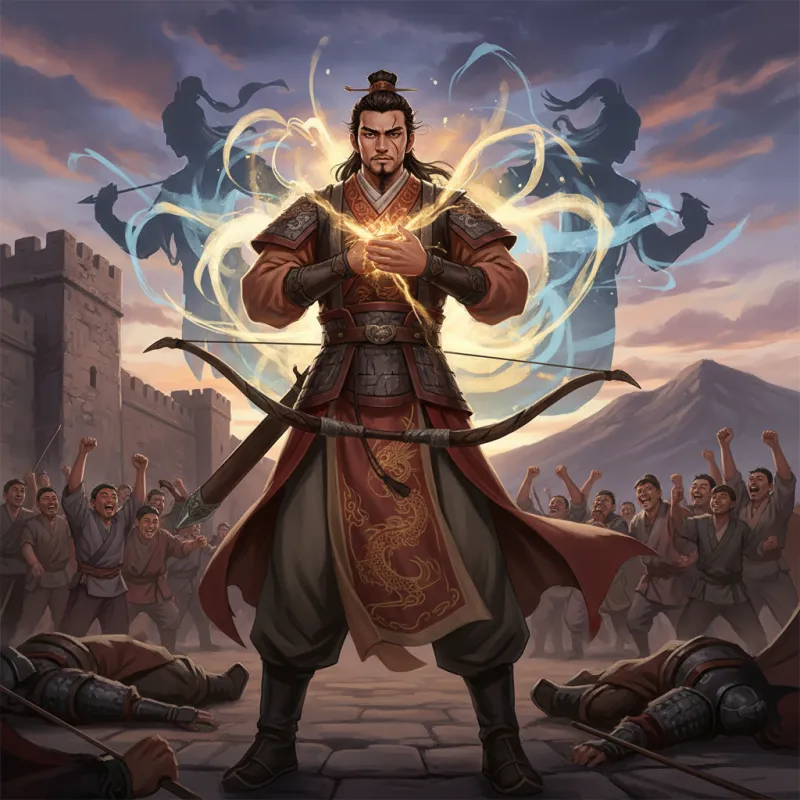
Picture this: A teenage boy stands before his six martial arts masters, attempting the same basic sword form for the hundredth time. He fumbles. Again. His teachers exchange weary glances. One mutters under his breath. This boy, Guo Jing (郭靖 Guō Jìng), is supposed to be their great hope, their answer to the arrogant Yang Kang who studies under the Quanzhen masters. But watching him struggle with moves that other students master in days, they can't help but wonder: have they bet on the wrong horse?
Jin Yong's (金庸 Jīn Yōng) choice of Guo Jing as the protagonist of The Legend of the Condor Heroes (射雕英雄传 Shèdiāo Yīngxióng Zhuàn) was, by all conventional storytelling logic, insane. In a genre built on prodigies and natural talents, he gave us someone who needed to be told the same thing ten times and still wouldn't get it. And yet, by the novel's end, Guo Jing stands as perhaps the most beloved hero in all of wuxia literature. This wasn't an accident. It was Jin Yong's most subversive statement about what actually makes a hero.
The Boy Who Couldn't Learn
Let's be brutally honest about Guo Jing's abilities: he's thick as a brick. The Seven Freaks of Jiangnan (江南七怪 Jiāngnán Qī Guài) take him on as a student when he's a child, pouring years of instruction into him. These aren't mediocre teachers — they're respected martial artists with decades of experience. And what do they get for their efforts? A student who can barely remember a simple sequence of moves.
Compare this to Yang Kang (杨康 Yáng Kāng), Guo Jing's sworn brother and narrative foil. Yang Kang learns effortlessly, impresses everyone he meets, and masters techniques that leave others gasping in admiration. He's everything a martial arts protagonist should be: quick-witted, naturally talented, charismatic. He's also, as we discover, a coward, a traitor, and ultimately a villain. Jin Yong isn't subtle about the comparison he's drawing.
The early chapters of Condor Heroes are almost painful to read if you're rooting for Guo Jing. He fails, repeatedly and publicly. His mother, Li Ping (李萍 Lǐ Píng), watches with quiet heartbreak as her son struggles. His masters begin to doubt. Even Huang Rong (黄蓉 Huáng Róng), when she first meets him, thinks he's an idiot — and she's not wrong, exactly. He is slow. He does miss obvious things. He will never be clever.
The Turning Point: When Stupidity Becomes Strength
But here's where Jin Yong's genius reveals itself. Guo Jing's lack of natural talent forces him to develop something far more valuable: an unshakeable work ethic and absolute sincerity. Because he can't learn quickly, he learns thoroughly. Because he can't rely on intuition, he practices until techniques become muscle memory. Because he can't improvise, he masters the fundamentals so completely that he doesn't need to.
When Hong Qigong (洪七公 Hóng Qīgōng), the leader of the Beggars' Sect, takes Guo Jing as a student, something shifts. Hong Qigong sees what the Seven Freaks couldn't quite articulate: Guo Jing's simplicity isn't just a limitation, it's a form of purity. He teaches Guo Jing the Eighteen Dragon-Subduing Palms (降龙十八掌 Jiàng Lóng Shíbā Zhǎng), a technique that requires immense internal power and straightforward execution — perfect for someone who can't do fancy tricks but can hit really, really hard.
The transformation isn't dramatic or sudden. Guo Jing doesn't suddenly become smart. He remains the same earnest, literal-minded person he's always been. But that earnestness, combined with years of grinding practice, produces something remarkable: mastery without ego. While talented fighters like Ouyang Feng twist themselves into knots trying to prove their superiority, Guo Jing simply does what needs to be done.
The Moral Dimension: Why Stupidity Equals Integrity
Jin Yong makes an argument through Guo Jing that would have resonated deeply with traditional Chinese values while simultaneously subverting them. Confucian thought prizes learning and self-cultivation, but it also emphasizes virtue over cleverness. The Analects are full of warnings about people who are too clever for their own good. Guo Jing embodies this perfectly: he's not smart enough to rationalize bad behavior.
Watch how Guo Jing responds to moral dilemmas throughout the novel. When he discovers that his sworn brother Yang Kang has betrayed the Song dynasty, he doesn't engage in complex political reasoning. He doesn't weigh competing loyalties or calculate advantages. He simply knows: betraying your country is wrong. This simplicity looks like stupidity to sophisticated observers, but it's actually moral clarity.
Yang Kang, by contrast, is always calculating. He's been raised as a prince in the Jin court, and when he learns his true heritage, he faces a genuine dilemma: should he abandon the only family he's known? His intelligence allows him to construct elaborate justifications for staying with the Jin. He can see multiple perspectives, understand competing claims, rationalize his choices. And every bit of that intelligence leads him further into moral compromise.
The novel suggests something radical: maybe being too smart is actually a handicap when it comes to being good. Guo Jing can't talk himself into betrayal because he's not clever enough to make betrayal sound reasonable. His stupidity is a form of protection against the corrupting influence of his own self-interest.
The Romantic Dimension: Earning Huang Rong
Guo Jing's relationship with Huang Rong (黄蓉 Huáng Róng) is one of the great romances in Chinese literature, and it works precisely because of the mismatch between them. Huang Rong is the daughter of Huang Yaoshi (黄药师 Huáng Yàoshī), one of the Five Greats, and she's inherited her father's brilliance. She's clever, manipulative when she needs to be, and capable of running circles around almost anyone intellectually.
She should, by all logic, end up with someone like Yang Kang — someone who can match her wit, appreciate her schemes, keep up with her verbal sparring. Instead, she falls completely in love with the dumbest boy in the jianghu. Why? Because Guo Jing offers something that clever people rarely find: absolute sincerity. He cannot lie to her, not because he's morally opposed to lying (though he is), but because he's not smart enough to maintain a deception. What you see is what you get.
For someone like Huang Rong, who's spent her life surrounded by people trying to manipulate her or use her father's reputation, Guo Jing's transparency is intoxicating. She can relax around him. She doesn't have to calculate or defend herself. His stupidity creates a space of safety that her brilliance never could. And crucially, he treats her well not because he's figured out that's the smart play, but because it genuinely doesn't occur to him to do otherwise.
Their relationship also inverts the typical dynamic in wuxia romances. Usually, the male hero is the capable one who rescues the female character. Huang Rong saves Guo Jing constantly — from social embarrassment, from political intrigue, from his own inability to read situations. But she never resents it. If anything, his need for her makes her feel valued in a way that mere admiration never could. He doesn't love her despite needing her help; his need for her is part of why the relationship works.
The Military Genius: Stupidity in Strategy
By The Return of the Condor Heroes (神雕侠侣 Shén Diāo Xiá Lǚ) and especially in the later parts of the Condor trilogy, Guo Jing has become the defender of Xiangyang (襄阳 Xiāngyáng), holding the city against Mongol invasion for decades. This is where Jin Yong's argument about Guo Jing reaches its culmination: the dumb boy has become a brilliant military commander.
How? The same way he became a martial arts master: through absolute thoroughness and moral clarity. Guo Jing doesn't try to be clever in his defense of Xiangyang. He doesn't look for brilliant tactical innovations or try to outsmart the Mongol generals. He simply does everything that needs to be done, completely and without shortcuts. He trains the troops. He maintains the walls. He ensures supplies. He keeps morale high. It's boring, unglamorous work, and it requires someone who won't get distracted by the desire to be seen as brilliant.
Moreover, his moral authority — earned through decades of consistent, selfless behavior — means that people actually follow him. Clever commanders can inspire through charisma or intimidate through fear, but Guo Jing leads through example. Soldiers defend Xiangyang not because they've been manipulated into it, but because they genuinely believe in what Guo Jing represents. You can't fake that kind of leadership, and you can't achieve it through intelligence alone.
The historical resonance here is deliberate. Jin Yong was writing in the 1950s and 60s, and the fall of Xiangyang to the Mongols in 1273 CE was a pivotal moment in Chinese history, leading eventually to the collapse of the Song dynasty. By making his "stupid" hero the defender of Chinese civilization against foreign invasion, Jin Yong was making a statement about what actually preserves a culture: not brilliance or sophistication, but fundamental decency and unwavering commitment.
The Legacy: Why We Need Guo Jing
Jin Yong wrote fourteen novels over his career, creating dozens of memorable protagonists. Some, like Linghu Chong, are more charismatic. Others, like Wei Xiaobao from The Deer and the Cauldron, are more complex and psychologically interesting. But Guo Jing remains the moral center of Jin Yong's universe, the character who most clearly embodies what the author believed a hero should be.
In a literary tradition that often celebrated cleverness and individual achievement, Guo Jing stands as a rebuke. He suggests that maybe the qualities we prize most highly — intelligence, talent, quick wit — aren't actually the most important ones. Maybe what matters more is persistence, sincerity, and an unshakeable moral compass. Maybe being too smart makes it too easy to rationalize away your principles.
This isn't anti-intellectualism. Jin Yong himself was one of the most educated and sophisticated writers of his generation. But through Guo Jing, he's arguing for a hierarchy of values where character trumps capability. It's a deeply Confucian idea, but Jin Yong presents it through a character who probably couldn't explain Confucian philosophy if you asked him to.
The genius of Guo Jing as a character is that he makes this argument without ever articulating it. He's not self-aware enough to understand what he represents. He just keeps showing up, doing his best, treating people decently, and somehow that's enough. More than enough, actually. By the end of his story, this boy who couldn't learn a simple sword form has become the greatest hero of his age.
The Uncomfortable Truth
Here's what makes Guo Jing's story both inspiring and slightly uncomfortable: it suggests that most of us are making excuses. We tell ourselves we could be better if only we were smarter, more talented, more naturally gifted. Guo Jing strips away that excuse. He proves that you don't need to be brilliant to be good, or even to be great. You just need to keep trying, stay honest, and refuse to compromise your principles.
That's a harder path than being naturally talented. Yang Kang's tragedy isn't that he lacked ability — it's that his ability made the wrong choices too easy. He could always talk his way out of consequences, rationalize his decisions, find clever solutions that avoided hard truths. Guo Jing never had that option. Every achievement in his life came through sheer, grinding effort.
Jin Yong asks us: which would you rather be? The brilliant person who compromises, or the simple person who doesn't? It's not actually a comfortable question, because most of us would like to think we can be both brilliant and good. Guo Jing suggests that's harder than it looks, and that if you have to choose, you should choose good.
In the end, that's why Guo Jing endures as a character. Not because he's relatable — most of us are neither as stupid nor as good as he is. But because he represents something we recognize as true: that heroism isn't about being exceptional, it's about being decent, consistently, even when it's hard. Especially when it's hard. The dumbest genius in Chinese literature turns out to be the smartest choice Jin Yong ever made.
Related Reading
- The Top 10 Villains in Jin Yong's Novels
- Qiao Feng / Xiao Feng: The Tragic Hero Who Defined Wuxia
- Xiao Longnü: The Maiden Beyond the World
- Huang Rong: The Smartest Person in Jin Yong's Universe
- Ren Yingying: Love and Freedom
- The Art of Duels in Jin Yong's Wuxia Novels: A Journey Through Martial Valor
- Best and Worst Jin Yong Adaptations: A Definitive Guide
- Exploring the Intricate Sects within Jin Yong's Iconic Wuxia Novels