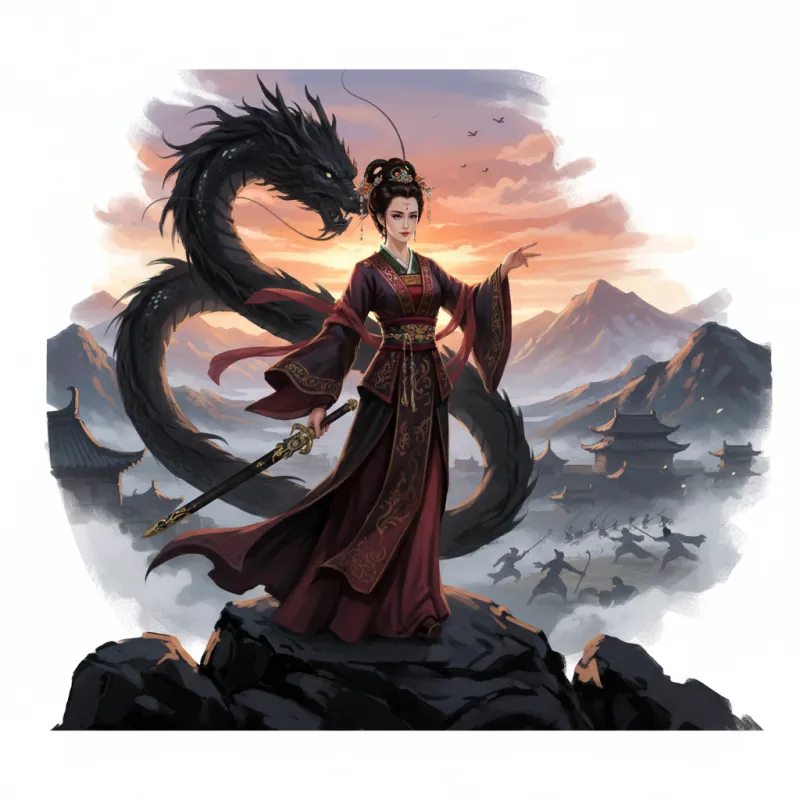
When Ren Yingying first appears in The Smiling, Proud Wanderer (笑傲江湖, Xiào'ào Jiānghú), she's disguised as an elderly woman playing the qin—a calculated performance that reveals everything about her character. She's the daughter of Ren Woxing (任我行, Rèn Wǒxíng), leader of the Sun Moon Holy Cult (日月神教, Rìyuè Shénjiào), yet she chooses to hide her identity, manipulate perceptions, and operate in shadows. This isn't weakness. It's strategy. And it's precisely this tension—between her inherited power and her chosen path—that makes her one of Jin Yong's most compelling explorations of what it means to be free while being in love.
The Paradox of Power and Submission
Ren Yingying commands the resources of an entire cult. She has martial artists at her disposal, intelligence networks spanning the jianghu (江湖, jiānghú—the martial arts world), and the political acumen to orchestrate prison breaks and manipulate sect politics. Yet when she falls for Linghu Chong (令狐冲, Línghú Chōng), she repeatedly positions herself as subordinate, even servile. She nurses him through illness, endures his drunken ramblings about his shifu's daughter, and never once leverages her actual authority to force his hand.
This isn't the behavior of a weak woman. It's the choice of someone who understands that love cannot be commanded—a lesson her father, with his domineering Xīxīng Dàfǎ (吸星大法, Star Absorbing Great Technique), never learned. Where Ren Woxing absorbs others' power by force, Yingying gains influence through genuine connection. She's internalized a truth that eludes most of Jin Yong's power-hungry characters: real freedom means choosing your constraints.
Freedom Through Disguise
Yingying's various disguises throughout the novel aren't just plot devices—they're philosophical statements. As the elderly qin player, as "Ren Yingying the Holy Maiden," as the dutiful daughter, she demonstrates that identity itself is performance. This connects her to broader Daoist themes in Jin Yong's work, where the most powerful characters often achieve strength through yielding, like water flowing around obstacles.
Compare her approach to Huang Rong's tactical brilliance in The Legend of the Condor Heroes. Both women use intelligence over brute force, but Huang Rong's cleverness serves her survival and ambition. Yingying's disguises serve a different purpose: they create space for others to reveal themselves. When she hides her identity from Linghu Chong, she's not testing him—she's giving him room to be authentic, to show who he is when he thinks no one important is watching.
The Music of Unspoken Understanding
The qin becomes Yingying's primary language of freedom. In a world where martial arts techniques are named, catalogued, and fought over—where even love often becomes transactional—music exists outside the power structures of the jianghu. When she plays Xiào'ào Jiānghú (笑傲江湖, "Smiling, Proud Wanderer") with Linghu Chong, they create something that cannot be absorbed, stolen, or dominated. It simply exists between them.
This musical connection represents the novel's ideal: two people who are complete individuals choosing to harmonize without losing their distinct voices. Linghu Chong plays the xiao (箫, xiāo—vertical bamboo flute), Yingying the qin. Different instruments, different timbres, but when played together, they create something neither could achieve alone. Jin Yong, writing in 1967 during the Cultural Revolution's early years, embedded a subtle political message here about the value of individual expression within collective harmony.
Love Without Possession
What distinguishes Yingying from many other female leads in wuxia fiction is her refusal to possess Linghu Chong even when she has the power to do so. She knows about his feelings for Yue Lingshan (岳灵珊, Yuè Língshān). She watches him drink himself into oblivion over another woman. She has the resources to eliminate rivals, manipulate circumstances, or use her father's authority to arrange a marriage.
She does none of these things.
This restraint isn't passivity—it's the highest form of respect for another person's autonomy. She understands what her father never could: that forcing someone to stay with you means you're always alone. True companionship requires the other person to choose you freely, every day, knowing they could walk away. This philosophy aligns her more closely with the unorthodox (邪教, xiéjiào) sects' emphasis on individual will than with the orthodox (正派, zhèngpài) sects' rigid hierarchies—ironic, given that the orthodox sects view her cult as evil.
The Daughter's Rebellion
Yingying's relationship with her father reveals another dimension of her character. Ren Woxing is one of Jin Yong's most domineering patriarchs, a man who literally absorbs others' life force to increase his own power. He expects absolute obedience and sees people as tools for his ambitions. Yingying loves him but refuses to become an extension of his will.
When she chooses Linghu Chong—a man her father initially respects but later sees as insufficiently ambitious—she's asserting that her life belongs to her, not to family legacy or political calculation. This mirrors the broader generational conflicts in Jin Yong's novels, where children must decide whether to inherit their parents' grudges and ambitions or forge their own paths. Guo Jing chose to honor his parents' legacy; Yingying chooses to transcend hers.
Freedom as Acceptance
The novel's conclusion sees Yingying and Linghu Chong withdrawing from the jianghu entirely, living in seclusion where they can play music and live simply. Some readers interpret this as defeat—a retreat from the world's complexities. But Jin Yong suggests something more nuanced: that true freedom isn't the absence of constraints but the ability to choose which constraints you'll accept.
Yingying chooses love, music, and simplicity over power, status, and political influence. She's free precisely because she's made this choice consciously, with full knowledge of what she's giving up. This distinguishes her from characters like Dongfang Bubai (东方不败, Dōngfāng Bùbài), who becomes trapped by the very power he sought, or Yue Buqun (岳不群, Yuè Bùqún), who sacrifices everything for ambition and ends up with nothing.
The Legacy of Ren Yingying
Ren Yingying represents Jin Yong's mature understanding of female agency in wuxia fiction. She's not defined by martial prowess like Huang Rong, nor by tragic sacrifice like Xiao Longnu. Instead, she embodies a quieter but more radical form of power: the ability to define success on her own terms, to love without losing herself, and to find freedom not through rebellion against all constraints but through conscious choice of which bonds to honor.
In a genre often criticized for relegating women to supporting roles, Yingying stands as proof that Jin Yong evolved. She's not waiting to be rescued, not serving as a prize for the hero's journey, not sacrificing herself for a man's growth. She's a fully realized person whose choices drive the narrative as much as Linghu Chong's do. Her freedom and her love aren't in conflict—they're two expressions of the same fundamental truth: that a life worth living is one you've chosen for yourself, consequences and all.
Related Reading
- The Top 10 Villains in Jin Yong's Novels
- Zhang Wuji: The Reluctant Leader
- Huang Rong: The Smartest Person in Jin Yong's Universe
- Jin Yong's Greatest Characters: The Ones You Never Forget
- Xiao Longnü: The Maiden Beyond the World
- Exploring the Enigmatic Worlds of Jin Yong's Wuxia Novels
- Jin Yong's Music: The Soundtracks That Made a Nation Cry
- How the Condor Trilogy Connects: Characters, Weapons, and Secrets Across 155 Years