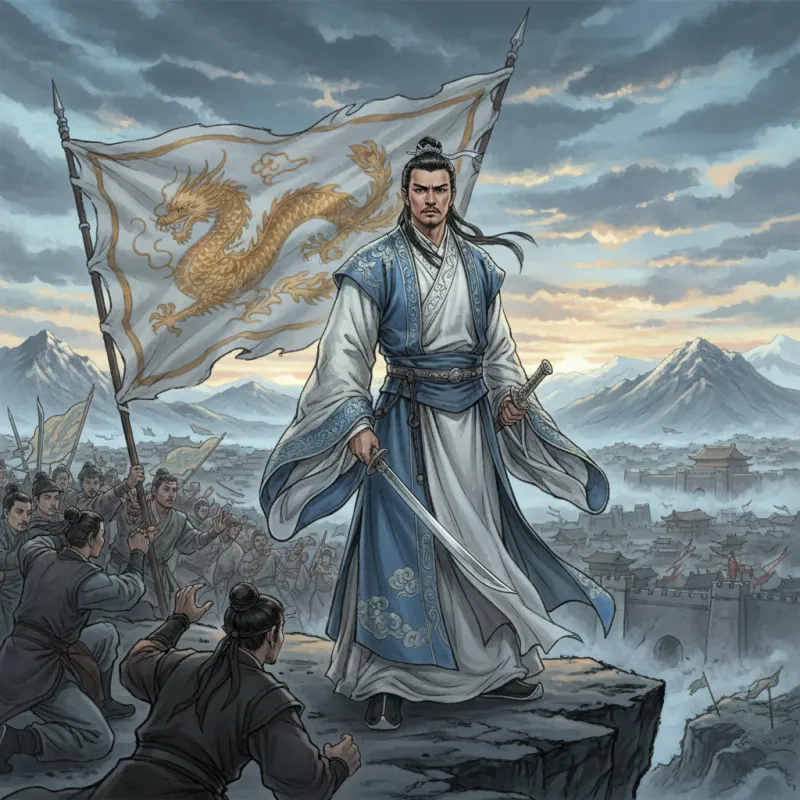
When Zhang Wuji finally becomes the leader of the Ming Cult, he does so not with triumphant fanfare but with tears streaming down his face, begging the assembled heroes to choose someone—anyone—else. This moment, near the midpoint of Jin Yong's The Heaven Sword and Dragon Saber (倚天屠龍記, Yitian Tulong Ji, 1961), captures everything essential about one of wuxia literature's most psychologically complex protagonists. Unlike the confident Yang Guo or the duty-bound Guo Jing, Zhang Wuji spends the entire novel trying to escape the very destiny that readers know he must fulfill.
The Weight of Inherited Trauma
Zhang Wuji's reluctance isn't mere personality quirk—it's the logical outcome of a childhood steeped in tragedy. By age ten, he's watched his father commit suicide, seen his mother take her own life, and been poisoned with the Xuanming Divine Palm's cold energy that slowly kills him from within. His parents' deaths stem directly from the martial world's (江湖, jianghu) brutal politics: his father Zhang Cuishan's association with the "evil" Heavenly Eagle Cult and his possession of the Dragon Saber's secret made him a target for every righteous sect in the land.
This trauma creates a young man who fundamentally distrusts authority and organized power. When the Ming Cult's (明教, Ming Jiao) various factions squabble and scheme, Wuji sees echoes of the "righteous" sects that hounded his parents to death. The novel makes clear that there's little moral difference between the so-called orthodox schools and the demonic cults—both sacrifice individuals for organizational power. Wuji's reluctance to lead stems from his intimate knowledge that leadership in the martial world means sending people to their deaths.
The Accidental Hero's Rise
What makes Zhang Wuji's ascension fascinating is how thoroughly accidental it is. He doesn't seek the Ming Cult leadership—he literally stumbles into their sacred chamber while trying to save his sworn brother Xie Xun. He doesn't master the Nine Yang Divine Skill (九陽神功, Jiuyang Shengong) through dedicated training but by accidentally reading a manual hidden in a white ape's belly while trapped in a valley. Even his mastery of the Heaven and Earth Great Shift (乾坤大挪移, Qiankun Da Nuoyi), the Ming Cult's supreme martial art, happens because he's bored and injured, not because he's pursuing power.
This pattern repeats throughout the novel. Wuji acquires legendary martial arts, beautiful women fall in love with him, and powerful allies pledge loyalty—all while he's actively trying to avoid these entanglements. Jin Yong uses this irony deliberately: the more Wuji resists his destiny, the more inexorably he's drawn into it. It's a sharp contrast to earlier Jin Yong heroes like Guo Jing, who actively pursue martial excellence and moral duty.
The Burden of Competing Loyalties
Zhang Wuji's leadership crisis deepens because he genuinely cares about everyone—often to his detriment. He loves four women simultaneously (Zhou Zhiruo, Zhao Min, Yin Li, and Xiao Zhao), cannot bring himself to choose between them, and suffers agonies of guilt over the pain his indecision causes. He's loyal to his sworn brother Xie Xun, to his Ming Cult subordinates, to the greater cause of resisting Mongol rule, and to his personal desire for a quiet life—and these loyalties constantly conflict.
This paralysis makes him a terrible leader by conventional standards. He refuses to execute traitors, hesitates at crucial moments, and frequently abandons his position to chase personal concerns. When Zhou Zhiruo steals the Dragon Saber and disappears, Wuji abandons the Ming Cult entirely to search for her, leaving his followers leaderless at a critical juncture. His subordinates follow him despite his flaws, not because of his leadership qualities.
Yet Jin Yong suggests this "weakness" is actually Wuji's greatest strength. In a martial world built on rigid hierarchies and ruthless pragmatism, Wuji's compassion and indecision become revolutionary acts. He refuses to sacrifice individuals for abstract causes, won't execute people for political expediency, and treats enemies as human beings worthy of mercy. His leadership style—reluctant, compassionate, and deeply personal—ultimately proves more effective than the iron-fisted approaches of his predecessors.
The Philosophy of Reluctant Power
The novel's Chinese title, Yitian Tulong Ji, references two legendary weapons: the Heaven Relying Sword (倚天劍) and the Dragon Slaying Saber (屠龍刀). These weapons symbolize supreme power in the martial world, and everyone assumes that whoever possesses them will rule. The novel's central revelation—that the weapons contain military manuals and not magical powers—mirrors Zhang Wuji's character arc. True power doesn't come from weapons or positions but from the wisdom to use them reluctantly.
This philosophy reflects Daoist principles that Jin Yong weaves throughout his later novels. The Dao De Jing teaches that the best leaders are those who lead so subtly that people believe they accomplished everything themselves. Wuji embodies this ideal accidentally—he doesn't want credit, doesn't seek glory, and would happily give up his position. His followers are loyal precisely because he doesn't demand their loyalty.
The contrast with other characters illuminates this point. Cheng Kun, the novel's primary antagonist, craves power and manipulates everyone around him, ultimately destroying himself. Zhou Zhiruo, corrupted by her master's dying command to lead Emei Sect, becomes cruel and calculating. Zhao Min, born to power as a Mongol princess, must learn to relinquish control to find happiness. Only Wuji, who never wanted power, wields it without being corrupted.
The Cost of Compassion
Jin Yong doesn't romanticize Wuji's reluctance—the novel makes clear that his indecision has real costs. His refusal to choose between Zhou Zhiruo and Zhao Min leads to Zhou's psychological breakdown and her murder of multiple innocents. His hesitation to deal firmly with Ming Cult traitors allows conspiracies to fester. His abandonment of leadership responsibilities at crucial moments nearly destroys the organization he's supposed to lead.
The novel's ending reinforces this ambiguity. Wuji doesn't achieve a traditional hero's triumph—he doesn't unite the martial world, doesn't become emperor, doesn't even definitively choose between his love interests until the final pages. Instead, he disappears from history, presumably living quietly with Zhao Min far from the martial world's conflicts. For a character who spent the entire novel trying to escape, this ending feels earned rather than triumphant.
Legacy of the Reluctant Leader
Zhang Wuji represents Jin Yong's mature meditation on heroism and power, written at the height of his career. Unlike earlier heroes who embodied clear virtues—Guo Jing's righteousness, Yang Guo's passion—Wuji embodies ambivalence. He's powerful but wishes he weren't, loved but can't reciprocate cleanly, destined for greatness but dreams of obscurity.
This complexity makes him enduringly relevant. In an era skeptical of strongman leadership and grand narratives, Wuji's reluctance feels modern. He's a hero for people who distrust heroes, a leader for those who question leadership itself. His story suggests that perhaps the people most suited for power are precisely those who don't want it—and that the greatest strength might be knowing when to walk away.
The martial world needs Zhang Wujis: people who lead because they must, not because they want to; who see followers as individuals rather than resources; who understand that power's greatest temptation is the belief that you deserve it. His tears at his inauguration as Ming Cult leader weren't weakness—they were the last honest response to power's burden that anyone in that world had shown in generations.
Related Reading
- Huang Rong: The Smartest Person in Jin Yong's Universe
- Jin Yong's Greatest Characters: The Ones You Never Forget
- Qiao Feng / Xiao Feng: The Tragic Hero Who Defined Wuxia
- Guo Jing: The Hero Who Proved Heart Matters More Than Talent
- The Enduring Legacy of Jin Yong’s Wuxia Characters and Martial Arts
- Exploring Legendary Weapons in Jin Yong’s Wuxia Novels: Symbolism and Martial Arts Mastery
- Exploring the Love Stories in Jin Yong's Wuxia Novels: Romance Amidst Adventure
- The Most Tragic Villains in Jin Yong's Novels