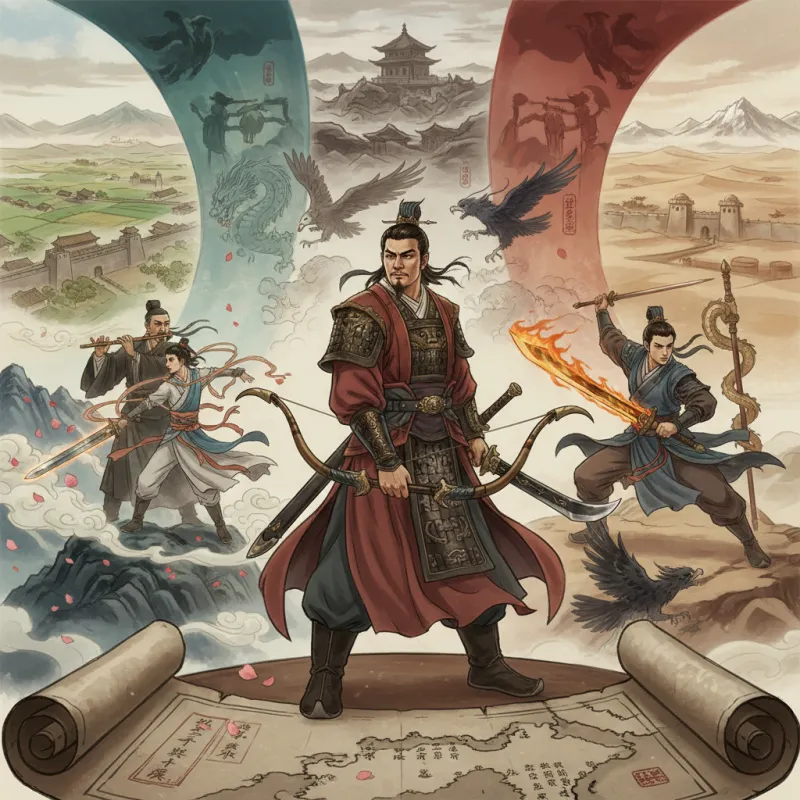
When Guo Jing and Huang Rong hide the Nine Yin Manual and the Eighteen Dragon-Subduing Palms inside the Heavenly Sword and Dragon Saber, they set in motion a treasure hunt that won't be solved for another century. This is Jin Yong at his most ambitious: three novels that function independently yet interlock like nested puzzle boxes, where a minor character's decision in 1206 ripples forward to determine the fate of martial arts sects in 1361.
The 155-Year Timeline
The Condor Trilogy (射雕三部曲, Shèdiāo Sānbùqǔ) spans from 1206 to 1361, covering the fall of the Song Dynasty, the rise and dominance of the Mongol Yuan Dynasty, and the brewing rebellion that will birth the Ming. Legend of the Condor Heroes (射雕英雄传, Shèdiāo Yīngxióng Zhuàn) runs 1206-1227. Return of the Condor Heroes (神雕侠侣, Shéndiāo Xiálǚ) picks up in 1239 and concludes in 1260. Then comes a 90-year gap before Heaven Sword and Dragon Saber (倚天屠龙记, Yǐtiān Túlóng Jì) opens in 1337 and closes in 1361.
That gap is crucial. Jin Yong deliberately lets the heroes of the first two novels pass into legend, so that by the third book, characters argue about whether Guo Jing was real or mythical. Zhang Wuji grows up hearing bedtime stories about the Divine Eagle and Yang Guo, never imagining he'll one day wield weapons that contain their parents' martial arts secrets.
Bloodlines and Broken Families
The most obvious connection is genealogical. Yang Guo, protagonist of the second novel, is the son of Yang Kang, the tragic antagonist of the first. This reversal is quintessential Jin Yong: the traitor's son becomes the greatest hero of his generation, while the hero Guo Jing's daughter Guo Fu becomes the trilogy's most frustrating character, the woman who severs Yang Guo's arm in a moment of jealous rage.
But the bloodlines get murkier in the third novel. Zhang Wuji has no direct connection to the Guo or Yang families—his link to the previous novels runs through his parents' generation and the weapons themselves. His father Zhang Cuishan is a disciple of Zhang Sanfeng, who appears briefly in Return as a young Shaolin monk named Jue Yuan. His mother Yin Susu comes from the unorthodox Heavenly Eagle Sect, founded by Yang Guo's descendants.
This is where Jin Yong's architecture becomes elegant: he doesn't force direct lineage. Instead, he shows how martial arts sects function as alternative family structures, passing down techniques and grudges with the same intensity as blood relations.
The Weapons That Remember
The Heavenly Sword (倚天剑, Yǐtiān Jiàn) and Dragon Saber (屠龙刀, Túlóng Dāo) are the trilogy's most ingenious plot device. Forged from the Heavy Iron Sword that Yang Guo used in Return, they contain the Nine Yin Manual (九阴真经, Jiǔyīn Zhēnjīng) and the Eighteen Dragon-Subduing Palms (降龙十八掌, Xiánglóng Shíbā Zhǎng)—the two supreme martial arts that defined the first novel.
Guo Jing and Huang Rong, knowing Xiangyang will fall to the Mongols, hide these texts inside the weapons along with tactical military writings. They inscribe the weapons with the famous couplet: "Supreme in the martial world, the precious Saber slays the dragon / Command the realm, none dare disobey / Relying on Heaven, none can compete." The secret? "The Saber and Sword, when brought together, reveal the hiding place of the treasures."
For 80 years, the martial arts world tears itself apart trying to obtain these weapons, not knowing what they truly contain. When Zhang Wuji finally breaks them open, he finds not just martial arts manuals but a message from the past: Guo Jing's final instructions for defending China against foreign invasion. The weapons are a time capsule, a letter from the dead to the living.
Locations as Memory
Peach Blossom Island (桃花岛, Táohuā Dǎo), Huang Yaoshi's eccentric paradise in the first novel, becomes a place of pilgrimage by the third. The Ancient Tomb (古墓, Gǔmù) where Yang Guo and Xiaolongnü live in isolation becomes legendary—characters in Heaven Sword speak of it the way we might speak of Camelot.
But the most haunting location is Xiangyang (襄阳). In Legend, it's where Guo Jing and Huang Rong make their stand against the Mongols. In Return, it's still standing, defended by an aging Guo Jing and his family. By Heaven Sword, it has fallen, and characters mention it only as the site of a great tragedy. Jin Yong never shows us Xiangyang's fall—he lets it happen in the gap between novels, making it more devastating. We know Guo Jing and Huang Rong died there, but we never see how.
Martial Arts as Inheritance
The trilogy tracks how martial arts techniques pass through generations, mutate, and sometimes die out. The Nine Yin Manual, the MacGuffin of the first novel, becomes the foundation text that everyone has partially learned by the third. Zhou Botong's (周伯通) Mutual Hands technique (双手互搏, Shuāngshǒu Hùbó) appears in all three novels, taught from master to student across 150 years.
Zhang Sanfeng, who appears as a minor character in Return, becomes the founder of the Wudang Sect (武当派, Wǔdāng Pài) by Heaven Sword, his Taiji techniques rivaling Shaolin's supremacy. This is Jin Yong showing us how legends are born: we meet Zhang Sanfeng as an earnest young monk, then see him 90 years later as a 100-year-old grandmaster whose mere presence stops battles.
The martial arts system in Jin Yong's world isn't static—it evolves. Yang Guo creates the Dismal Ecstasy Palm (黯然销魂掌, Ànrán Xiāohún Zhǎng) from his heartbreak. Zhang Wuji synthesizes multiple styles into the Great Shift of the Universe (乾坤大挪移, Qiánkūn Dà Nuóyí). Each generation doesn't just inherit techniques; they transform them.
The Sects' Long Memory
The Five Greats (五绝, Wǔjué) of the first novel—Eastern Heretic, Western Venom, Southern Emperor, Northern Beggar, and Central Divinity—cast shadows across all three books. By Heaven Sword, they're mythical figures, but their sects remain: the Beggars' Sect (丐帮, Gàibāng) is still powerful, still using the Dog-Beating Staff technique (打狗棒法, Dǎgǒu Bàngfǎ) that Hong Qigong taught Huang Rong 150 years earlier.
The sect rivalries also persist. The conflict between Shaolin and Wudang in Heaven Sword has roots in events from Return. The Quanzhen Sect (全真教, Quánzhēn Jiào), founded by Wang Chongyang and dominant in the first two novels, has declined by the third—Jin Yong showing us how institutions rise and fall across generations.
What's remarkable is how Jin Yong makes these connections feel organic rather than forced. The sects don't exist just to provide continuity; they're institutions with their own internal politics, succession crises, and evolving philosophies. The Beggar Sect's transformation from righteous heroes to corrupt politicians mirrors China's own dynastic cycles.
The Unorthodox Lineage
Yang Guo's descendants found the Heavenly Eagle Sect (天鹰教, Tiānyīng Jiào), which becomes part of the Persian Ming Cult (明教, Míngjiào) in Heaven Sword. This is Jin Yong at his most subversive: the greatest hero of the second novel has descendants who are considered unorthodox, even demonic, by the third novel's "righteous" sects.
Yin Susu, Zhang Wuji's mother, carries Yang Guo's legacy through this unorthodox line. When she teaches her son martial arts in exile, she's passing down techniques that originated with the Divine Eagle himself. The trilogy suggests that orthodoxy and heterodoxy are just matters of perspective and time—today's hero becomes tomorrow's demon, and vice versa.
Why the Trilogy Works
Jin Yong could have written three unrelated novels. Instead, he created a structure where each book enriches the others. Reading Legend alone, you get a complete story. But reading all three, you understand that Guo Jing's heroism has consequences, that Yang Kang's betrayal births redemption, that weapons and techniques carry memory across generations.
The trilogy works because Jin Yong understands that history isn't a series of isolated events—it's a web of cause and effect, where a decision made in 1227 determines who lives and dies in 1361. The characters don't know they're part of a trilogy; they're just living their lives, making choices, forging weapons, hiding manuals. But we, the readers, see the pattern.
That's the genius of the Condor Trilogy: it makes 155 years feel like a single, coherent story while never sacrificing the independence of each novel. It's Jin Yong's answer to Tolkien's Middle-earth or Asimov's Foundation—a fully realized world where time passes, legends fade, and new heroes rise from the ashes of the old.
Related Reading
- A Timeline of Jin Yong's Martial World: From the Song Dynasty to the Qing
- Jin Yong's Writing Career: From First Novel to Final Retirement
- Jin Yong Novel Chronology: When Each Story Takes Place
- The Complete Timeline of Events Across Jin Yong's Novels
- The Five Greats Across All Generations: How the Rankings Changed
- The Enduring Legacy of Jin Yong’s Wuxia Novels: Characters, Martial Arts, and Cultural Influence
- Exploring Jin Yong's Wuxia Novels: Characters, Martial Arts, and Storylines