When Jin Yong's (金庸 Jīn Yōng) daughter asked him which of his novels happened first, he had to pause and think. After all, he'd written these fourteen stories over nearly two decades, jumping between dynasties and centuries as inspiration struck. But the question reveals something fascinating: these standalone novels, written in no particular order, actually form a secret chronology spanning more than a thousand years of Chinese history. And when you arrange them by their historical settings rather than publication dates, a haunting pattern emerges—the martial arts world grows weaker with each passing century, heroes become more conflicted, and the 江湖 (jiānghú, the martial arts underworld) slowly loses its independence to imperial power.
The Ancient Era: When Martial Arts Were Pure
The earliest story sits in a peculiar place. The Sword of the Yue Maiden (越女剑 Yuènǚ Jiàn) takes place during the Spring and Autumn period, around 500 BCE, making it the only Jin Yong work set before the common era. It's also his shortest—barely a novella—and reads more like a fable than a typical wuxia tale. The protagonist, A Qing (阿青 Ā Qīng), is a village girl who learns swordsmanship by watching apes fight with sticks. Her martial arts are instinctive, almost primal, untainted by the complex schools and rivalries that dominate later novels.
This matters because A Qing represents martial arts in their mythical infancy—before the Shaolin Temple, before the Wudang sect, before the elaborate hierarchies of the jianghu. She defeats two thousand soldiers single-handedly, a feat that would be impossible in Jin Yong's later, more "realistic" novels. By placing this story first, Jin Yong suggests that martial arts began as something pure and almost superhuman, only to be gradually diminished by politics, greed, and human weakness.
The Tang Dynasty: Martial Arts Meet History
The Book and the Sword (书剑恩仇录 Shū Jiàn Ēnchóu Lù) jumps forward more than two millennia to the Qianlong Emperor's reign in the 18th century—but we'll return to that. The true Tang Dynasty entry is Demi-Gods and Semi-Devils (天龙八部 Tiānlóng Bābù), which despite its Song Dynasty setting, contains flashbacks to the Tang era that establish crucial backstory for the martial arts world.
Actually, Jin Yong's chronology has a significant gap here. The Tang Dynasty (618-907 CE) was China's golden age, yet he wrote no novel set primarily in this period. This absence is telling. The Tang was when Buddhism fully integrated into Chinese culture, when the Shaolin Temple supposedly developed its martial arts, when the foundations of the jianghu were laid. By skipping it, Jin Yong avoids the origin story—he's more interested in decline than genesis.
The Song Dynasty: The Golden Age
The Song Dynasty (960-1279 CE) hosts three of Jin Yong's most beloved novels, and it's no coincidence. This was the jianghu's golden age, when martial arts sects operated with relative independence, when heroes could still make a difference, when the martial world had its own rules and honor codes that actually meant something.
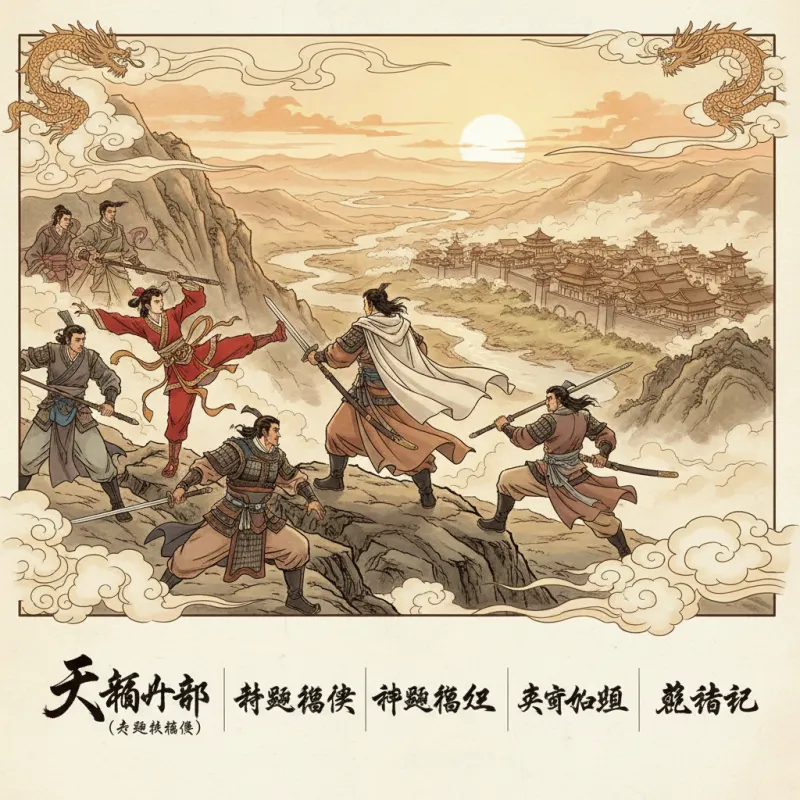
Demi-Gods and Semi-Devils (天龙八部 Tiānlóng Bābù) takes place during the Northern Song (around 1094 CE) and features perhaps the most powerful martial artists in all of Jin Yong's works. Xiao Feng (萧峰 Xiāo Fēng) can kill with his bare hands, Duan Yu (段誉 Duàn Yù) has the Six Meridians Divine Sword, and the Shaolin Temple's Sweeping Monk is essentially invincible. The martial arts here are at their peak—complex, devastating, and still somewhat magical.
The Legend of the Condor Heroes (射雕英雄传 Shèdiāo Yīngxióng Zhuàn) occurs during the Southern Song (around 1206-1227 CE), after the Jurchen Jin Dynasty conquered northern China. The martial arts are still formidable—the Five Greats (五绝 Wǔjué) are legendary figures—but there's a new element: foreign invasion. Guo Jing (郭靖 Guō Jìng) must balance his martial arts training with defending Xiangyang against the Mongols. The jianghu can no longer exist in isolation from history. You might find The Five Greats: Ranking Jin Yong's Most Powerful Masters interesting for more on this era's martial artists.
The Return of the Condor Heroes (神雕侠侣 Shéndiāo Xiálǚ) continues this story twenty years later (around 1239-1260 CE). Yang Guo (杨过 Yáng Guò) is powerful, but he's also damaged, orphaned, and morally ambiguous in ways that Guo Jing never was. The martial arts are fragmenting—the Quanzhen Sect is in decline, ancient manuals are being lost, and the Mongol threat is growing. By the novel's end, Xiangyang is doomed, and everyone knows it.
The Yuan-Ming Transition: Fragmentation and Loss
The Heaven Sword and Dragon Saber (倚天屠龙记 Yǐtiān Túlóng Jì) jumps to the late Yuan Dynasty (around 1337-1360 CE), nearly a century after the Mongols conquered China. The martial arts world is in chaos. The great sects—Shaolin, Wudang, Emei, Kunlun—are fighting each other over legendary weapons. Zhang Wuji (张无忌 Zhāng Wújì) is powerful, but his strength comes from lucky encounters with lost manuals, not from a living tradition. The jianghu has become obsessed with artifacts and secrets from the past because the present is so diminished.
Notice what's happened: in the Song Dynasty, martial artists learned from living masters. By the Yuan Dynasty, they're digging up old books and hoping to reconstruct what's been lost. This is Jin Yong's thesis in action—martial arts are dying, and each generation is weaker than the last.
The Ming Dynasty: Decline and Corruption
The Ming Dynasty (1368-1644 CE) hosts several novels, and they're notably darker than the Song stories. The Smiling, Proud Wanderer (笑傲江湖 Xiàoào Jiānghú) has no specific date, but Jin Yong confirmed it's set in the Ming. The martial arts world here is thoroughly corrupt—sects are political factions, the Songshan Sect's leader is essentially a mob boss, and the "righteous" schools are often more villainous than the "evil" ones. Linghu Chong (令狐冲 Línghú Chōng) survives by refusing to play the game, but he can't fix the system.
The Duke of Mount Deer (鹿鼎记 Lùdǐng Jì) takes place during the early Qing Dynasty (around 1670-1689 CE), but it's really about the Ming's collapse. Wei Xiaobao (韦小宝 Wéi Xiǎobǎo) can't do martial arts at all—he's a conman who succeeds through luck and cunning. The great martial artists in this novel are either dead, dying, or irrelevant. The jianghu has lost its power, and the future belongs to people like Wei Xiaobao who understand that politics and money matter more than kung fu.
This is Jin Yong's final word on the chronology: martial arts end not with a bang but with a whimper, replaced by a world where a clever nobody can outmaneuver legendary masters.
The Qing Dynasty: The End of an Era
The Qing Dynasty (1644-1912 CE) hosts Jin Yong's most historically grounded novels. The Book and the Sword (书剑恩仇录 Shū Jiàn Ēnchóu Lù), set around 1756 CE, features the Red Flower Society trying to overthrow the Manchu government. The martial arts are competent but not extraordinary—no one here could challenge the Song Dynasty masters. More importantly, the jianghu is now explicitly political, serving nationalist causes rather than its own code.
Fox Volant of the Snowy Mountain (雪山飞狐 Xuěshān Fēihú) and The Young Flying Fox (飞狐外传 Fēihú Wàizhuàn) occur around 1780 CE and focus on family vendettas and treasure hunts. The martial arts world has become small and petty, obsessed with past grievances rather than present heroism.
Sword Stained with Royal Blood (碧血剑 Bìxuè Jiàn) takes place during the Ming-Qing transition (around 1644 CE), showing the jianghu caught between dynasties and unable to affect the outcome. Yuan Chengzhi (袁承志 Yuán Chéngzhì) is skilled but ultimately powerless—he can't save the Ming, can't stop the Qing, and ends up fleeing to Southeast Asia.
The Pattern Reveals Itself
When you read Jin Yong's novels in chronological order rather than publication order, the decline becomes unmistakable. The Song Dynasty heroes are powerful and principled. The Yuan heroes are conflicted and searching for lost knowledge. The Ming heroes are cynical and corrupt. The Qing heroes are competent but historically irrelevant. And by the end, Wei Xiaobao proves that martial arts themselves have become obsolete.
This wasn't Jin Yong's original plan—he wrote these novels over twenty years, following his interests and the demands of newspaper serialization. But consciously or not, he created a coherent vision of history where martial arts serve as a metaphor for traditional Chinese culture itself: glorious in the past, fragmenting under foreign invasion, corrupted by politics, and finally made irrelevant by modernity.
The chronology also reveals Jin Yong's pessimism. Unlike Western fantasy, where magic is eternal, or Japanese manga, where heroes can always train to surpass their predecessors, Jin Yong's martial arts world is dying. Each generation loses something that can never be recovered. The Shaolin Temple's Sweeping Monk in Demi-Gods and Semi-Devils represents a level of mastery that no later character can approach. By the time we reach The Duke of Mount Deer, that world is as distant and mythical as A Qing's primal swordsmanship.
Yet there's something beautiful in this decline. Jin Yong's heroes don't need to be the strongest to be heroic. Guo Jing knows Xiangyang will fall, but he defends it anyway. Linghu Chong can't reform the jianghu, but he refuses to be corrupted by it. Yuan Chengzhi fails to save the Ming, but he saves the people he can. And Wei Xiaobao, who can't do martial arts at all, somehow embodies the survival instinct that allows Chinese culture to persist even when its traditional forms have died.
The chronology isn't just a timeline—it's Jin Yong's philosophy of history, his meditation on loss and persistence, and his answer to the question of what happens when the age of heroes ends. The answer, it turns out, is that life goes on, just less gloriously than before. For more on how Jin Yong's personal history influenced these themes, see Jin Yong's Life and Times: The Man Behind the Legends.
Related Reading
- How the Condor Trilogy Connects: Characters, Weapons, and Secrets Across 155 Years
- A Timeline of Jin Yong's Martial World: From the Song Dynasty to the Qing
- The Complete Timeline of Events Across Jin Yong's Novels
- Jin Yong's Writing Career: From First Novel to Final Retirement
- Jin Yong: The Man Behind the Martial Arts World
- The Art of Duels in Jin Yong's Wuxia Novels: A Journey Through Martial Valor
- A Map of the Jianghu: Geography in Jin Yong's Novels