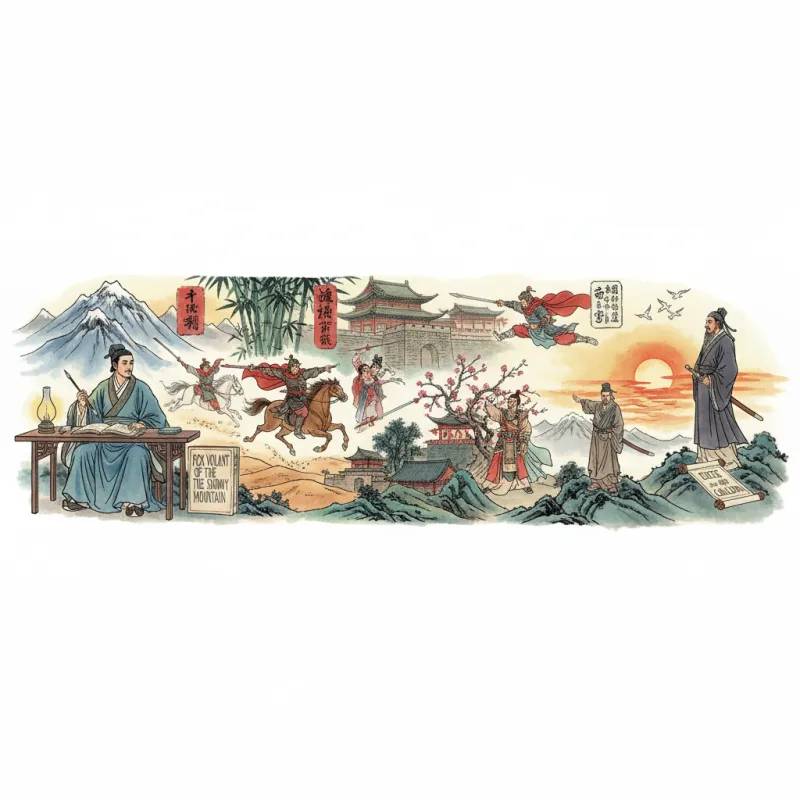
When Jin Yong put down his pen in 1972 after finishing The Deer and the Cauldron (鹿鼎記 Lùdǐng Jì), he was only 48 years old — younger than many writers when they're just hitting their stride. He had seventeen years of continuous serialization behind him, fourteen novels that had made him the most widely read Chinese author of the 20th century, and he simply... stopped. No farewell tour, no "one more book," no comeback decades later. The abruptness of his retirement is almost as remarkable as the career itself, and understanding why he quit reveals everything about what he was trying to accomplish.
The Apprentice Years: 1955-1957
Jin Yong's first novel, The Book and the Sword (書劍恩仇錄 Shūjiàn Ēnchóu Lù), began serialization in February 1955 in the New Evening Post (新晚報 Xīn Wǎnbào). He was 31, working as a newspaper editor, and had never written fiction before. The novel shows it — the plot meanders, the hero Chen Jialuo (陳家洛 Chén Jiāluò) is frustratingly passive, and the martial arts descriptions lack the kinetic energy of his later work. But it was popular enough that the paper asked for more.
What's fascinating is how quickly he improved. The Sword of the Yue Maiden (越女劍 Yuènǚ Jiàn), a short work from 1970 but set in the Spring and Autumn period, would later show his mastery of economy — but in these early years, he was learning by doing. The Swordsman (碧血劍 Bìxuè Jiàn), serialized from 1956-1957, introduced Yuan Chengzhi (袁承志 Yuán Chéngzhì), another somewhat bland hero, but the novel's real achievement was its historical backdrop — the fall of the Ming Dynasty. Jin Yong was discovering that history wasn't just decoration; it was the engine of tragedy.
The Return of the Condor Heroes (神鵰俠侶 Shéndiāo Xiálǚ), which ran from 1959-1961, marked his first major breakthrough. Yang Guo (楊過 Yáng Guò) was everything his previous heroes weren't — rebellious, emotionally complex, scarred both physically and psychologically. The forbidden romance with his teacher Xiaolongnü (小龍女 Xiǎolóngnǚ) scandalized readers. Jin Yong had learned that conflict — internal and external — was what made characters live.
The Golden Period: 1959-1963
Between 1959 and 1963, Jin Yong wrote what many consider his three greatest novels in rapid succession. This wasn't just productivity; it was a writer operating at the absolute peak of his powers, each novel pushing further than the last.
Demi-Gods and Semi-Devils (天龍八部 Tiānlóng Bābù), serialized from 1963-1966, is his most ambitious work — three protagonists, each representing a different Buddhist concept, their fates intertwining across the Song Dynasty's conflicts with the Liao and Dali kingdoms. Qiao Feng (喬峰 Qiáo Fēng), the tragic Khitan hero caught between two peoples, remains his most beloved character. The novel's philosophical depth — exploring karma, identity, and the futility of violence — showed that wuxia (武俠 wǔxiá, martial arts fiction) could tackle serious themes without losing its entertainment value.
The Smiling, Proud Wanderer (笑傲江湖 Xiào'ào Jiānghú), written from 1967-1969, took a different approach. By deliberately avoiding any specific historical period, Jin Yong created a timeless political allegory. Linghu Chong (令狐沖 Lìnghú Chōng), the carefree swordsman who just wants to drink wine and play music, gets dragged into the jianghu's (江湖 jiānghú, martial world) power struggles. The novel is Jin Yong's most cynical — every sect, every "righteous" alliance, is corrupt. It's no coincidence he wrote this during the Cultural Revolution's chaos.
The Heaven Sword and Dragon Saber (倚天屠龍記 Yǐtiān Túlóng Jì), serialized from 1961-1963, completed his "Condor Trilogy" and showed his growing interest in moral ambiguity. Zhang Wuji (張無忌 Zhāng Wújì) is perhaps his most indecisive protagonist, unable to choose between four women, unable to commit fully to any cause. Critics sometimes see this as a weakness, but it's deliberate — Jin Yong was exploring how good intentions and personal weakness can shape history as much as villainy.
The Experimental Phase: 1963-1969
After establishing his reputation, Jin Yong started taking risks. The Fox Volant of the Snowy Mountain (雪山飛狐 Xuěshān Fēihú), a short novel from 1959, experimented with structure — the entire story takes place during a single night, with flashbacks revealing the complex history between four families. It's his most tightly plotted work, every scene essential.
The Young Flying Fox (飛狐外傳 Fēihú Wàizhuàn), written 1960-1961 as a prequel, goes even further. The novel ends with the protagonist Hu Fei (胡斐 Hú Fēi) raising his blade to strike, and Jin Yong never tells us whether he brings it down. Readers were furious. Jin Yong's response? Some questions don't have answers. This willingness to frustrate expectations showed a writer more interested in truth than satisfaction.
Ode to Gallantry (俠客行 Xiákè Xíng), serialized 1965-1967, featured a protagonist who couldn't read — a bold choice in a genre that often celebrated scholarly heroes. Shi Potian (石破天 Shí Pòtiān) stumbles into greatness through misunderstanding and accident, a comic deconstruction of the typical hero's journey. You can see Jin Yong getting restless with his own conventions.
The Final Statement: 1969-1972
The Deer and the Cauldron was Jin Yong's goodbye, and he made sure everyone knew it. Wei Xiaobao (韋小寶 Wèi Xiǎobǎo), the protagonist, is everything a wuxia hero shouldn't be — he can't do martial arts, he's a compulsive liar, he's lecherous, cowardly, and motivated entirely by self-interest. He succeeds not through virtue but through cunning, luck, and shamelessness.
The novel is set during the early Qing Dynasty, and Wei Xiaobao serves the Kangxi Emperor while secretly working for the Heaven and Earth Society (天地會 Tiāndìhuì) that opposes Qing rule. But Jin Yong doesn't present this as heroic — it's pure opportunism. Wei Xiaobao has seven wives, not because he's romantic, but because he can't say no and doesn't see why he should.
Critics were divided. Some saw it as a betrayal of everything wuxia stood for. Others recognized it as a deliberate dismantling — Jin Yong was showing that the "righteous hero" was a fantasy, that real people are messy, contradictory, and morally gray. After seventeen years of writing about heroes, he ended with an anti-hero who wins by being unheroic. What else was there to say?
The Revision Years: 1970-1997
Jin Yong didn't write new novels after 1972, but he spent decades revising the old ones. This wasn't just editing for clarity — he made substantial changes to plots, characters, and themes. The revisions show a writer still wrestling with his own work, still unsatisfied.
In Demi-Gods and Semi-Devils, he softened some of the more melodramatic elements and deepened the Buddhist philosophy. In The Return of the Condor Heroes, he made Yang Guo's character arc more consistent. Some changes were controversial — fans of the original serializations argued he was sanitizing his own work, removing the rough edges that made it vital.
The revision process reveals something important about Jin Yong's relationship to his novels. He saw them as living texts, not fixed artifacts. This is closer to the classical Chinese literary tradition, where texts were constantly annotated and reinterpreted, than to modern Western notions of authorial intent. For more on how Jin Yong's work fits into Chinese literary traditions, see Jin Yong's Literary Legacy: Bridging Popular Fiction and Classical Literature.
Why He Stopped
Jin Yong gave various reasons for his retirement over the years — he wanted to focus on his newspaper business, he'd said everything he wanted to say, he was tired of the grind of serialization. All probably true, but the real answer is in The Deer and the Cauldron itself.
After seventeen years of exploring what it meant to be a hero in the jianghu, he'd arrived at Wei Xiaobao — a character who succeeds precisely because he doesn't believe in heroism. It's a conclusion, not a pause. Writing another novel would have meant either repeating himself or contradicting his own endpoint. Jin Yong was too smart for either.
There's also a practical element. By 1972, he was wealthy, his newspaper Ming Pao (明報 Míng Bào) was successful, and he was only 48. Why keep grinding out serializations when he'd already accomplished more than any wuxia writer in history? The genre he'd elevated was now crowded with imitators. He could spend his remaining years revising, reflecting, and enjoying the legacy he'd built.
The Legacy of Seventeen Years
Jin Yong's writing career was remarkably compressed — fourteen novels in seventeen years, then nothing. But that compression is part of what makes it remarkable. He didn't have a late-career decline, didn't write one book too many, didn't become a parody of himself. He arrived, transformed the genre, and left.
Every Chinese-speaking person knows his characters — Guo Jing's (郭靖 Guō Jìng) loyalty, Huang Rong's (黃蓉 Huáng Róng) cleverness, Linghu Chong's freedom, Wei Xiaobao's shamelessness. They're part of the cultural vocabulary, referenced in everything from political speeches to business negotiations. That's not just popularity; it's cultural penetration on a scale few writers achieve.
The novels themselves remain endlessly readable. Yes, they're long, sometimes meandering, occasionally melodramatic. But they're also funny, moving, philosophically rich, and structured around questions that don't have easy answers. What do you do when loyalty conflicts with justice? How do you maintain integrity in a corrupt world? Is violence ever justified? Can love survive incompatible values?
Jin Yong spent seventeen years asking these questions through the lens of martial arts fantasy. Then he stopped asking and let the questions stand. That's not a bad way to end a career. For a deeper look at how his novels interconnect, check out The Condor Trilogy: How Three Generations Shaped Jin Yong's Martial World.
Related Reading
- Jin Yong Novel Chronology: When Each Story Takes Place
- How the Condor Trilogy Connects: Characters, Weapons, and Secrets Across 155 Years
- The Complete Timeline of Events Across Jin Yong's Novels
- A Timeline of Jin Yong's Martial World: From the Song Dynasty to the Qing
- Exploring the Enduring Legacy of Jin Yong's Wuxia Novels
- Exploring the Rich Tapestry of Jin Yong's Wuxia Novels and Their Enduring Legacy
- Jin Yong's Villains: Why the Bad Guys Are Often the Best Characters