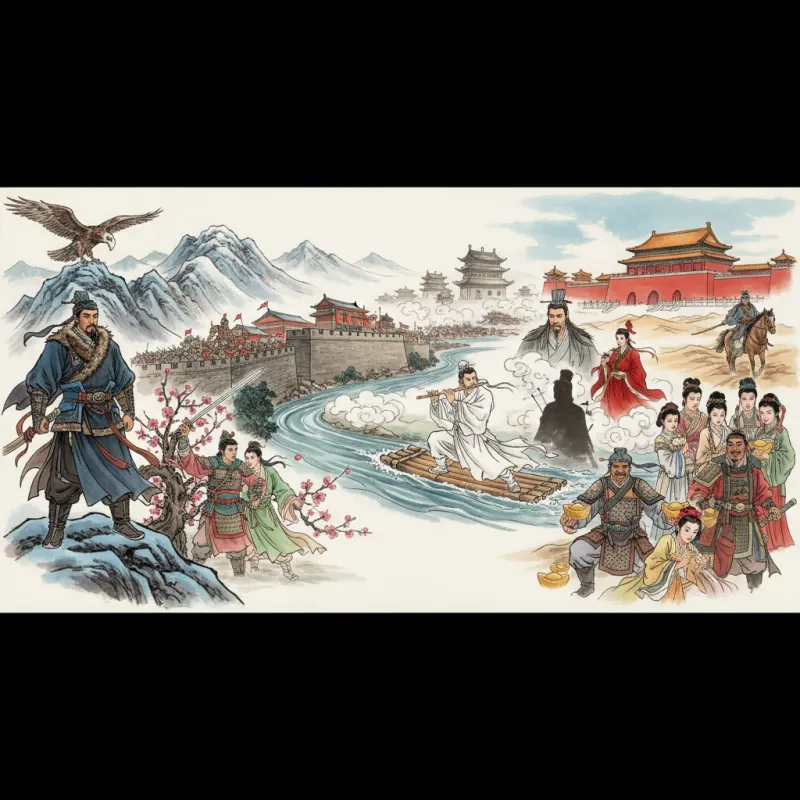
When Guo Jing stands on the walls of Xiangyang, watching Mongol armies mass on the horizon, he's not just defending a city—he's holding back the tide of history itself. Jin Yong understood something profound: martial arts heroes don't exist in a vacuum. They're shaped by their times, crushed by dynasties, and forced to choose sides in wars that will redraw the map of China. Across his fifteen novels, Jin Yong constructed a secret history of China spanning nearly a millennium, where the greatest swordsmen and martial artists move through the shadows of real historical events, their personal struggles mirroring the rise and fall of empires.
The Northern Song: When China Faced Enemies on All Sides
The Northern Song Dynasty (960-1127) was an era of cultural brilliance and military weakness—a paradox that Jin Yong exploited brilliantly in Demi-Gods and Semi-Devils (天龙八部, Tiānlóng Bābù). Set in the 1090s, the novel unfolds when Song China is surrounded by powerful neighbors: the Liao Empire of the Khitans to the north, the Western Xia kingdom of the Tanguts to the northwest, and the independent Dali kingdom in the southwest.
What makes this novel remarkable is how Jin Yong uses this geopolitical complexity to explore questions of identity and loyalty. Xiao Feng, the novel's tragic hero, is ethnically Khitan but raised as Han Chinese. His identity crisis isn't just personal drama—it's a meditation on what happens when ethnic boundaries become battle lines. When he discovers his true heritage, he's forced to choose between the people who raised him and the people who share his blood. There's no good answer, which is precisely Jin Yong's point.
The martial arts world (江湖, jiānghú) in this era is fragmented along the same lines as the political world. The Beggar Clan, traditionally the most patriotic of martial sects, must decide whether a Khitan can lead them. The Shaolin Temple tries to maintain neutrality while pressured to take sides. Even the novel's martial arts reflect this tension—Xiao Feng's Eighteen Dragon-Subduing Palms represent raw, overwhelming force, while Duan Yu's Six Meridians Divine Sword is elegant but unreliable, much like the Song Dynasty itself.
The Southern Song: The Long Goodbye
After the Jurchen Jin Dynasty conquered northern China in 1127, the Song court fled south and established the Southern Song (1127-1279). This truncated dynasty, always looking north with longing and shame, provides the setting for Jin Yong's most beloved trilogy: The Legend of the Condor Heroes (射雕英雄传, Shèdiāo Yīngxióng Zhuàn), The Return of the Condor Heroes (神雕侠侣, Shéndiāo Xiálǚ), and The Heaven Sword and Dragon Saber (倚天屠龙记, Yǐtiān Túlóng Jì).
The Legend of the Condor Heroes begins in 1205, when the Jin Dynasty still rules the north but a new threat is emerging: the Mongols under Genghis Khan. Guo Jing, the novel's earnest hero, grows up among the Mongols and becomes Genghis Khan's adopted son, but his loyalty ultimately lies with the Han Chinese. The novel's climax—the defense of Jiaxing against Jin forces—is a small-scale preview of the larger tragedy to come.
By the time of The Return of the Condor Heroes (set in the 1230s-1240s), the Mongols have conquered the Jin Dynasty and are pressing against the Southern Song's borders. Yang Guo and Xiaolongnü's romance unfolds against this backdrop of inevitable doom. The famous sixteen-year separation that structures the novel's plot mirrors the Southern Song's own desperate attempts to buy time. When Yang Guo finally kills Mongol prince Möngke with a stone at the Battle of Xiangyang, it's a temporary reprieve, nothing more.
The fall finally comes in The Heaven Sword and Dragon Saber, which spans from the late Song through the early Ming Dynasty (1260s-1360s). The novel opens with Guo Jing and Huang Rong making their last stand at Xiangyang in 1273. They die when the city falls—Jin Yong doesn't show it, but we know. Their daughter Guo Xiang survives to found the Emei Sect, carrying forward her parents' legacy into a world where the Mongol Yuan Dynasty rules all of China. For more on how Jin Yong's own life experiences shaped these historical narratives, see Jin Yong's Writing Career: From First Novel to Final Retirement.
The Yuan Dynasty: Resistance and Collaboration
The Mongol Yuan Dynasty (1271-1368) was China's first period of rule by foreign conquerors, and Jin Yong treats it with appropriate ambivalence. In The Heaven Sword and Dragon Saber, the martial arts world is split between those who collaborate with Yuan rule and those who resist. The six major sects—Shaolin, Wudang, Emei, Kunlun, Kongtong, and Huashan—all claim to oppose the Mongols, but their resistance is more rhetorical than real.
Zhang Wuji, the novel's protagonist, becomes leader of the Ming Cult (明教, Míngjiào), a religious movement that's also a resistance organization. The cult's Persian Manichaean origins reflect the Yuan Dynasty's cosmopolitan character—this was an era when China was connected to the wider world through the Mongol Empire's trade networks. But Jin Yong is clear-eyed about revolutionary movements: the Ming Cult is riven by internal power struggles, and its members are often more interested in settling personal scores than overthrowing the dynasty.
The novel ends with Zhu Yuanzhang, a minor character who's been lurking in the background, poised to found the Ming Dynasty. Zhang Wuji, who did the actual fighting, retires from the martial world. It's a cynical but historically accurate touch—the people who make revolutions rarely get to enjoy them.
The Ming Dynasty: Paranoia and Intrigue
The Ming Dynasty (1368-1644) was founded by a peasant rebel and remained paranoid about threats to its legitimacy throughout its existence. This atmosphere of suspicion and intrigue permeates The Smiling, Proud Wanderer (笑傲江湖, Xiào'ào Jiānghú), though Jin Yong deliberately keeps the historical setting vague. Most scholars place it in the mid-Ming period, when eunuch factions and secret police terrorized the court.
The novel's central conflict—the struggle for the "Sunflower Manual" (葵花宝典, Kuíhuā Bǎodiǎn), a martial arts manual so powerful that men castrate themselves to learn it—is a transparent allegory for political power. The eunuch Dongfang Bubai, who seizes control of the Sun Moon Holy Cult, represents the eunuch dictators who dominated late Ming politics. The orthodox sects' obsession with destroying the cult mirrors the Ming state's paranoid campaigns against heterodoxy.
Linghu Chong, the novel's protagonist, refuses all positions of power and authority. His drunken, wandering lifestyle is a rejection of the entire system—both the orthodox martial world and its heterodox opponents. In the context of Ming political culture, where neutrality was impossible and everyone was forced to take sides, Linghu Chong's individualism is quietly revolutionary.
The Duke of Mount Deer (鹿鼎记, Lùdǐng Jì), Jin Yong's final and most subversive novel, is set during the Ming-Qing transition (1644-1689). Wei Xiaobao, an illiterate street urchin who becomes the Kangxi Emperor's closest friend, is everything a Jin Yong hero shouldn't be: cowardly, lecherous, amoral, and completely ignorant of martial arts. Yet he succeeds where all the noble heroes fail. The novel is Jin Yong's farewell to the martial arts genre—a recognition that in the real world, history is made by Wei Xiaobao, not Guo Jing.
The Qing Dynasty: The End of the Martial World
The Qing Dynasty (1644-1912), China's last imperial dynasty, was founded by the Manchus, another group of foreign conquerors. Jin Yong sets several novels in the early Qing period, when Han Chinese resistance to Manchu rule was still active. The Book and the Sword (书剑恩仇录, Shūjiàn Ēnchóu Lù), Jin Yong's first novel, follows the Red Flower Society's attempts to overthrow the Qianlong Emperor. Fox Volant of the Snowy Mountain (雪山飞狐, Xuěshān Fēihú) and its prequel The Young Flying Fox (飞狐外传, Fēihú Wàizhuàn) are also set in the Qing period.
But the most significant Qing-era novel is The Deer and the Cauldron, which spans the Kangxi Emperor's reign (1661-1722). By this point, the Qing Dynasty has consolidated its rule, and anti-Manchu resistance movements like the Heaven and Earth Society are reduced to futile gestures. Wei Xiaobao serves both the Qing emperor and the anti-Qing rebels, betraying everyone and remaining loyal to no one except his friends. His success suggests that in the modern world—and the Qing Dynasty, with its bureaucratic efficiency and commercial economy, was the beginning of China's modern world—the old martial values of loyalty and righteousness are obsolete.
Jin Yong never set a novel after the mid-Qing period. By the late 19th century, China was being carved up by Western and Japanese imperialism, and the martial arts world was irrelevant to the nation's survival. The jianghu that Jin Yong loved—a world where individual martial skill mattered, where heroes could change history—couldn't exist in the age of gunpowder and industrialization. His chronology ends where it must: at the moment when the martial world becomes a nostalgic fantasy rather than a living tradition.
Why the Timeline Matters
Jin Yong's careful attention to historical chronology isn't just scholarly pedantry—it's essential to understanding what his novels are really about. Each era presents different moral dilemmas. In the Song Dynasty, heroes must choose between ethnic loyalty and personal conscience. In the Yuan Dynasty, they must decide whether resistance or accommodation is the path of righteousness. In the Ming Dynasty, they must navigate a world where power corrupts everyone who touches it. And in the Qing Dynasty, they must confront the possibility that their entire value system is obsolete.
The progression from Xiao Feng's tragic heroism in Demi-Gods and Semi-Devils to Wei Xiaobao's amoral pragmatism in The Deer and the Cauldron isn't just Jin Yong's artistic evolution—it's a meditation on Chinese history itself. As dynasties rise and fall, as foreign conquerors come and go, as the modern world encroaches on traditional values, what remains? For Jin Yong, the answer isn't the martial arts or the political causes or even the dynasties themselves. What remains is human connection: friendship, love, loyalty to individuals rather than abstractions. That's the real timeline of Jin Yong's martial world—not the succession of dynasties, but the enduring bonds between people trying to live with honor in dishonorable times.
For readers interested in how Jin Yong's personal experiences during China's turbulent 20th century influenced his historical vision, explore Jin Yong's Major Life Events and Milestones. And to understand how his novels reflect broader patterns in Chinese martial arts fiction, see The Evolution of Wuxia Literature in Modern China.
Related Reading
- How the Condor Trilogy Connects: Characters, Weapons, and Secrets Across 155 Years
- Jin Yong Novel Chronology: When Each Story Takes Place
- The Complete Timeline of Events Across Jin Yong's Novels
- The Art of Duels in Jin Yong's Wuxia Novels: A Journey Through Martial Valor
- Four-Word Martial Arts Idioms from Jin Yong's Novels
- The 20 Strongest Characters in Jin Yong's Universe: A Definitive Ranking