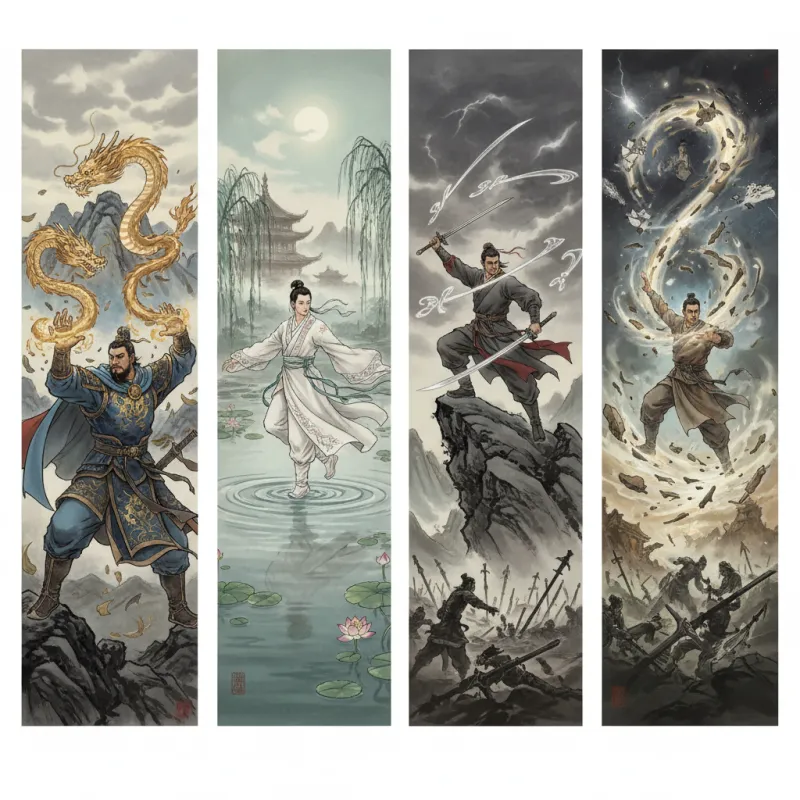
When Guo Jing stood atop Mount Hua watching the greatest martial artists of his generation clash in philosophical debate as much as physical combat, he witnessed something that would outlive them all — not just a tournament, but a linguistic revolution. Jin Yong's novels didn't merely tell stories; they minted phrases that would become the vocabulary of modern Chinese discourse. Walk into any Shanghai boardroom or Beijing coffee shop today, and you'll hear executives and students alike dropping four-character phrases from The Condor Heroes or Demi-Gods and Semi-Devils as naturally as they quote Confucius. These aren't just literary references anymore — they're how people think.
The Alchemy of Four Characters
Chinese has always loved its four-character idioms (成语 chéngyǔ), those compressed nuggets of wisdom inherited from classical texts. But Jin Yong did something audacious: he created new ones that felt ancient. His 四字成语 (sìzì chéngyǔ) carry the rhythmic weight of phrases from the Analects or Romance of the Three Kingdoms, yet they're describing fictional martial arts tournaments and imaginary kung fu techniques. The genius lies in how seamlessly they blend into the existing idiom ecosystem.
Take 华山论剑 (Huáshān Lùnjiàn) — "Sword Contest at Mount Hua." This phrase from The Legend of the Condor Heroes (射雕英雄传 Shèdiāo Yīngxióng Zhuàn) originally described the legendary tournament where the Five Greats (五绝 Wǔjué) — Eastern Heretic, Western Venom, Southern Emperor, Northern Beggar, and Central Divinity — competed for the title of supreme martial artist. Today? It's corporate jargon for any high-stakes competition between industry leaders. When Alibaba and Tencent battle for market dominance, commentators call it a 华山论剑. The phrase has completely transcended its fictional origins.
独孤求败 (Dúgū Qiúbài) — "Lonely Seeking Defeat"
Here's where Jin Yong's linguistic influence gets really interesting. Dugu Qiubai never actually appears in any novel — he's a legendary swordsman mentioned only in backstory, a ghost whose reputation haunts The Return of the Condor Heroes (神雕侠侣 Shéndiāo Xiálǚ) and The Smiling, Proud Wanderer (笑傲江湖 Xiàoào Jiānghú). Yet his name has become shorthand for someone so dominant in their field that they have no worthy opponents.
The phrase literally means "Solitary Seeking Defeat" — a master so skilled he desperately searches for someone capable of beating him. When a chess grandmaster wins their hundredth consecutive match, when a tech company monopolizes an entire sector, when an athlete dominates their sport so thoroughly that competitions become formalities — that's 独孤求败. The loneliness of absolute supremacy, the melancholy of having no peers. It's a concept that resonates far beyond martial arts, touching on the isolation that comes with any form of extreme excellence.
降龙十八掌 (Jiànglóng Shíbā Zhǎng) — "Eighteen Dragon-Subduing Palms"
This one's pure martial arts poetry. The signature technique of the Beggars' Sect (丐帮 Gàibāng), passed down through legendary heroes like Hong Qigong and Guo Jing, the Eighteen Dragon-Subduing Palms represents the pinnacle of external martial arts — raw, overwhelming power channeled through perfect technique. Each of the eighteen moves has its own poetic name, drawn from the I Ching (易经 Yìjīng): "Haughty Dragon Repents" (亢龙有悔 Kàng Lóng Yǒu Huǐ), "Dragon Soars in the Sky" (飞龙在天 Fēi Lóng Zài Tiān).
In contemporary usage, 降龙十八掌 has become metaphorical shorthand for a comprehensive skill set or a devastating series of strategic moves. A lawyer might describe their closing argument as deploying all eighteen palms. A negotiator might save their 降龙十八掌 for the final round of talks. The phrase captures both the systematic nature of mastery (eighteen distinct techniques) and the overwhelming force of their combined application. It's interesting how this phrase maintains its martial flavor even in business contexts — there's always an implication of controlled aggression, of power held in reserve until the decisive moment.
六脉神剑 (Liùmài Shénjiàn) — "Six Meridians Divine Sword"
From Demi-Gods and Semi-Devils (天龙八部 Tiānlóng Bābù), this technique of the Duan family of Dali represents the opposite philosophy from the Dragon-Subduing Palms. Instead of external force, it's pure internal energy (内力 nèilì) projected through the fingertips as invisible sword qi. The practitioner doesn't even need a weapon — their fingers become blades of concentrated force.
What makes 六脉神剑 fascinating as a cultural phrase is how it's evolved to mean "invisible influence" or "subtle but devastating power." When someone achieves their goals through behind-the-scenes maneuvering rather than direct confrontation, that's 六脉神剑. When a company dominates a market through strategic partnerships rather than aggressive competition, they're using the Six Meridians Divine Sword. The phrase has become associated with sophistication, with achieving maximum effect through minimum visible effort.
There's also a self-deprecating usage that's become popular: when someone's 六脉神剑 is described as "sometimes working, sometimes not" (时灵时不灵 shí líng shí bù líng) — a reference to Duan Yu's inconsistent mastery of the technique in the novel — it means their skills or luck are unreliable. This shows how deeply these phrases have penetrated everyday speech; people are making jokes based on plot details from novels written in the 1960s.
九阴真经 (Jiǔyīn Zhēnjīng) — "Nine Yin Manual"
The most coveted martial arts manual in Jin Yong's universe, the 九阴真经 appears across multiple novels as the ultimate source of martial knowledge. In The Legend of the Condor Heroes, it's the MacGuffin that drives much of the plot — everyone wants it, people die for it, and its techniques are so powerful that even partial knowledge makes someone formidable.
Today, calling something a 九阴真经 means it's the definitive guide, the secret knowledge that separates masters from amateurs. Every industry has its Nine Yin Manual — the proprietary algorithm, the insider knowledge, the technique that can't be learned from books. Tech startups talk about their 九阴真经 of growth hacking. Chefs guard their 九阴真经 of signature dishes. The phrase has become a playful way to describe any jealously guarded expertise.
What's particularly clever about how this phrase is used is the implicit acknowledgment that such "secret knowledge" is often overrated. In Jin Yong's novels, the Nine Yin Manual causes more problems than it solves — people go mad studying it, misinterpret its teachings, or use it for evil. There's a knowing irony when someone claims to possess the 九阴真经 of their field; the reference itself suggests that maybe the "secret" isn't as transformative as advertised.
武林盟主 (Wǔlín Méngzhǔ) — "Martial Arts Alliance Leader"
This title appears across Jin Yong's novels as the nominal head of the martial arts world (武林 wǔlín), though the position is always more complicated than it sounds. The 武林盟主 is supposed to unite the various sects and schools, mediate disputes, and lead the righteous martial artists against evil forces. In practice, it's a political nightmare — a position that attracts the ambitious, requires constant legitimization, and often ends in betrayal or tragedy.
The phrase has become perfect for describing anyone in a leadership position that's more ceremonial than substantive, or that requires managing fractious coalitions. The head of an industry association might be called the 武林盟主 — nominally in charge, but actually herding cats. A political leader trying to unite disparate factions gets the same label. There's always an undertone of skepticism; calling someone 武林盟主 suggests their authority is more symbolic than real, that they're one scandal or challenge away from losing their position.
The Living Language
What makes these phrases remarkable isn't just their popularity — it's how they've evolved beyond Jin Yong's original meanings. They've become tools for thinking, frameworks for understanding competition, power, skill, and ambition. When a Chinese speaker uses 华山论剑 to describe a business competition, they're not just making a literary reference; they're invoking an entire conceptual framework about how contests should be conducted, about the relationship between skill and reputation, about the difference between true mastery and mere victory.
This is Jin Yong's deepest legacy. His novels created a shared vocabulary that allows Chinese speakers to discuss abstract concepts with precision and poetry. These four-character phrases are more than idioms — they're conceptual shortcuts, each one carrying layers of meaning that would take paragraphs to explain in English. They're proof that great fiction doesn't just reflect culture; it shapes the very language culture uses to understand itself.
The next time you hear someone casually drop 独孤求败 in conversation, remember: you're witnessing a novelist's words becoming part of how an entire civilization thinks. That's not just literary influence — that's linguistic immortality.
Related Reading
- Jin Yong's Quotes That Every Chinese Person Knows
- Jin Yong on Love: The Most Memorable Quotes About Romance
- 25 Most Famous Jin Yong Quotes That Every Chinese Person Knows
- The Most Famous Lines in Jin Yong's Novels
- The Art of Duels in Jin Yong's Wuxia Novels: A Journey Through Martial Valor
- Jin Yong Reading Order Guide: Where to Start
- The Allure of Jin Yong's Wuxia: Exploring Martial Arts, Characters, and Legendary Storylines