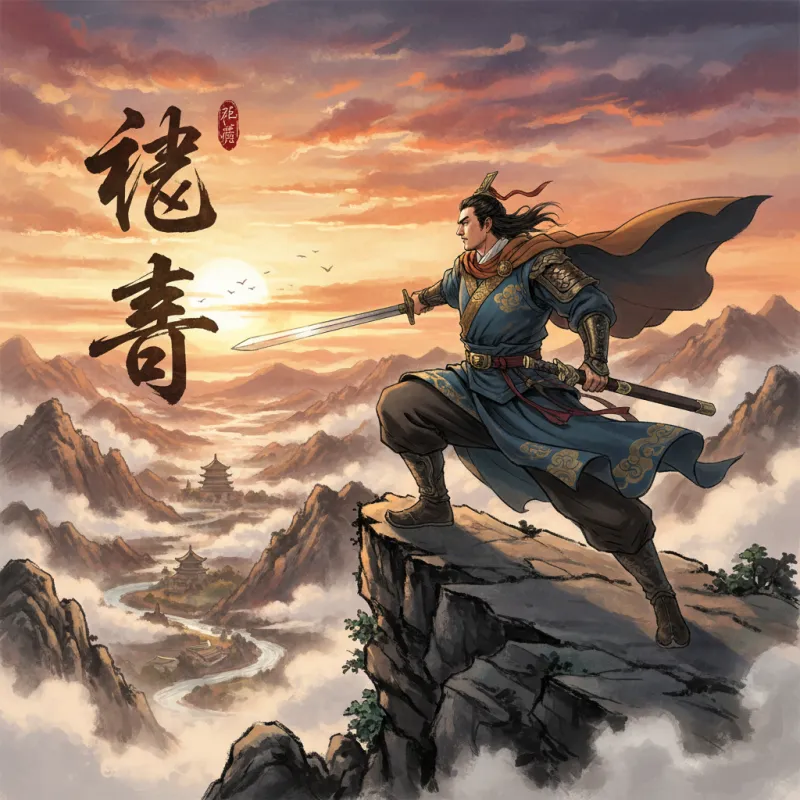
"Where there are people, there is jianghu (江湖, jiānghú)." Zhang Wuji's father tells him this in The Heaven Sword and Dragon Saber, and the line has become shorthand for a truth every Chinese person understands: society is a battlefield of competing interests, and you cannot escape it. But this is just one of dozens of Jin Yong quotes that have transcended their fictional origins to become part of everyday Chinese speech. Walk through any Chinese city, scroll through social media, listen to business meetings or family arguments, and you'll hear his words — often from people who've never read a single one of his novels.
The Philosopher-Hero: Guo Jing's Definition of Greatness
"侠之大者,为国为民" (xiá zhī dà zhě, wèi guó wèi mín) — "The greatest hero serves country and people." When Guo Jing speaks these words to Yang Guo in The Return of the Condor Heroes, he's not just offering advice to his godson. He's articulating a moral philosophy that would reshape how Chinese readers understood heroism itself.
Before Jin Yong, wuxia heroes were often lone wolves or sect loyalists. After this line, the standard changed. A true hero transcends personal grudges and factional politics. The phrase appears constantly in Chinese public discourse — in editorials praising doctors who fought COVID-19, in critiques of corrupt officials, in graduation speeches. It's become a litmus test: does this person serve themselves, or something larger?
What makes the quote powerful is its source. Guo Jing is famously simple-minded, almost dull. He's not a clever strategist like Huang Rong or a martial arts prodigy like Yang Guo. But his moral clarity is absolute. When he says these words while defending Xiangyang against the Mongol invasion, knowing the city will eventually fall, knowing he will die there — the quote gains tragic weight. Heroism isn't about winning. It's about choosing the right side even when defeat is certain.
The Taoist Paradox: Zhang Sanfeng's Lesson in Yielding
"他强由他强,清风拂山岗;他横由他横,明月照大江" (tā qiáng yóu tā qiáng, qīng fēng fú shān gǎng; tā hèng yóu tā hèng, míng yuè zhào dà jiāng) — "Let him be strong; the breeze caresses the hills. Let him be fierce; the bright moon shines on the river."
Zhang Wuji learns this verse from the Nine Yang Manual in The Heaven Sword and Dragon Saber, and it becomes the philosophical foundation of his martial arts. The principle is pure Taoism: don't meet force with force. The breeze doesn't fight the mountain. The moonlight doesn't resist the river. They simply exist, unchanged by external aggression.
Chinese people quote this constantly when discussing how to handle difficult bosses, toxic relationships, or political pressure. It's advice for survival in an authoritarian context — maintain your inner integrity while appearing to yield. The quote has a subversive edge that makes it particularly useful. On the surface, it sounds passive. In practice, it's about preserving your core self while letting external forces exhaust themselves.
The martial arts application is brilliant too. Zhang Wuji uses this principle to master the Qian Kun Da Nuo Yi (乾坤大挪移, Great Art of Cosmic Shift), which redirects opponents' force rather than blocking it. Jin Yong understood that the best Chinese philosophy is always embodied, never abstract. You don't just think these ideas — you practice them with your body until they become instinct.
The Existential Question: Linghu Chong's Freedom
"只要有人的地方就有恩怨,有恩怨就会有江湖,人就是江湖" (zhǐ yào yǒu rén de dì fāng jiù yǒu ēn yuàn, yǒu ēn yuàn jiù huì yǒu jiānghú, rén jiù shì jiānghú) — "Where there are people, there are grievances. Where there are grievances, there is jianghu. People are the jianghu."
This line from The Smiling, Proud Wanderer captures something essential about Chinese social reality. Linghu Chong spends the entire novel trying to escape jianghu politics — the sect rivalries, the power struggles, the endless cycles of revenge. He just wants to drink wine, play music, and live freely. But he learns that jianghu isn't a place you can leave. It's the inevitable result of human interaction.
The quote resonates because it describes the Chinese workplace, family dynamics, academic politics — any social environment where favors are owed, slights are remembered, and alliances shift. Young people quote it cynically when they realize their idealistic hopes for a "pure" career or friendship group are naive. Middle-aged people quote it with resignation. It's a fundamentally tragic insight: you cannot opt out of social competition without becoming a hermit.
What's interesting is how Jin Yong frames this through Linghu Chong, who represents Taoist freedom and spontaneity. Even the most free-spirited person cannot escape jianghu. The best you can do is navigate it with integrity, like Linghu Chong does — refusing to compromise his principles even when it costs him everything. The quote appears in The Heaven Sword and Dragon Saber too, when Zhang Wuji's father warns him before dying. It's clearly a theme Jin Yong returned to obsessively.
The Romantic Tragedy: Yang Guo's Impossible Love
"问世间情为何物,直教人生死相许" (wèn shì jiān qíng wéi hé wù, zhí jiào rén shēng sǐ xiāng xǔ) — "What is this thing called love, that binds us beyond life and death?"
Technically, Jin Yong didn't write this line — it's from a Yuan Dynasty poem by Yuan Haowen. But he made it famous by placing it at the beginning of The Return of the Condor Heroes, where it becomes the thematic statement for Yang Guo and Xiaolongnü's sixteen-year separation. The line is now inseparable from Jin Yong in popular consciousness.
Chinese people quote this at weddings, in breakup texts, in social media posts about celebrity couples. It's become the standard expression for love that transcends rational boundaries — love that makes no sense but feels inevitable. The phrase captures something about Chinese romantic culture: the valorization of suffering in love, the idea that true love requires sacrifice and endurance.
Yang Guo and Xiaolongnü's relationship embodies this perfectly. They're teacher and student (taboo), she's emotionally cold (difficult), they're separated for sixteen years (torture), and Yang Guo spends that time waiting at the edge of a cliff, ready to jump if she doesn't return. It's completely insane and completely romantic. The quote gives language to that insanity. When someone says "生死相许" (shēng sǐ xiāng xǔ, pledged beyond life and death), everyone knows they're talking about love that has crossed into obsession — and in Chinese culture, that's often seen as the most authentic kind.
The Philosophical Resignation: Duan Yu's Buddhist Wisdom
"一切有为法,如梦幻泡影" (yī qiè yǒu wéi fǎ, rú mèng huàn pào yǐng) — "All conditioned phenomena are like dreams, illusions, bubbles, shadows."
This line from the Diamond Sutra appears repeatedly in Demi-Gods and Semi-Devils, particularly in relation to Duan Yu's character development. Like the romantic quote above, Jin Yong didn't originate it — but he popularized it for modern readers by weaving it into his narrative structure.
The quote expresses Buddhist impermanence: everything you chase — power, love, revenge, glory — is ultimately empty. Duan Yu begins the novel as a naive prince who refuses to learn martial arts because of his Buddhist beliefs. By the end, after witnessing countless deaths and betrayals, he understands the teaching on a deeper level. His martial arts mastery comes not from ambition but from letting go of attachment.
Chinese people quote this when dealing with failure, loss, or disappointment. It's a way of saying: this too shall pass, nothing is permanent, don't cling too tightly. The phrase has a melancholic beauty in Chinese — the four images (dream, illusion, bubble, shadow) create a rhythm that feels like watching things dissolve. It's particularly popular among older readers who've lived through political upheavals and understand viscerally that power and status are temporary.
The Cynical Truth: Wei Xiaobao's Survival Philosophy
"做人要厚道" (zuò rén yào hòu dào) — "One must be decent in conduct."
Wei Xiaobao says this constantly in The Deer and the Cauldron, and it's hilarious because he's the least decent person in Jin Yong's entire corpus. He lies, cheats, manipulates, and betrays his way through the Qing court. But he says "做人要厚道" with complete sincerity, usually right before doing something completely unscrupulous.
The phrase has become ironic shorthand in Chinese internet culture. When someone does something selfish or underhanded, people comment "做人要厚道" sarcastically. It's a way of calling out hypocrisy while acknowledging that everyone engages in it. The quote captures something about Chinese social reality: the gap between stated values and actual behavior, the performance of morality that everyone recognizes as performance but maintains anyway.
What makes Wei Xiaobao fascinating is that Jin Yong clearly loves him. Unlike the noble heroes of earlier novels, Wei Xiaobao has no martial arts skills and no moral principles. He survives through cunning and adaptability. He's a trickster figure who succeeds precisely because he doesn't take the heroic code seriously. In a way, he's more realistic than Guo Jing or Yang Guo — he's how most people actually navigate complex social hierarchies. The quote's ironic usage reflects this: we all know "being decent" is the official line, but we also know survival often requires flexibility with that principle.
Why These Quotes Endure
Jin Yong's phrases have become proverbial because they articulate experiences that Chinese people recognize but lack language for. "侠之大者,为国为民" gives words to a specific kind of moral aspiration. "他强由他强" provides a strategy for dealing with power you cannot defeat. "人就是江湖" names the inescapability of social competition. These aren't just memorable lines — they're conceptual tools.
The quotes also work because they're embedded in stories that millions have read. When someone says "侠之大者,为国为民," Chinese readers don't just hear the words — they see Guo Jing on the walls of Xiangyang, they remember his entire character arc, they feel the weight of his choice. The quotes carry their narrative context with them, which gives them emotional resonance that abstract philosophy lacks.
This is Jin Yong's real achievement: he created a shared language for discussing ethics, relationships, and social reality. His novels function like Confucian classics once did — as a common reference point that educated people can invoke to make sense of their lives. When a Chinese person quotes Jin Yong, they're not just showing off literary knowledge. They're participating in a collective conversation about what it means to live well in a complicated world. And that conversation continues decades after his death, in every social media post, every business meeting, every family dinner where someone says, "As Jin Yong wrote..." and everyone nods in recognition.
For more on Jin Yong's philosophical themes, see The Concept of Xia in Jin Yong's Novels and Buddhist Themes in Demi-Gods and Semi-Devils.
Related Reading
- Jin Yong on Love: The Most Memorable Quotes About Romance
- The Most Famous Lines in Jin Yong's Novels
- Four-Word Martial Arts Idioms from Jin Yong's Novels
- 25 Most Famous Jin Yong Quotes That Every Chinese Person Knows
- The Unsung Heroes of Jin Yong's Wuxia Novels: Side Characters That Steal the Spotlight
- The Forbidden City in Jin Yong's Wuxia Fiction
- The Book and the Sword: Jin Yong's First Novel