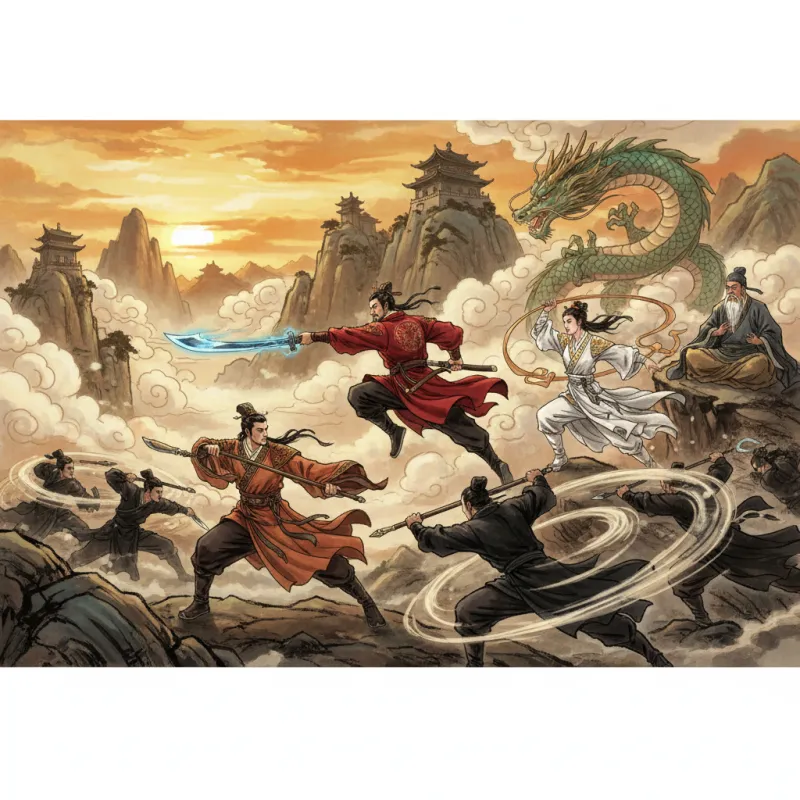
"Where there is a man, there is the jianghu (江湖, jiānghú)." Jin Yong wrote that line in The Smiling, Proud Wanderer, and it became more than a quote—it became a philosophy. His novels didn't just entertain; they rewired how Chinese speakers think about loyalty, love, and what it means to be human. Walk into any Chinese bookstore, tea house, or family gathering, and you'll hear his phrases dropped into conversation as naturally as proverbs. These aren't literary references anymore. They're the language itself.
The Philosophy of Martial Arts
Jin Yong understood something fundamental: the best fighters don't look like fighters. His most famous martial arts quote comes from Return of the Condor Heroes (神雕侠侣, Shéndiāo Xiálǚ), when Yang Guo encounters Dugu Qiubai's sword tomb: "The heavy sword has no edge, great skill appears clumsy" (重剑无锋,大巧不工, zhòng jiàn wú fēng, dà qiǎo bù gōng). This isn't just about swordplay. It's about mastery in any field—the programmer who writes elegant code, the chef whose knife work looks effortless, the teacher who makes complex ideas feel simple. The phrase has migrated far beyond wuxia novels into business seminars and self-help books across Asia.
Then there's the line that launched a thousand plot twists: "With the Heaven Sword and Dragon Saber, who dares to compete for supremacy?" (倚天屠龙,号令天下,莫敢不从, yǐtiān túlóng, hàolìng tiānxià, mò gǎn bù cóng). From Heaven Sword and Dragon Saber (倚天屠龙记, Yǐtiān Túlóng Jì), this rhyme drives the entire novel's treasure hunt. But Jin Yong's genius was showing that the real power wasn't in the weapons—it was in the people who chose not to use them.
"No move to break, no move to win" (无招胜有招, wú zhāo shèng yǒu zhāo) represents the pinnacle of Dugu Nine Swords (独孤九剑, Dúgū Jiǔ Jiàn) in The Smiling, Proud Wanderer. Linghu Chong learns that true freedom in combat comes from abandoning fixed patterns entirely. It's the martial arts equivalent of jazz improvisation—and it's quoted by everyone from martial artists to entrepreneurs talking about adaptive strategy.
On Love and Longing
Jin Yong wrote romance like he wrote sword fights: with devastating precision. "Ask what love is in this world, it teaches life and death to pledge to each other" (问世间情为何物,直教人生死相许, wèn shìjiān qíng wéi hé wù, zhí jiào rén shēngsǐ xiāng xǔ) appears in Return of the Condor Heroes, though Jin Yong borrowed it from Yuan Dynasty poet Yuan Haowen. The line accompanies the tragic love story of the Condor couple, and it's become the go-to quote for Chinese weddings, breakup songs, and Valentine's Day posts. If you want to understand Chinese romantic fatalism, start here.
"The greatest love is like no love at all" (情之所钟,正在我辈, qíng zhī suǒ zhōng, zhèng zài wǒ bèi) from Demi-Gods and Semi-Devils (天龙八部, Tiānlóng Bābù) captures Duan Yu's impossible love for Wang Yuyan. She loves someone else. He loves her anyway. The phrase has become shorthand for unrequited love that persists despite—or because of—its hopelessness.
The Jianghu and Human Nature
"Where there is a man, there is the jianghu" (有人的地方就有江湖, yǒu rén de dìfāng jiù yǒu jiānghú) might be Jin Yong's most culturally significant line. It appears in The Smiling, Proud Wanderer and redefines the jianghu from a physical place (the "rivers and lakes" where martial artists roam) to a psychological state. Office politics? That's jianghu. Family dynamics? Jianghu. Online forums? Definitely jianghu. The phrase acknowledges that wherever humans gather, there will be alliances, betrayals, hierarchies, and conflicts. It's simultaneously cynical and accepting—very Chinese in its worldview.
"The affairs of the jianghu are like a great dream" (江湖事如梦, jiānghú shì rú mèng) reflects the Buddhist undertones in Jin Yong's later works. After decades of writing about martial arts glory, he increasingly questioned whether any of it mattered. This line resonates with middle-aged readers who've achieved their ambitions and found them hollow.
"He's strong, let him be strong; the bright moon shines on the great river" (他强由他强,清风拂山岗;他横由他横,明月照大江, tā qiáng yóu tā qiáng, qīngfēng fú shāngāng; tā hèng yóu tā hèng, míngyuè zhào dàjiāng) comes from the Nine Yang Manual (九阳真经, Jiǔyáng Zhēnjīng) in Heaven Sword and Dragon Saber. It's a meditation technique that teaches practitioners to remain unmoved by external force. In modern usage, it's become a meme for dealing with difficult people: let them rage, you stay calm. The poetic imagery—wind on mountains, moonlight on rivers—makes it infinitely quotable.
On Loyalty and Betrayal
"For the country and the people, a great hero" (为国为民,侠之大者, wèi guó wèi mín, xiá zhī dà zhě) defines Guo Jing's character in The Legend of the Condor Heroes (射雕英雄传, Shèdiāo Yīngxióng Zhuàn). This is Jin Yong's answer to what makes a true hero—not martial arts skill, but moral purpose. The phrase appears on statues, in political speeches, and in discussions about what constitutes genuine heroism versus mere celebrity. It's also a subtle critique: how many people claiming to serve "country and people" actually do?
"The greatest evil is not evil itself, but the belief that one is doing good" (最大的恶不是恶本身,而是以为自己在行善, zuì dà de è bù shì è běnshēn, ér shì yǐwéi zìjǐ zài xíng shàn) captures the moral complexity of characters like Yue Buqun in The Smiling, Proud Wanderer. Jin Yong's villains rarely think they're villains—they're convinced they're righteous. This line has found new life in political discourse and social media debates about moral certainty.
On Fate and Choice
"Life is like a chess game, one wrong move and you lose everything" (人生如棋,落子无悔, rénshēng rú qí, luò zǐ wú huǐ) appears in multiple novels but resonates most strongly in Demi-Gods and Semi-Devils, where characters make irreversible choices. The phrase combines fatalism (life is a game with rules) with agency (you still have to make your moves). It's quoted in business contexts, relationship advice, and anywhere people discuss consequential decisions.
"The world's affairs are like a new chess game" (世事如新棋, shìshì rú xīn qí) offers a counterpoint—every situation is unique, requiring fresh thinking. Together, these chess metaphors create a dialectic about whether life follows patterns or demands improvisation.
On Power and Ambition
"To practice this skill, one must first castrate oneself" (欲练神功,必先自宫, yù liàn shén gōng, bì xiān zì gōng) from The Swordsman (笑傲江湖, Xiào'ào Jiānghú) has become a darkly comic phrase about the costs of ambition. The Sunflower Manual (葵花宝典, Kuíhuā Bǎodiǎn) promises ultimate power but demands ultimate sacrifice. In modern usage, it's applied to any situation where success requires giving up something fundamental to your identity—the entrepreneur who sacrifices family life, the artist who abandons commercial appeal. The phrase is both warning and joke, depending on context.
"When the birds are gone, the good bow is put away" (飞鸟尽,良弓藏, fēiniǎo jìn, liánggōng cáng) isn't original to Jin Yong—it's from ancient Chinese history—but his use of it in Demi-Gods and Semi-Devils gave it new currency. It describes how useful people are discarded once they've served their purpose, a theme that resonates in corporate culture and political purges.
The Wisdom of Age
"The older the ginger, the spicier it gets" (姜还是老的辣, jiāng háishì lǎo de là) celebrates the value of experience. Jin Yong's older characters—like Huang Yaoshi or Hong Qigong—often outthink younger, stronger opponents. In a culture that traditionally reveres age, this phrase validates the wisdom that comes with years.
"A young man doesn't know the taste of sorrow" (少年不识愁滋味, shàonián bù shí chóu zīwèi) captures the bittersweet nostalgia in Jin Yong's later works. His young heroes rush toward adventure; his older characters know what those adventures cost. The phrase is quoted by parents, teachers, and anyone watching younger people make predictable mistakes.
On Freedom and Constraint
"The greatest freedom is having no freedom" (最大的自由就是没有自由, zuì dà de zìyóu jiùshì méiyǒu zìyóu) represents Jin Yong's Buddhist philosophy. True freedom comes from accepting constraint, from understanding that the self is an illusion. It's a paradox that drives characters like Linghu Chong, who finds freedom by abandoning the pursuit of it.
"To retreat is to advance" (退一步海阔天空, tuì yī bù hǎikuò tiānkōng) literally means "step back and the sea and sky are boundless." It's tactical advice that becomes life philosophy—sometimes the way forward is backward. The phrase appears in negotiation guides, relationship counseling, and anywhere people discuss strategic patience.
The Nature of Truth
"The truth is often the opposite of what it appears" (真相往往与表象相反, zhēnxiàng wǎngwǎng yǔ biǎoxiàng xiāngfǎn) drives Jin Yong's plot twists. The hero is the villain. The villain is the victim. The treasure is worthless. This meta-awareness about narrative deception has made readers skeptical of surface appearances—in fiction and in life.
"What the eye sees is not necessarily true" (眼见不一定为实, yǎnjiàn bù yīdìng wéi shí) reinforces this epistemological uncertainty. Jin Yong's novels are full of misunderstandings, false accusations, and tragic mistakes based on incomplete information. The phrase has become a caution against rushing to judgment.
On Revenge and Forgiveness
"Revenge breeds revenge, when will it end?" (冤冤相报何时了, yuān yuān xiāng bào héshí liǎo) questions the cycle of vengeance that drives so many wuxia plots. Jin Yong's mature works increasingly suggest that breaking the cycle requires someone to absorb the injustice without retaliating—a Buddhist solution to a Confucian problem.
"To repay kindness with kindness, to repay enmity with justice" (以德报德,以直报怨, yǐ dé bào dé, yǐ zhí bào yuàn) offers a middle path between unconditional forgiveness and endless revenge. It's Confucian pragmatism: reward good, punish evil, but don't confuse the two.
The Final Wisdom
"All martial arts in the world come from Shaolin" (天下武功出少林, tiānxià wǔgōng chū Shàolín) establishes the Shaolin Temple as the source of all martial arts in Jin Yong's universe. It's historically dubious but narratively powerful, giving his fictional world a coherent origin point. The phrase has been adopted by the actual Shaolin Temple in their marketing, a case of fiction reshaping reality.
"When you reach the peak, you realize there is no peak" (登峰造极之后才发现无峰可登, dēngfēng zàojí zhīhòu cái fāxiàn wú fēng kě dēng) captures the emptiness of achievement. Jin Yong's greatest masters often feel lost after reaching the summit of martial arts. It's a warning about goal-oriented living and a suggestion that the journey matters more than the destination.
These quotes have outlived their original context. They're no longer just lines from novels—they're how Chinese speakers think about love, power, loyalty, and what it means to live well. Jin Yong didn't just write stories; he wrote the language people use to understand their stories. That's why, decades after publication, his words still shape conversations from Beijing to Singapore to San Francisco's Chinatown. The novels may fade, but the phrases remain, embedded in the culture like sword techniques passed from master to student, generation after generation.
For more insights into Jin Yong's philosophical depth, explore The Philosophy Behind Jin Yong's Martial Arts and Understanding Jianghu in Modern Context.
Related Reading
- Jin Yong's Quotes That Every Chinese Person Knows
- The Most Famous Lines in Jin Yong's Novels
- Four-Word Martial Arts Idioms from Jin Yong's Novels
- Jin Yong on Love: The Most Memorable Quotes About Romance
- The Enigmatic Hidden Techniques in Jin Yong’s Wuxia Novels Explored
- Jin Yong's Writing Career: From First Novel to Final Retirement
- The Enduring Legacy of Jin Yong’s Wuxia Characters and Martial Arts