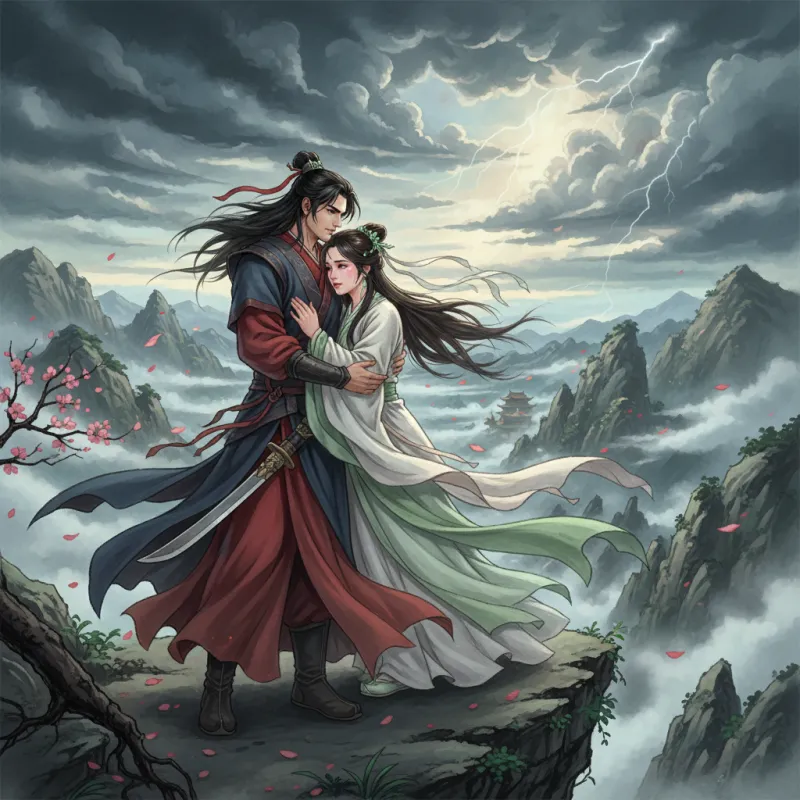
"Ask the world: what is love, that it binds life and death together?" When Li Mochou (李莫愁 Lǐ Mòchóu), the murderous Scarlet Serpent Fairy, sings these words in The Return of the Condor Heroes, she's not being poetic — she's genuinely asking. Here's a woman who's killed hundreds, who poisons entire families without blinking, and yet she can't understand why love destroyed her more thoroughly than any enemy ever could. That's the genius of Jin Yong's (金庸 Jīn Yōng) approach to romance: his characters don't recite pretty words about love. They bleed from it.
The Quote That Became a Cultural Phenomenon
"问世间,情为何物,直教生死相许" (Wèn shìjiān, qíng wèi hé wù, zhí jiào shēngsǐ xiāng xǔ) — "Ask the world: what is love, that it binds life and death together?" — didn't originate with Jin Yong. It comes from a 13th-century Yuan Dynasty poem by Yuan Haowen (元好问 Yuán Hàowèn), written after he witnessed a goose die of grief when its mate was killed by hunters. But Jin Yong's genius was putting these words in Li Mochou's mouth as she dies, transforming an ancient poem into the defining statement about love's destructive power.
This quote appears everywhere in Chinese culture now — wedding toasts, breakup texts, social media posts, even as tattoos. It's been covered by dozens of singers, referenced in countless TV dramas, and parodied so often it's become a meme. But in The Return of the Condor Heroes (神雕侠侣 Shén Diāo Xiálǚ), it's not romantic — it's tragic. Li Mochou sings it because she genuinely doesn't understand how love turned her into a monster. Her junior martial sister stole the man she loved, and that single betrayal transformed a talented young woman into the jianghu's (江湖 jiānghú) most feared killer.
"情深不寿,强极则辱"
Qíng shēn bù shòu, qiáng jí zé rǔ "Deep love leads to early death; extreme strength invites humiliation"
This line from The Book and the Sword (书剑恩仇录 Shū Jiàn Ēnchóu Lù) is Jin Yong at his most cynical. It's not advice — it's an observation about how the jianghu works. The characters who love most intensely are the ones who die first. Chen Jialuo (陈家洛 Chén Jiāluò) loves Huo Qingtong (霍青桐 Huò Qīngtóng) but marries Princess Fragrance (香香公主 Xiāngxiāng Gōngzhǔ) out of duty, and everyone ends up miserable. The strongest fighters become arrogant and get destroyed by their own pride.
What makes this quote devastating is how often Jin Yong proves it true across his novels. Qiao Feng (乔峰 Qiáo Fēng) in Demi-Gods and Semi-Devils (天龙八部 Tiānlóng Bābù) is the strongest hero in the jianghu, and his strength means nothing when the woman he loves dies in his arms. A'Zhu (阿朱 Ā Zhū) doesn't die in some epic battle — she dies because of a tragic misunderstanding, killed by the man who loved her most. That's the cruelty Jin Yong captures: in the jianghu, being strong doesn't protect you from heartbreak, and loving deeply doesn't guarantee happiness.
"你瞧这些白云聚了又散,散了又聚,人生离合,亦复如斯"
Nǐ qiáo zhèxiē báiyún jù le yòu sàn, sàn le yòu jù, rénshēng líhé, yì fù rú sī "Look at these white clouds — they gather and scatter, scatter and gather. Human meetings and partings are just the same"
Duan Yu (段誉 Duàn Yù) says this in Demi-Gods and Semi-Devils, and it's the most Buddhist take on love in all of Jin Yong's work. He's not being pessimistic — he's being realistic. People come into your life, they leave, sometimes they come back. Fighting against this natural flow only causes suffering. It's the kind of wisdom that sounds simple but takes a lifetime to actually accept.
The context matters here. Duan Yu spends most of the novel hopelessly in love with Wang Yuyan (王语嫣 Wáng Yǔyān), who barely notices him because she's obsessed with her cousin Murong Fu (慕容复 Mù Róng Fù). By the time Duan Yu says this line, he's learned that you can't force someone to love you back, and that's okay. The clouds don't mourn when they scatter. They just drift on. It's a level of emotional maturity that most of Jin Yong's heroes never reach — they're too busy dying dramatically for love to achieve this kind of peace.
"情不知所起,一往而深"
Qíng bù zhī suǒ qǐ, yī wǎng ér shēn "Love arises without knowing where it comes from, yet it grows deeper and deeper"
This quote, which Jin Yong references in The Smiling, Proud Wanderer (笑傲江湖 Xiào Ào Jiānghú), actually comes from Tang Xianzu's (汤显祖 Tāng Xiǎnzǔ) 16th-century play The Peony Pavilion (牡丹亭 Mǔdān Tíng). But Jin Yong uses it to describe the relationship between Linghu Chong (令狐冲 Lìng Hú Chōng) and Ren Yingying (任盈盈 Rèn Yíngyíng), and it perfectly captures how love works in his novels — it's not logical, it's not planned, it just happens.
Linghu Chong doesn't decide to fall in love with Ren Yingying. For most of the novel, he's still hung up on his junior martial sister Yue Lingshan (岳灵珊 Yuè Língshān), even though she's married someone else. But somewhere between Ren Yingying nursing him back to health and playing the qin (琴 qín) for him, he falls for her without even realizing it. That's what this quote captures — love isn't a choice you make consciously. It's something that happens to you, and by the time you notice, you're already in too deep to escape.
"既见君子,云胡不喜"
Jì jiàn jūnzǐ, yún hú bù xǐ "Having seen you, how could I not be happy?"
This line from the Book of Songs (诗经 Shījīng) — China's oldest poetry collection, dating back over 2,500 years — appears in The Deer and the Cauldron (鹿鼎记 Lù Dǐng Jì) when Shuang'er (双儿 Shuāng'er) thinks about Wei Xiaobao (韦小宝 Wèi Xiǎobǎo). It's the simplest, purest expression of love in all of Jin Yong's work. No drama, no tragedy, just: I see you, and that makes me happy.
What's remarkable is that Jin Yong puts this ancient, elegant line in the mouth of a character thinking about Wei Xiaobao — possibly the least elegant hero in all of wuxia literature. Wei Xiaobao is a conman, a liar, a coward who can't do martial arts. But Shuang'er loves him anyway, not despite his flaws but including them. That's the power of this quote: real love isn't about finding someone perfect. It's about finding someone whose presence makes you happy, even when they're ridiculous. For more on how Jin Yong subverts traditional romance tropes, see Jin Yong's Most Unconventional Love Stories.
"有生之年,狭路相逢,终不能幸免"
Yǒu shēng zhī nián, xiá lù xiāng féng, zhōng bù néng xìngmiǎn "In this lifetime, on a narrow road we meet — there's no escaping it"
This line from Ashes of Time (东邪西毒 Dōng Xié Xī Dú) — actually from Wong Kar-wai's film adaptation, but so perfectly capturing Jin Yong's spirit that it's become inseparable from the source material — describes love as fate, as inevitability. Some people you're meant to meet, and once you do, your life is never the same.
The "narrow road" (狭路 xiá lù) is crucial here. It's not a wide, comfortable highway where you have room to avoid each other. It's a narrow path where you have to face each other directly. That's how Jin Yong writes romance — his characters can't just casually date and see how things go. They meet in life-or-death situations, they save each other's lives, they betray each other, they forgive each other. There's no escaping the intensity. Yang Guo (杨过 Yáng Guò) and Xiaolongnü (小龙女 Xiǎo Lóng Nǚ) in The Return of the Condor Heroes meet when he's a child and she's his teacher, which should be simple. But their narrow road leads through sixteen years of separation, societal condemnation, and near-death experiences before they can be together.
"我走之后,你要好好照顾自己"
Wǒ zǒu zhī hòu, nǐ yào hǎohǎo zhàogù zìjǐ "After I'm gone, you must take good care of yourself"
This isn't a famous literary quote — it's just something people say. But Jin Yong uses variations of this line repeatedly across his novels, and it's always devastating because it's so ordinary. These are the last words A'Zhu says to Qiao Feng. They're what Guo Jing (郭靖 Guō Jìng) says to Huang Rong (黄蓉 Huáng Róng) before the final battle in The Return of the Condor Heroes. They're what parents say to children, what lovers say to each other, what friends say when they know they might not meet again.
The power of this line is in its mundanity. Jin Yong's heroes can recite poetry, they can quote classics, but when they're actually facing separation or death, they say the same simple things everyone says: take care of yourself. Eat well. Don't be sad. It's a reminder that underneath all the martial arts and adventure, these are just people who love each other and don't want to say goodbye. For more on how Jin Yong portrays everyday moments in extraordinary circumstances, see The Quiet Moments in Jin Yong's Action Scenes.
Why These Quotes Endure
Jin Yong's love quotes work because they're not about love in the abstract — they're about specific people in impossible situations. Li Mochou asking what love is while dying from her own poison. Duan Yu comparing love to clouds after years of unrequited longing. Linghu Chong falling in love without meaning to. These aren't pretty sentiments designed to sound good on greeting cards. They're observations earned through suffering.
The jianghu is a world of violence, betrayal, and impossible choices. In that context, love isn't a refuge — it's another battlefield. Jin Yong's characters don't get to date casually or break up cleanly. They love intensely, they suffer dramatically, and sometimes they die for it. That's why these quotes resonate: they acknowledge that love is dangerous, that it can destroy you, and that people choose it anyway. Not because they're foolish, but because being human means being vulnerable to something stronger than any martial arts technique.
The most memorable love quotes in Jin Yong aren't the prettiest ones — they're the truest ones. They're the lines that make you think about your own relationships, your own heartbreaks, your own impossible choices. They're the words that characters say when they've run out of clever things to say and can only speak from the heart. And that's why, decades after Jin Yong wrote them, people still quote these lines when they're trying to explain what love feels like: terrifying, inevitable, and worth it. For a deeper look at how Jin Yong's philosophy shapes his portrayal of romance, see Jin Yong's Philosophy of Love and Fate.
Related Reading
- Jin Yong's Quotes That Every Chinese Person Knows
- The Most Famous Lines in Jin Yong's Novels
- Four-Word Martial Arts Idioms from Jin Yong's Novels
- 25 Most Famous Jin Yong Quotes That Every Chinese Person Knows
- Exploring the Enigmatic Worlds of Jin Yong's Wuxia Novels
- Gu Long vs. Jin Yong: The Great Wuxia Debate
- Love and Sacrifice in Jin Yong's World