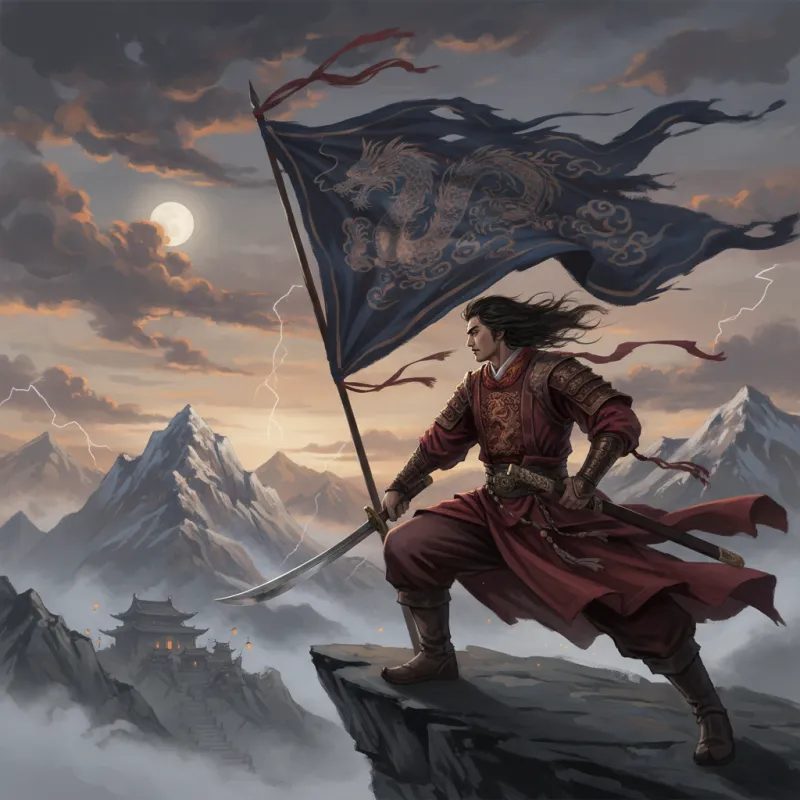
"The greatest heroes serve their country and their people." When Guo Jing speaks these eight characters in The Legend of the Condor Heroes, he's not making a speech — he's defining what separates a martial artist from a true hero. Jin Yong (金庸 Jīn Yōng) wrote thousands of pages, but certain lines cut so deep they became part of Chinese consciousness. These aren't just memorable quotes. They're the sentences people reach for when explaining honor, love, or what it means to live well.
The Line That Defines Heroism
"侠之大者,为国为民" (Xiá zhī dà zhě, wèi guó wèi mín — "The greatest heroes serve their country and their people") appears in The Legend of the Condor Heroes when Guo Jing finally understands what his teachers meant all along. It's the moment a simple, honest boy becomes the moral center of Jin Yong's universe.
This line rewrote the rules of wuxia fiction. Before Jin Yong, heroes were often lone wolves, righting wrongs on personal whims. After this line, heroism required something bigger: responsibility to the collective. Guo Jing isn't the smartest or most talented martial artist, but he embodies this principle so completely that he becomes the standard against which all other Jin Yong heroes are measured.
The phrase entered everyday Chinese language. Politicians quote it. Parents use it to teach children about duty. It appears on motivational posters in schools. Jin Yong took the individualistic fantasy of martial arts mastery and anchored it to Confucian social responsibility — and somehow made it thrilling rather than preachy.
The Couplet That Contains Everything
"飞雪连天射白鹿,笑书神侠倚碧鸳" (Fēi xuě lián tiān shè bái lù, xiào shū shén xiá yǐ bì yuān) is Jin Yong's signature — literally. This couplet contains the first character of all fourteen of his novels, arranged into two lines of seven characters each. Read vertically from right to left, you get: 飞狐外传 (Fox Volant of the Snowy Mountain), 雪山飞狐 (The Young Flying Fox), 连城诀 (A Deadly Secret), 天龙八部 (Demi-Gods and Semi-Devils), 射雕英雄传 (The Legend of the Condor Heroes), 白马啸西风 (White Horse Neighs in the Western Wind), 鹿鼎记 (The Deer and the Cauldron), 笑傲江湖 (The Smiling, Proud Wanderer), 书剑恩仇录 (The Book and the Sword), 神雕侠侣 (The Return of the Condor Heroes), 侠客行 (Ode to Gallantry), 倚天屠龙记 (The Heaven Sword and Dragon Saber), 碧血剑 (Sword Stained with Royal Blood), 鸳鸯刀 (The Mandarin Duck Sabres).
Jin Yong composed this himself, which tells you something about his mind. The couplet actually means something poetic: "Flying snow fills the sky as white deer are shot; laughing, I write of divine heroes leaning on mandarin duck swords." It's not just a mnemonic device — it's a compressed image of his entire fictional universe. Snow, deer, laughter, heroes, swords. That's the world of Jin Yong in fourteen characters.
Fans use this couplet as a reading order guide, a party trick, a way to signal membership in the club. It's become so iconic that Chinese readers simply call it "the fourteen-character couplet" and everyone knows what you mean.
The Question That Haunts Every Character
"情为何物,直教生死相许?" (Qíng wéi hé wù, zhí jiào shēng sǐ xiāng xǔ? — "What is this thing called love, that it binds us even unto death?") comes from The Return of the Condor Heroes, spoken by the Taoist priest Li Mochou. She's a villain, driven mad by romantic betrayal, and this line is her curse and her confession.
Jin Yong borrowed this from Yuan dynasty poet Yuan Haowen's poem about geese who mate for life, but he transformed it into something darker. In the original poem, it's a meditation on devotion. In Jin Yong's hands, it becomes a question with no good answer. Li Mochou asks it while poisoning people. Yang Guo and Xiaolongnü live it through sixteen years of separation. The question echoes through every Jin Yong novel because his characters keep discovering that love is both the most beautiful and most destructive force in the jianghu (江湖 jiānghú — the martial arts world).
This line appears in Chinese pop songs, wedding toasts, and breakup texts. It's the go-to quote for anyone trying to express that love is inexplicable and overwhelming. Jin Yong understood that the question is more powerful than any answer could be.
The Philosophy of Detachment
"有人的地方就有江湖" (Yǒu rén de dìfang jiù yǒu jiānghú — "Wherever there are people, there is jianghu") appears in The Smiling, Proud Wanderer, and it's Jin Yong's most cynical observation. Linghu Chong wants to escape the martial arts world's politics and violence, but this line explains why he can't. The jianghu isn't a place — it's human nature.
This quote resonates because it applies to everything. Office politics? That's jianghu. Family drama? Jianghu. Online forums? Definitely jianghu. Jin Yong was saying that the martial arts world is just a heightened version of regular life, where the same patterns of ambition, betrayal, loyalty, and conflict play out with swords instead of spreadsheets.
The line has become shorthand for "you can't escape human nature" or "politics exist wherever humans gather." It's both pessimistic and liberating — if jianghu is everywhere, you might as well stop running and figure out how to navigate it with integrity. For more on how Jin Yong's characters navigate these moral complexities, see The Philosophy Behind Jin Yong's Heroes.
The Paradox of Martial Arts Mastery
"无招胜有招" (Wú zhāo shèng yǒu zhāo — "No technique defeats all techniques") is Dugu Qiubai's ultimate principle, passed down through generations in multiple novels. It's the endpoint of martial arts philosophy in Jin Yong's universe: true mastery means transcending all fixed forms.
This concept appears most explicitly in The Smiling, Proud Wanderer and The Return of the Condor Heroes, but it underlies Jin Yong's entire approach to martial arts. Beginners learn specific moves. Intermediate practitioners master many techniques. But the ultimate level is formlessness — responding spontaneously to any situation without being bound by predetermined patterns.
It's pure Daoist philosophy dressed up as sword fighting. The Dao De Jing talks about how the softest things overcome the hardest, how water defeats stone through formlessness. Jin Yong took that ancient wisdom and made it into the coolest martial arts concept in Chinese fiction. The phrase has been adopted by business strategists, military theorists, and anyone who wants to sound wise about flexibility and adaptation.
The Weight of Reputation
"人在江湖,身不由己" (Rén zài jiānghú, shēn bù yóu jǐ — "When you're in the jianghu, you can't control your own fate") captures the tragic dimension of Jin Yong's world. Once you have a reputation, once people know your name, you're trapped by expectations and obligations. You can't just walk away.
This line appears in various forms across multiple novels, but it's most poignant in Demi-Gods and Semi-Devils, where nearly every major character is imprisoned by their identity. Qiao Feng can't escape being Khitan. Duan Yu can't escape being a prince. Xu Zhu can't escape his sudden transformation from monk to sect leader. Their reputations and roles determine their choices more than their own desires do.
Chinese people quote this when explaining why they can't quit a job, leave a relationship, or abandon a responsibility. It's become the standard excuse for feeling trapped by social obligations. Jin Yong understood that freedom is the rarest thing in his fictional world — and in the real one. The tension between personal desire and social duty runs through all of Jin Yong's work, as explored in The Conflict Between Love and Duty.
The Emptiness of Victory
"胜固欣然,败亦可喜" (Shèng gù xīn rán, bài yì kě xǐ — "Victory is naturally delightful, but defeat can also bring joy") is the attitude of true martial arts masters in Jin Yong's novels. It appears in The Book and the Sword and represents the highest level of mental cultivation — beyond ego, beyond attachment to outcomes.
This is Jin Yong channeling Buddhist non-attachment through martial arts philosophy. The greatest fighters don't fight to win; they fight to test themselves, to learn, to engage fully with the moment. Defeat teaches more than victory. Loss reveals character more than triumph. It's the opposite of the Western "winning isn't everything, it's the only thing" mentality.
The line has become a consolation for anyone who needs to save face after losing. But in Jin Yong's novels, it's not just a consolation — it's a genuine philosophical position. Characters who can't accept defeat become villains. Characters who learn from defeat become heroes. The ability to find joy in loss is what separates the wise from the merely skilled.
The Loneliness of Perfection
"独孤求败" (Dúgū Qiú Bài — "Dugu Seeks Defeat") is technically a character name, but it functions as a philosophical statement. This legendary swordsman, who never appears alive in any Jin Yong novel, was so skilled that he couldn't find anyone worthy of fighting. His name literally means "Lonely Seeks Defeat."
Dugu Qiubai's story is told through the swords he left behind and the techniques he passed down. He progressed from a sharp sword to a heavy sword to a wooden sword to no sword at all — each stage representing a deeper understanding of martial arts. But his ultimate achievement was also his ultimate tragedy: he became so good that he was alone.
This character has become a cultural reference point for anyone at the top of their field who feels isolated by their excellence. Athletes, CEOs, artists — anyone who has outgrown their peer group quotes Dugu Qiubai. Jin Yong understood that mastery is lonely, that being the best means having no equals, no real challenges, no one who truly understands what you've achieved. It's a warning wrapped in a legend: be careful what you wish for when you pursue perfection.
Why These Lines Endure
Jin Yong's most famous lines work because they're compressed wisdom. Each one contains a complete philosophy in a handful of characters. They're quotable, memorable, and applicable to situations far beyond martial arts fiction. They sound good in Chinese — the rhythm, the parallelism, the classical elegance of the phrasing.
But more than that, they're true. Not factually true, but emotionally and psychologically true. They capture something about human experience that readers recognize immediately. That's why they've outlived their original context and become part of how Chinese people think and talk about life.
These aren't just lines from novels. They're tools for understanding the world, for explaining yourself, for making sense of the gap between who you are and who you want to be. Jin Yong wrote entertainment, but he embedded philosophy so deep that readers absorbed it without noticing. That's the real mastery — not the martial arts he described, but the way he made wisdom feel like adventure.
Related Reading
- 25 Most Famous Jin Yong Quotes That Every Chinese Person Knows
- Four-Word Martial Arts Idioms from Jin Yong's Novels
- Jin Yong on Love: The Most Memorable Quotes About Romance
- Jin Yong's Quotes That Every Chinese Person Knows
- The Book and the Sword: Jin Yong's First Novel
- Alternative Endings Fans Wish Jin Yong Had Written
- Jin Yong's Influence on Asian Pop Culture