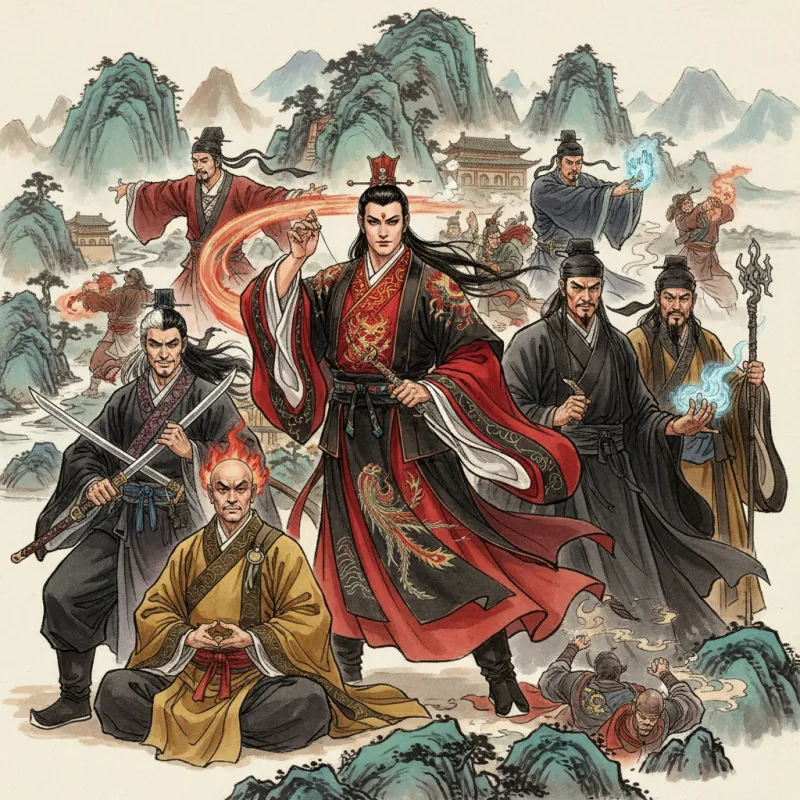
Why do we remember Ouyang Feng's final duel with Hong Qigong more vividly than Guo Jing's triumph? Why does Yue Buqun's slow corruption haunt us longer than Linghu Chong's heroism? Jin Yong understood something fundamental about storytelling: the villain's journey is often more psychologically complex than the hero's, because while heroes must maintain their virtue, villains get to explore the full spectrum of human weakness, ambition, and self-destruction.
The Architecture of a Jin Yong Villain
Jin Yong's villains aren't obstacles—they're tragic figures with their own narrative arcs. Unlike Western fantasy's Dark Lords or wuxia's stock "evil sect masters," his antagonists possess three defining qualities: legitimate grievances, internally consistent logic, and the capacity for genuine human connection.
Take Qiu Qianren (裘千仞, Qiū Qiānrèn) from The Legend of the Condor Heroes. He's introduced as a ruthless killer, but Jin Yong reveals he murdered Yang Kang's father not from pure malice but from a complex web of sect politics and personal ambition. His later transformation into a monk isn't redemption—it's the logical endpoint of a man who realizes his martial arts mastery brought him nothing but isolation. The tragedy isn't that he was evil; it's that he was human.
This architectural approach means Jin Yong's villains often have better character development than his heroes. Guo Jing must remain steadfastly loyal and somewhat dim. But Ouyang Feng? He gets to descend into madness, experience unrequited love, practice forbidden techniques, and ultimately find a strange peace in insanity.
Ouyang Feng: The Aristocrat of Madness
Ouyang Feng (歐陽鋒, Ōuyáng Fēng), the Western Venom, represents Jin Yong's most audacious villain arc: a man who achieves transcendence through complete mental breakdown. When he practices the Nine Yin Manual backwards and loses his memory, he doesn't become a mindless beast—he becomes something more honest than he ever was as a calculating schemer.
His final scene in The Return of the Condor Heroes is devastating. He and Hong Qigong, mortal enemies, sit together on a mountaintop. Ouyang Feng has forgotten who he is but remembers that Hong Qigong is important to him. They fight one last time, not from hatred but from a kind of love—the only relationship either man truly understood. When Hong Qigong dies, Ouyang Feng laughs and dies beside him. It's the most emotionally honest moment in either character's life.
What makes this work is that Jin Yong never treats Ouyang Feng's madness as punishment. It's liberation. Sane Ouyang Feng was trapped by his need to be the strongest, to win his sister-in-law's love, to prove himself superior. Mad Ouyang Feng is free to simply exist, to fight for the joy of fighting, to sit with an old enemy and feel something like friendship.
Yue Buqun: The Slow Corruption
If Ouyang Feng is a sudden fall, Yue Buqun (岳不群, Yuè Bùqún) from The Smiling, Proud Wanderer is erosion. Jin Yong gives us nearly an entire novel to watch a respected sect leader transform into a monster, and the genius is that we can pinpoint exactly when each compromise happens.
Yue Buqun doesn't start evil. He starts afraid—afraid his Huashan Sect is declining, afraid he'll fail his predecessors, afraid of irrelevance. Each villainous act is justified by the previous one. He manipulates his daughter's marriage because he needs political alliances. He betrays his allies because they might discover his secrets. He castrates himself to practice the Sunflower Manual because he's already sacrificed so much that turning back would mean it was all for nothing.
The brilliance is that Jin Yong makes us understand every step. We don't agree with Yue Buqun, but we see the logic. He's not insane or possessed—he's a man who convinced himself that the ends justify the means, then discovered the means had become the end. His final fate, blind and powerless, is less a punishment than an inevitability. He optimized himself into oblivion.
This gradual corruption makes Yue Buqun more disturbing than any cackling villain. He represents the respectable evil of institutions, the way good intentions curdle into tyranny when mixed with fear and ambition. His relationship with power mirrors real historical figures who began as reformers and ended as despots.
Dongfang Bubai: Gender, Power, and Transcendence
Dongfang Bubai (東方不敗, Dōngfāng Bùbài)—literally "The East is Undefeated"—takes the Sunflower Manual arc to its logical extreme. Where Yue Buqun castrates himself reluctantly, Dongfang Bubai embraces the transformation. The manual requires practitioners to "first castrate themselves" to achieve ultimate speed and power, and Dongfang Bubai doesn't just comply—they transcend.
Jin Yong wrote this character in 1967, decades before mainstream discussions of gender fluidity, yet Dongfang Bubai's arc is remarkably nuanced. They don't become "a woman" in any simple sense—they become something beyond the gender binary that constrained them. Their obsession with embroidery isn't played for laughs; it's portrayed as genuine artistic expression, as valid as any martial arts technique.
What makes Dongfang Bubai a great villain isn't their power—it's their isolation. They achieve near-invincibility and lose all human connection except with Yang Lianting, who loves them for their power, not their person. Their final battle is almost casual; they're so far beyond normal martial artists that fighting is boring. The tragedy is that they sacrificed their humanity for supremacy and discovered supremacy is lonely.
The 1992 film adaptation, with Brigitte Lin's iconic performance, understood this perfectly. Dongfang Bubai isn't a monster—they're someone who chose power over connection and can't undo that choice.
Li Mochou: Trauma and Vengeance
Li Mochou (李莫愁, Lǐ Mòchóu), the Scarlet Serpent Fairy, is Jin Yong's exploration of how trauma creates villains. Her backstory is simple: she loved Lu Zhanyuan, he abandoned her for another woman, and she spent the next decades murdering anyone connected to him. But Jin Yong's execution makes her one of his most psychologically complex characters.
What's remarkable is that Jin Yong never lets us forget that Li Mochou was once capable of innocent love. She carries Lu Zhanyuan's handkerchief for years. She sings the same love song throughout the novel, a haunting reminder of who she was before betrayal broke her. When she finally dies, trapped in flames, she's still singing that song. She never moved past that moment of abandonment—she just built a mountain of corpses on top of it.
Li Mochou represents the dark mirror of romantic obsession in Jin Yong's work. Where heroes like Yang Guo channel their pain into growth, Li Mochou channels hers into destruction. The difference isn't moral superiority—it's circumstance and choice. Yang Guo had Xiaolongnü's love to anchor him. Li Mochou had nothing but her rage.
Her relationship with her disciple Hong Lingbo adds another layer. She's capable of genuine affection, even maternal care, but her trauma has so warped her that she can't express it without violence. She's not incapable of love—she's incapable of healthy love. That's more tragic than simple evil.
Jiumozhi: The Warrior Monk's Paradox
Jiumozhi (鳩摩智, Jiūmózhì), the Tubo monk from Demi-Gods and Semi-Devils, embodies a fascinating contradiction: a Buddhist monk obsessed with martial supremacy. He's named after the historical translator Kumārajīva, and Jin Yong uses this to explore the tension between spiritual enlightenment and worldly achievement.
Jiumozhi's tragedy is that he genuinely believes he can reconcile Buddhism with his ambition. He doesn't see himself as a hypocrite—he thinks mastering martial arts is a form of spiritual cultivation. He quotes sutras while threatening people, not from cynicism but from genuine conviction that he's serving the dharma by becoming powerful enough to protect it.
His eventual defeat comes not from a stronger opponent but from his own body. He's forced so much internal energy through his meridians that they're damaged beyond repair. The resolution is perfect: he loses his martial arts entirely and, stripped of his power, finally achieves the enlightenment he'd been seeking. He becomes a true monk only when he can no longer be a warrior.
This arc is Jin Yong's commentary on the corruption of religious institutions. Jiumozhi isn't a fraud—he's a true believer who confused the trappings of power with spiritual authority. His redemption comes through humiliation, through losing everything he thought made him worthy.
Why Villains Work Better
Jin Yong's villains succeed because they're allowed to fail in ways heroes can't. Heroes must maintain their integrity, must make the right choices, must embody virtues. Villains get to be messy, contradictory, self-destructive—in other words, human.
Consider the structural advantage: a hero's arc is about maintaining virtue under pressure. A villain's arc is about transformation, even if that transformation is downward. Change is inherently more dramatic than consistency. We watch Yue Buqun corrode, Ouyang Feng fragment, Li Mochou ossify around her trauma. These are dynamic processes. Guo Jing's steadfast loyalty is admirable but static.
Moreover, Jin Yong's villains often have more interesting relationships. Heroes must treat people ethically; villains can be manipulative, obsessive, or codependent. Ouyang Feng's twisted love for his sister-in-law, Dongfang Bubai's isolation, Li Mochou's corrupted maternal instinct—these relationships are psychologically richer than most heroic friendships because they're allowed to be unhealthy.
The best Jin Yong villains also serve as dark mirrors to his heroes, showing what they might become under different circumstances. Yang Guo and Li Mochou both suffer romantic betrayal. Linghu Chong and Yue Buqun both lead the Huashan Sect. The difference is choice and luck, not inherent moral superiority. This makes the heroes' virtue feel earned rather than predetermined.
The Legacy of Complexity
Jin Yong's approach to villains influenced generations of Chinese storytelling. Modern wuxia and xianxia novels routinely feature morally complex antagonists, but few achieve Jin Yong's balance of sympathy and condemnation. He never excuses his villains' actions, but he always explains them. He shows us how a person becomes a monster without suggesting monsters are inevitable.
This matters beyond literature. In a genre often criticized for moral simplicity—righteous heroes versus evil sects—Jin Yong demonstrated that wuxia could explore genuine psychological depth. His villains aren't just better than typical genre antagonists; they're better than most literary fiction's villains, because he gave them the dignity of coherent inner lives.
The ultimate proof of their success? Decades later, we're still arguing about them. Was Yue Buqun always corrupt or did circumstances break him? Could Li Mochou have been saved? Did Ouyang Feng find peace or just oblivion? These questions don't have clear answers, which is exactly why these characters endure. Jin Yong understood that the best villains aren't the ones we love to hate—they're the ones we can't stop thinking about.
Related Reading
- The Greatest Villains in Jin Yong's Novels
- The Most Complex Villains in Jin Yong Fiction
- The Most Tragic Villains in Jin Yong's Novels
- Villains of Jin Yong's Wuxia Novels: Complexity, Motives, and Legacy
- Yue Buqun: The Most Terrifying Hypocrite in Chinese Literature
- The Definitive Jin Yong Martial Arts Power Ranking
- Exploring the Rich Tapestry of Jin Yong's Wuxia Novels and Their Enduring Legacy
- Exploring Legendary Weapons in Jin Yong’s Wuxia Novels: Symbolism and Martial Arts Mastery