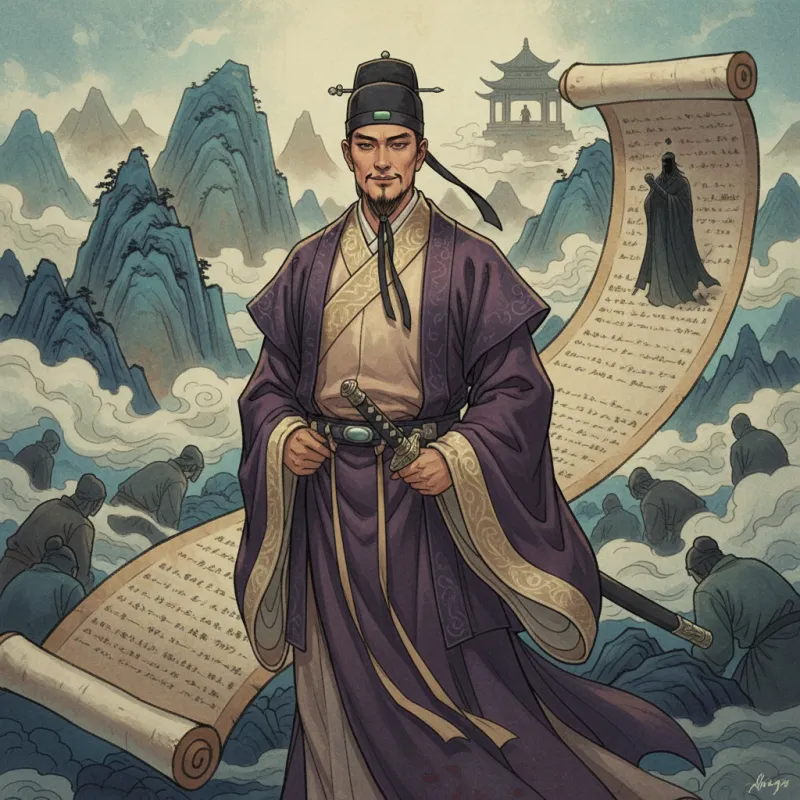
When Linghu Chong finally realizes his beloved master wants him dead, it's not because Yue Buqun suddenly turned evil. It's because the mask slipped — and the face underneath had been there all along. In The Smiling, Proud Wanderer (笑傲江湖 Xiào Ào Jiānghú), Jin Yong created something more unsettling than a villain: a man who weaponizes virtue itself, who turns righteousness into a blade sharper than any sword. Yue Buqun doesn't just betray his principles. He never had any to begin with.
The Gentleman's Mask
Yue Buqun (岳不群 Yuè Bùqún) carries the title "Gentleman Sword" (君子剑 Jūnzǐ Jiàn) like a shield. As the leader of the Huashan Sect (华山派 Huáshān Pài), he presents himself as the embodiment of orthodox martial arts values: honor, restraint, loyalty to tradition. He speaks in measured tones, quotes Confucian classics, and never raises his voice in anger. When other sect leaders argue at gatherings, Yue Buqun plays the mediator. When his students make mistakes, he corrects them with disappointed sighs rather than punishment.
This is precisely what makes him terrifying. Unlike Dongfang Bubai, who openly pursues power, or Ouyang Feng, whose cruelty is visible from the start, Yue Buqun understands that the most effective disguise is sincerity. He doesn't pretend to be good — he performs goodness so convincingly that even his own wife doesn't see through him until it's too late.
The genius of Jin Yong's characterization is that Yue Buqun never has a "turning point." There's no moment where he chooses evil over good. Instead, we slowly realize that every principled stance, every moral lecture, every act of seeming kindness was calculated from the beginning. The mask isn't hiding a transformation. It's hiding the fact that there was never anything underneath but ambition.
The Architecture of Hypocrisy
What separates Yue Buqun from simpler villains is the sophistication of his deception. He doesn't just lie — he builds an entire moral framework that serves his interests while appearing to serve justice. When he opposes the Demon Sect (魔教 Mójiào), it's not because he believes in righteousness, but because positioning himself as the defender of orthodoxy gives him authority. When he shows mercy to defeated opponents, it's not compassion but investment in his reputation.
Consider how he handles Linghu Chong's (令狐冲 Lìnghú Chōng) friendship with members of the unorthodox sects. A straightforward villain would simply forbid it. Yue Buqun does something more insidious: he expresses disappointment. He sighs. He speaks of how he understands youth's impetuousness, how he hopes Linghu Chong will eventually understand the wisdom of orthodox principles. This approach accomplishes two things simultaneously — it makes Linghu Chong feel guilty while reinforcing Yue Buqun's image as a patient, understanding teacher.
The brilliance is that Yue Buqun's hypocrisy isn't reactive. He doesn't compromise his principles when tempted — he designed his principles to have convenient loopholes from the start. When he needs to justify an action that contradicts his stated values, he doesn't struggle with the contradiction. He simply reframes it as a higher form of the same principle. Killing innocents becomes "protecting the greater good." Betraying allies becomes "maintaining orthodox unity." The language of morality becomes a tool for avoiding moral constraints.
The Evil Resplendent Manual
The Evil Resplendent Manual (辟邪剑谱 Bìxié Jiànpǔ) serves as the perfect test of Yue Buqun's character — and he fails it in the most revealing way possible. This legendary martial arts manual promises ultimate power but requires practitioners to castrate themselves first. For most people, this would be an impossible choice. For Yue Buqun, it's barely a hesitation.
What's chilling isn't that he makes this sacrifice for power. It's how quickly he makes it, and how little it seems to cost him emotionally. There's no agonized internal struggle, no sense that he's giving up something fundamental to his identity. He simply does the calculation: power versus everything else. Power wins. The ease of his decision reveals that all his talk of principle, all his performance of Confucian virtue, was exactly that — performance.
But even more revealing is what happens after. Yue Buqun doesn't abandon his righteous persona. If anything, he doubles down on it. He continues to speak of honor and tradition while secretly practicing techniques from a manual that the orthodox sects consider demonic. He lectures others about the dangers of unorthodox martial arts while becoming the very thing he claims to oppose. The hypocrisy isn't a side effect of his pursuit of power — it's the method itself.
Jin Yong understood something profound about this type of villain: the most dangerous hypocrites aren't the ones who fail to live up to their ideals. They're the ones who never believed in ideals at all, who see moral language purely as a tool for manipulation. Yue Buqun doesn't fall from grace because he was never standing on moral ground to begin with.
The Destruction of Linghu Chong
Yue Buqun's treatment of Linghu Chong reveals the full extent of his monstrosity. Linghu Chong is everything Yue Buqun pretends to be: genuinely honorable, loyal, willing to sacrifice for others. He's also Yue Buqun's most talented student, the one who should inherit the Huashan Sect. But that's precisely why Yue Buqun must destroy him.
The relationship between master and student in Chinese martial arts tradition is sacred — closer than blood, bound by loyalty that transcends family. Yue Buqun exploits this bond ruthlessly. He uses Linghu Chong's devotion as a weapon against him, knowing that the young man's loyalty will make him vulnerable, will make him doubt his own perceptions when the truth starts to emerge.
When Linghu Chong begins to see through the facade, Yue Buqun doesn't confront him directly. Instead, he orchestrates situations that make Linghu Chong look disloyal, that force him into positions where defending himself means appearing to attack his master. It's psychological warfare disguised as disappointed mentorship. Every interaction is designed to make Linghu Chong question himself while reinforcing Yue Buqun's image as the wronged teacher.
The cruelty isn't just in the betrayal itself — it's in how Yue Buqun makes Linghu Chong complicit in his own destruction. By maintaining the performance of the caring master even as he plots Linghu Chong's death, Yue Buqun ensures that Linghu Chong will blame himself, will wonder if he somehow failed his master rather than recognizing that his master failed him from the beginning.
Why Yue Buqun Terrifies Us
Jin Yong's villains usually represent extremes: extreme cruelty, extreme ambition, extreme obsession. Yue Buqun represents something more common and therefore more frightening — the person who uses morality as camouflage, who understands that the best way to avoid accountability is to control the language of accountability itself.
We've all encountered versions of Yue Buqun. The leader who speaks eloquently about values while violating them. The mentor who uses their position to manipulate rather than guide. The authority figure who weaponizes disappointment and moral superiority to maintain control. What makes Yue Buqun so effective as a character is that Jin Yong doesn't make him a caricature. His hypocrisy is subtle, sophisticated, almost plausible.
In Chinese literature, there's a long tradition of exploring the gap between appearance and reality, between the performance of virtue and actual virtue. Confucian philosophy itself warns against those who speak of righteousness but act without it — the "petty person" (小人 xiǎorén) who mimics the "superior person" (君子 jūnzǐ) without understanding the substance. Yue Buqun is the ultimate petty person, someone who has studied the performance so thoroughly that he can fool almost everyone.
What's particularly unsettling is that Yue Buqun's hypocrisy is sustainable. Unlike villains whose evil eventually consumes them, Yue Buqun's approach could theoretically work forever. If Linghu Chong hadn't been so stubbornly principled, if circumstances hadn't forced the truth into the open, Yue Buqun might have died respected and honored, his true nature never revealed. The mask could have become the legacy.
The Mirror We Don't Want to See
Perhaps the deepest reason Yue Buqun disturbs us is that he forces an uncomfortable question: how many of our own principles are genuine, and how many are performance? How often do we use moral language not because we believe it but because it's useful? When we talk about honor, loyalty, righteousness — are we describing our values or constructing our disguise?
Jin Yong doesn't let us off easy. He shows us that Yue Buqun's hypocrisy isn't supernatural or incomprehensible. It's human. It's the logical endpoint of treating morality as a tool rather than a commitment. Every time Yue Buqun makes a choice, we can follow his reasoning. We can see why he does what he does. And that's what makes him so terrifying — not that he's alien to us, but that he's not alien enough.
The tragedy of The Smiling, Proud Wanderer isn't just that evil wins for a while. It's that evil wins by looking exactly like good, by speaking the language of virtue so fluently that distinguishing between them becomes nearly impossible. Yue Buqun doesn't destroy the Huashan Sect through obvious villainy. He destroys it by being exactly what everyone thought a sect leader should be — until the moment when being that person no longer served his interests.
In the end, Yue Buqun's greatest crime isn't his ambition or his cruelty. It's his corruption of meaning itself, his transformation of every noble word into a potential lie. After Yue Buqun, how can anyone trust a gentleman's sword? How can anyone hear moral language without wondering what it's hiding? He doesn't just betray individuals — he betrays the possibility of trust itself.
That's why, decades after The Smiling, Proud Wanderer was published, Yue Buqun remains one of Jin Yong's most discussed villains. Not because he's the most powerful or the most cruel, but because he's the most recognizable. We've met him. We've trusted him. And some of us, in our worst moments, have been him. The gentleman's mask isn't just Yue Buqun's disguise. It's a warning about how easily any of us could pick it up and wear it ourselves.
Related Reading
- The Most Complex Villains in Jin Yong Fiction
- Jin Yong's Villains: Why the Bad Guys Are Often the Best Characters
- Villains of Jin Yong's Wuxia Novels: Complexity, Motives, and Legacy
- The Greatest Villains in Jin Yong's Novels
- The Most Tragic Villains in Jin Yong's Novels
- Exploring the Enigmatic Worlds of Jin Yong's Wuxia Novels
- Jin Yong's Writing Career: From First Novel to Final Retirement
- The 10 Most Powerful Martial Arts Techniques in Jin Yong's Novels