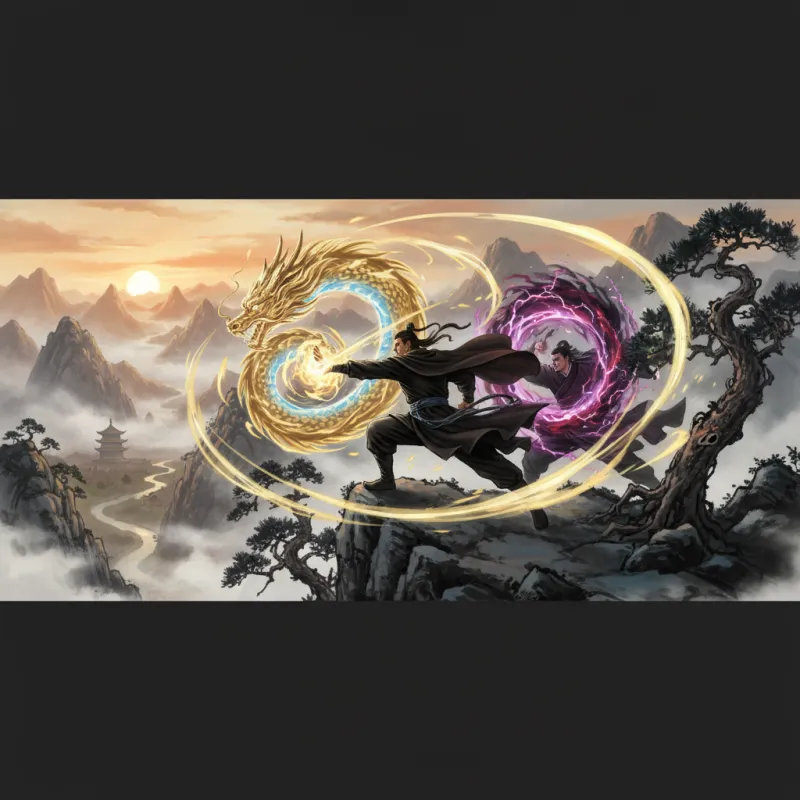
Every Jin Yong fan has wasted hours on this argument. You're three drinks in, someone mentions Dugu Qiubai, and suddenly it's 2 AM and you're drawing power-scaling diagrams on napkins. Which martial art technique reigns supreme across Jin Yong's (金庸 Jīn Yōng) fifteen novels? It's an impossible question with no right answer — which is exactly why we're going to answer it anyway.
The beauty of Jin Yong's martial arts system is that he actually cared about internal consistency. Unlike some wuxia (武侠 wǔxiá) authors who just kept inventing increasingly ridiculous techniques, Jin Yong built a world where power had rules, limitations, and trade-offs. Sure, he contradicted himself occasionally across novels, but there's enough evidence to make real arguments. So here's my definitive ranking of the ten most devastating techniques in the Jin Yong universe, fully aware that you'll disagree with at least half of them.
The Untouchable Top Tier
1. Six Meridians Divine Sword (六脉神剑 Liùmài Shénjiàn)
From Demi-Gods and Semi-Devils (天龙八部 Tiānlóng Bābù), this is the technique that breaks the game. Invisible sword qi (气 qì) that shoots from your fingertips at the speed of thought? It's basically having six lightsabers that your opponent can't see. Duan Yu stumbles into mastering this technique through sheer dumb luck and internal energy absorption, but when it works, it's unstoppable.
The genius of the Six Meridians Divine Sword is that it eliminates the fundamental problem of all martial arts: distance and reaction time. Your opponent can't block what they can't see coming. The only counter is overwhelming internal energy or not being there when it fires. Even Jiumozhi (鸠摩智 Jiūmózhì), one of the era's top martial artists, gets absolutely demolished when facing the complete technique.
2. Nine Yin Manual (九阴真经 Jiǔyīn Zhēnjīng)
This isn't just a technique — it's the entire martial arts PhD program compressed into one text. Appearing across multiple novels but most prominently in The Legend of the Condor Heroes (射雕英雄传 Shèdiāo Yīngxióng Zhuàn), the Nine Yin Manual is what happens when a genius decides to document everything. Internal energy cultivation, healing, combat techniques, even psychological warfare — it's all there.
What makes the Nine Yin Manual truly powerful is its completeness. Most martial arts have weaknesses or gaps. The Nine Yin Manual anticipated those gaps and filled them. Zhou Botong (周伯通 Zhōu Bótōng) goes from skilled fighter to absolute monster after learning it. Guo Jing (郭靖 Guō Jìng) uses it to shore up his defensive weaknesses. Even partial knowledge of it makes you formidable. The only downside? It takes decades to master properly, and most people who try end up going insane or dying from practice deviation.
3. Eighteen Dragon-Subduing Palms (降龙十八掌 Jiàng Lóng Shíbā Zhǎng)
The most iconic technique in Jin Yong's arsenal, and for good reason. This is the technique that proves sometimes the old ways are the best ways. No tricks, no invisibility, no mystical nonsense — just overwhelming force delivered with perfect technique. When Hong Qigong (洪七公 Hóng Qīgōng) or Guo Jing unleashes these palms, the earth literally shakes.
What I love about the Eighteen Dragon-Subduing Palms is that it's the great equalizer. You can see it coming. You know what it does. And you still can't stop it if the user has sufficient internal energy. It's the martial arts equivalent of a freight train — pure kinetic energy that doesn't care about your clever counters. The technique appears across multiple novels and consistently ranks as top-tier, which tells you everything about its effectiveness.
The Specialist Tier
4. Sunflower Manual (葵花宝典 Kuíhuā Bǎodiǎn)
Here's where things get controversial. The Sunflower Manual from The Smiling, Proud Wanderer (笑傲江湖 Xiào'ào Jiānghú) grants incredible speed and power, but at a cost that makes most practitioners hesitate. You know the cost. We all know the cost. Dongfang Bubai (东方不败 Dōngfāng Bùbài) becomes essentially unbeatable after mastering it, moving so fast that multiple top-tier fighters can barely track him.
The question is whether the technique itself is powerful or whether it's just Dongfang Bubai who's powerful. I'd argue it's both. The Sunflower Manual fundamentally rewrites how your body processes internal energy, granting speed that borders on supernatural. But it also requires a level of commitment that most martial artists won't make. That psychological barrier is part of what makes it so rare and feared.
5. Beiming Divine Art (北冥神功 Běimíng Shéngōng)
Another technique from Demi-Gods and Semi-Devils, and possibly the most broken ability in terms of pure potential. The Beiming Divine Art lets you absorb other people's internal energy directly. It's the martial arts equivalent of a vampire — you get stronger by draining your opponents. Duan Yu accidentally absorbs decades of cultivation from multiple masters and becomes a powerhouse without actually training.
The limitation is that you need the opportunity to make contact and absorb, which is harder against skilled opponents. But in terms of raw power ceiling, nothing else comes close. You're essentially stealing decades of other people's hard work. It's cheating, but it's effective cheating. The technique also appears in other power-scaling discussions as one of the most efficient cultivation methods.
6. Nine Yang Manual (九阳真经 Jiǔyáng Zhēnjīng)
The yang to the Nine Yin Manual's yin, appearing most prominently in The Heaven Sword and Dragon Saber (倚天屠龙记 Yǐtiān Túlóng Jì). While the Nine Yin Manual is comprehensive, the Nine Yang Manual is specialized — it's all about building an absolutely indestructible foundation of internal energy. Zhang Wuji (张无忌 Zhāng Wújì) masters this and becomes essentially immune to most attacks and poisons.
What makes the Nine Yang Manual special is that it's the ultimate defensive technique that also grants offensive power. Your internal energy becomes so pure and abundant that you can learn almost any other technique easily. Zhang Wuji picks up the Great Solar Shift in hours because his foundation is so solid. It's not flashy, but it's the technique you'd actually want if you had to survive in the jianghu (江湖 jiānghú).
The Wildcard Tier
7. Dugu Nine Swords (独孤九剑 Dúgū Jiǔ Jiàn)
Dugu Qiubai's (独孤求败 Dúgū Qiúbài) legendary technique, passed down to Linghu Chong (令狐冲 Línghú Chōng) in The Smiling, Proud Wanderer. This is the technique for people who think internal energy cultivation is boring. The Dugu Nine Swords is pure technique — it's about reading your opponent's moves and exploiting the inevitable weaknesses in any martial art.
The catch is that it requires genius-level martial arts comprehension and lightning-fast reactions. In the right hands, it can defeat techniques that should be far superior. Linghu Chong beats opponents with decades more internal energy because he can see the flaws in their forms. But it's also the technique most dependent on the user's natural talent. Give it to an average martial artist and they'll just die faster.
8. Yijin Jing (易筋经 Yìjīn Jīng)
The Shaolin Temple's ultimate internal energy cultivation method, appearing across multiple novels. The Yijin Jing doesn't teach you flashy moves — it rebuilds your body from the ground up, making your muscles, bones, and meridians far more efficient at channeling internal energy. It's the difference between running regular gasoline and rocket fuel.
What makes the Yijin Jing powerful is that it multiplies the effectiveness of everything else you know. Your ordinary palm strike becomes devastating. Your defensive techniques become impenetrable. It's the technique that turns good martial artists into great ones. The downside is that it takes years of dedicated Buddhist practice to master properly, which is why most people never complete it.
9. Star Absorbing Great Technique (吸星大法 Xīxīng Dàfǎ)
The evil twin of the Beiming Divine Art, from The Smiling, Proud Wanderer. Like the Beiming Divine Art, it absorbs other people's internal energy, but it's cruder and more dangerous. The absorbed energy isn't fully refined, which means you're constantly at risk of qi deviation. But in terms of rapid power gain, it's unmatched.
Ren Woxing (任我行 Rèn Wǒxíng) uses this technique to become one of the most feared martial artists of his generation. The technique represents the dark side of martial arts — the shortcut that works but might kill you. It's powerful enough to make this list, but it's also the technique most likely to backfire catastrophically. For more on the risks of rapid cultivation methods, see this analysis of cultivation dangers.
10. Toad Stance (蛤蟆功 Hámá Gōng)
Ouyang Feng's (欧阳锋 Ōuyáng Fēng) signature technique from The Legend of the Condor Heroes rounds out the list. Yes, it looks ridiculous. Yes, you have to squat like a toad. But it's also one of the most effective defensive and counter-attacking techniques in Jin Yong's universe. The stance generates explosive power from a seemingly vulnerable position, and the internal energy cultivation method is genuinely formidable.
What I appreciate about the Toad Stance is that it proves Jin Yong understood that effective martial arts don't have to look cool. Ouyang Feng is consistently ranked as one of the Five Greats, and this technique is a huge part of why. It's unorthodox, it's weird, but it works. Sometimes that's all that matters.
The Honorable Mentions
Several techniques barely missed the cut. The Finger Flicking Divine Skill (弹指神通 Tánzhǐ Shéntōng) is devastating but too specialized. The Jade Maiden Heart Sutra (玉女心经 Yùnǚ Xīnjīng) is powerful but requires two people. The Taizu Long Fist (太祖长拳 Tàizǔ Chángquán) is foundational but not flashy enough for a top ten list.
The truth is that Jin Yong created dozens of techniques that could arguably make this list. The ranking changes depending on whether you value versatility over raw power, or whether you care about the difficulty of mastery. That's what makes these novels endlessly rereadable — the power system is complex enough to support genuine debate.
What's your ranking? Because I guarantee it's different from mine, and that's exactly how Jin Yong would have wanted it.
Related Reading
- The Martial Arts Ranking Debate: Who Is Actually the Strongest in Jin Yong?
- The Five Greats Across All Generations: How the Rankings Changed
- The Definitive Jin Yong Martial Arts Power Ranking
- The 20 Strongest Characters in Jin Yong's Universe: A Definitive Ranking
- Exploring the Rich Tapestry of Jin Yong's Wuxia Novels: Characters and Martial Arts
- Jin Yong's Global Influence: How Wuxia Went Worldwide
- Exploring the Enigmatic Worlds of Jin Yong's Wuxia Novels