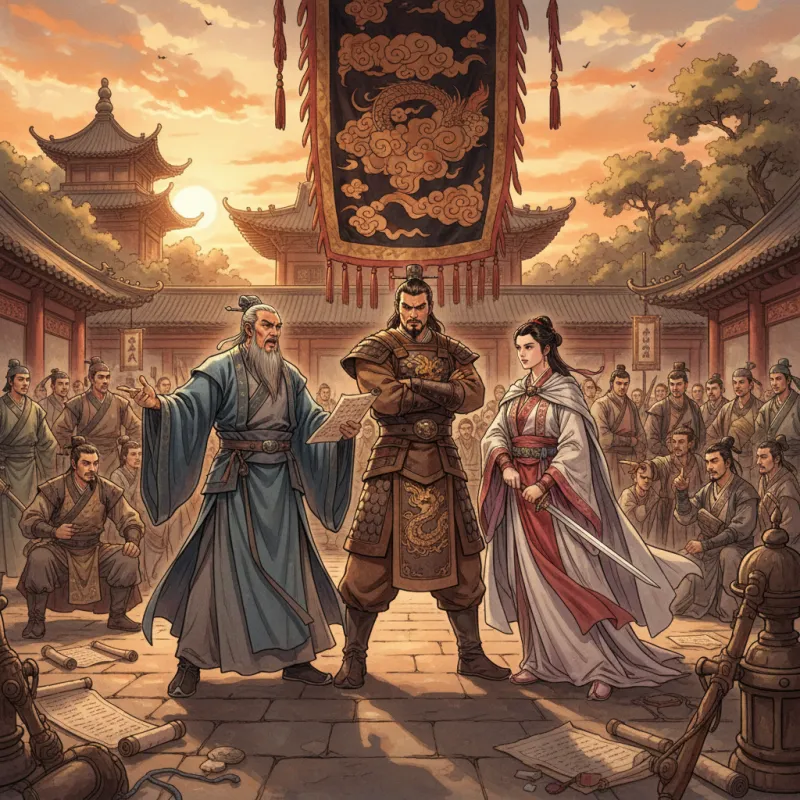
Who would win in a fight: a monk who can redirect force itself, a beggar who commands an army of information gatherers, or a dead swordsman nobody ever met? If you've spent any time in Jin Yong fan communities, you know this question starts wars. Not polite disagreements—actual, multi-page forum battles with citations, diagrams, and personal attacks. The martial arts ranking debate in Jin Yong's novels isn't just about power levels. It's about what power even means.
The Phantom at the Top
Dugu Qiubai (独孤求败, Dúgū Qiúbài)—the Solitary Sword Seeker—never appears in any Jin Yong novel. He's already centuries dead when the stories begin. Yet his shadow falls across multiple books. Yang Guo finds his cave in Return of the Condor Heroes. Linghu Chong inherits his techniques in Smiling, Proud Wanderer. His legend is consistent: he was so overwhelmingly powerful that he couldn't find anyone worth fighting, and he died alone, bored, possibly depressed.
The case for Dugu Qiubai rests on his final martial stage—fighting without weapons, using only internal energy to manipulate the environment. This represents the theoretical ceiling of wuxia achievement. He transcended technique entirely. But here's the problem: we never see him do anything. His power exists only in reputation, in the awe of characters who find his training grounds. He's Schrödinger's martial artist—simultaneously the strongest and completely unverifiable.
The Monk Who Rewrote Physics
Sweeping Monk (扫地僧, Sǎodì Sēng) appears for exactly one scene in Demigods and Semi-Devils, and that scene breaks the novel's power scaling. He's an unnamed janitor at Shaolin Temple who casually stops techniques that have killed dozens of masters. He doesn't just block attacks—he redirects them with such precision that fighters injure themselves. When Xiao Yuanshan and Murong Bo, two of the generation's top martial artists, attack him simultaneously, he defeats them while healing their decades-old internal injuries.
What makes Sweeping Monk terrifying isn't raw power—it's understanding. He explains that advanced martial arts damage the practitioner unless balanced with Buddhist cultivation. He's not just stronger; he's operating on a different level of comprehension. He sees the martial world the way a physicist sees a child's toy. The novel implies he's been at Shaolin for decades, possibly centuries, just sweeping floors and reading sutras. His power is almost accidental, a side effect of spiritual enlightenment.
But Sweeping Monk has the same problem as Dugu Qiubai: limited screen time. We see one fight. We don't know his limits. Jin Yong deliberately keeps him mysterious, which makes him narratively powerful but analytically frustrating.
The Beggar King's Different Game
Hong Qigong (洪七公, Hóng Qīgōng) from Legend of the Condor Heroes represents a different kind of strength. He's not the most technically skilled fighter—Huang Yaoshi and Ouyang Feng match him in pure martial ability. But Hong Qigong leads the Beggars' Sect, which means he commands the largest intelligence network in the martial world. He knows everyone's secrets, movements, and weaknesses before fights begin.
This raises an uncomfortable question: does martial arts ranking include strategic resources? Hong Qigong can call on thousands of beggars to gather information, create diversions, or poison an enemy's food supply. He doesn't need to be the strongest in single combat if he can ensure single combat never happens on unfavorable terms. When fans debate "strongest character," they usually mean one-on-one fights in neutral territory. But that's not how power works in Jin Yong's world. The novels repeatedly show that context, preparation, and allies matter more than individual skill.
The Women Everyone Forgets
The strongest character debates almost always focus on men, which reveals a bias in how fans read these novels. Xiao Longnu (小龙女, Xiǎo Lóngnǚ) from Return of the Condor Heroes masters the Ancient Tomb Sect's techniques, which are specifically designed to counter traditional martial arts. She fights without emotion, which makes her unpredictable and immune to psychological warfare. At her peak, she defeats multiple top-tier opponents simultaneously.
Huang Rong (黄蓉, Huáng Róng) is rarely mentioned in strength debates because her power is intellectual, not physical. But she outmaneuvers nearly every character in Legend of the Condor Heroes and Return of the Condor Heroes. She solves the Nine Yin Manual's mysteries, leads the Beggars' Sect, and orchestrates the defense of Xiangyang. If we're measuring who actually accomplishes the most and survives the longest, Huang Rong has a strong case.
The exclusion of female characters from "strongest" debates shows how fans unconsciously equate strength with masculine displays of force. Jin Yong's novels are more sophisticated than that.
The Technique Versus Cultivation Problem
Zhang Sanfeng (张三丰, Zhāng Sānfēng) founded Wudang and created Taiji Quan in his nineties. In Heaven Sword and Dragon Saber, he's over a hundred years old and still the most formidable martial artist alive. His strength comes from internal cultivation—he's built decades of pure internal energy that younger, more technically skilled fighters can't match.
This highlights the core tension in Jin Yong's martial arts philosophy: is peak performance about technique mastery or internal cultivation? Dugu Qiubai represents the technique path taken to its extreme—so skilled that weapons become unnecessary. Zhang Sanfeng represents the cultivation path—so much internal energy that technique becomes almost irrelevant.
Most characters in Jin Yong's novels are stuck between these poles. They learn techniques but don't live long enough to accumulate Zhang Sanfeng's decades of cultivation. They build internal energy but never achieve Dugu Qiubai's technical transcendence. The "strongest" character might simply be whoever lives longest without getting killed, which is a depressing but realistic answer.
What the Debate Actually Reveals
The martial arts ranking debate persists because Jin Yong deliberately made it unresolvable. He wrote different novels with different power scales. Demigods and Semi-Devils features characters who can kill with sound waves and destroy buildings with palm strikes. Fox Volant of the Snowy Mountain is much more grounded—fights are faster, deadlier, and more realistic. Comparing characters across novels is like comparing superheroes across different comic universes with different physics.
But the debate reveals what fans value. If you argue for Dugu Qiubai, you value theoretical perfection and the romance of the undefeated legend. If you argue for Sweeping Monk, you value wisdom and the integration of martial arts with spiritual cultivation. If you argue for Hong Qigong or Huang Rong, you value practical effectiveness over abstract power levels. If you argue for Zhang Sanfeng, you value longevity and the patient accumulation of skill.
The question "who is strongest" is really asking "what does strength mean?" And Jin Yong's answer, across sixteen novels, is that strength means different things in different contexts. The swordsman who can split mountains is useless in political intrigue. The strategic genius gets killed by a random arrow. The enlightened monk chooses not to fight at all.
The Real Answer Nobody Wants
Here's the uncomfortable truth: the strongest character in Jin Yong's novels is probably someone boring. It's the mid-tier martial artist who avoids stupid fights, builds alliances, lives carefully, and dies of old age. It's the person who never appears in "strongest character" debates because they're not narratively interesting.
Jin Yong's novels are tragedies disguised as adventure stories. The most powerful characters—Xiao Feng, Yang Guo, Linghu Chong—are all deeply damaged. Their strength isolates them, makes them targets, ruins their relationships. Dugu Qiubai literally died of loneliness. The pursuit of martial supremacy is presented as both glorious and poisonous.
So who's actually the strongest? It depends on whether you're asking who would win a fight, who accomplishes the most, who lives the best life, or who embodies Jin Yong's ideals. The debate never ends because the question has no single answer—and that's exactly what makes Jin Yong's martial arts world so endlessly fascinating.
For more on how Jin Yong's characters develop their abilities, see The Evolution of Internal Energy Cultivation. And if you're interested in how different sects approach martial training, check out Comparing the Major Martial Arts Schools.
Related Reading
- The Definitive Jin Yong Martial Arts Power Ranking
- The 10 Most Powerful Martial Arts Techniques in Jin Yong's Novels
- The 20 Strongest Characters in Jin Yong's Universe: A Definitive Ranking
- The Five Greats Across All Generations: How the Rankings Changed
- Exploring the Enigmatic Worlds of Jin Yong's Wuxia Novels
- The Most Complex Villains in Jin Yong Fiction
- Peach Blossom Island: The Most Magical Location in Jin Yong's World