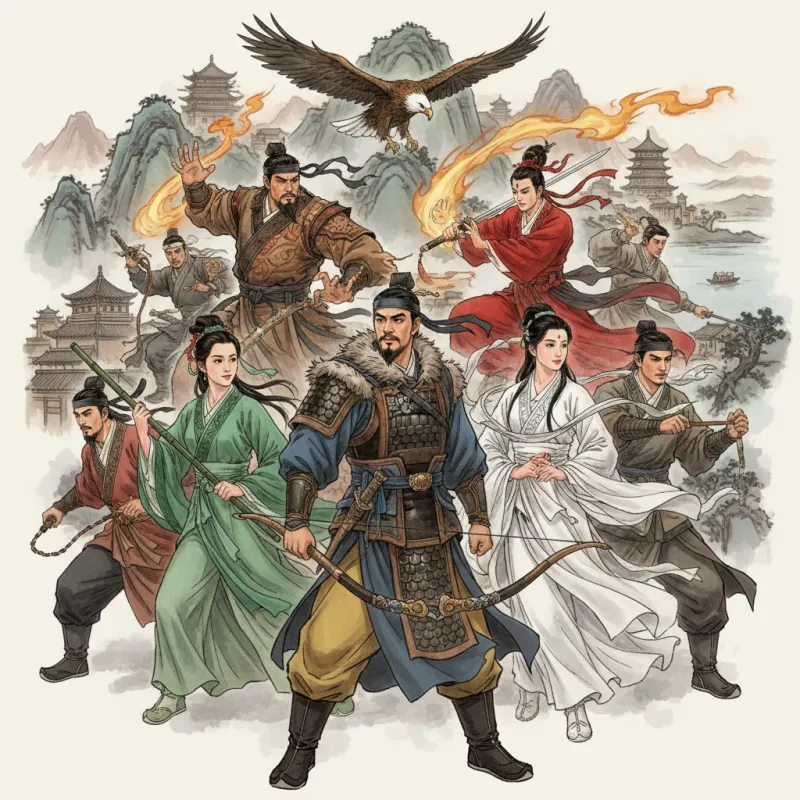
When Guo Jing stood atop the walls of Xiangyang, facing down the Mongol hordes with nothing but his Eighteen Dragon-Subduing Palms (降龍十八掌, jiàng lóng shíbā zhǎng) and an unshakeable sense of duty, Jin Yong wasn't just writing another martial arts scene. He was crystallizing a philosophy that would captivate hundreds of millions of readers and fundamentally reshape how Chinese people—and eventually, the world—understood heroism, loyalty, and the martial way. Louis Cha Leung-yung (查良鏞, Chá Liángyōng), writing under the pen name Jin Yong (金庸, Jīn Yōng), didn't merely revive the wuxia genre between 1955 and 1972. He transformed it into something approaching modern mythology.
The Architect of Modern Wuxia
Before Jin Yong, wuxia fiction existed in a state of pulpy disrepute—entertaining, perhaps, but rarely taken seriously as literature. Writers like Huanzhulouzhu had pioneered fantastical martial arts tales in the Republican era, but their works often descended into absurdity, with heroes leaping miles through the air and summoning divine swords from thin air. Jin Yong changed everything by grounding his martial arts in a kind of internal logic, creating systems like the Nine Yin Manual (九陰真經, jiǔ yīn zhēn jīng) and the Beggars' Sect's Dog-Beating Staff Technique (打狗棒法, dǎ gǒu bàng fǎ) that felt simultaneously mystical and believable.
His fifteen novels—from "The Book and the Sword" (書劍恩仇錄, shū jiàn ēn chóu lù) in 1955 to "The Deer and the Cauldron" (鹿鼎記, lù dǐng jì) in 1972—sold over 300 million copies worldwide. But numbers don't capture the cultural penetration. In Chinese-speaking communities, you're more likely to find someone who hasn't read Shakespeare than someone unfamiliar with Linghu Chong's carefree swordsmanship or Huang Rong's cunning intelligence. Jin Yong's characters became the vocabulary through which people discussed personality types, moral dilemmas, and romantic ideals.
Martial Arts as Philosophy, Not Just Combat
What distinguishes Jin Yong's martial arts from mere fight choreography is their philosophical depth. Take the Dugu Nine Swords (獨孤九劍, dú gū jiǔ jiàn), the legendary technique that appears in "The Smiling, Proud Wanderer" (笑傲江湖, xiào ào jiāng hú). This isn't just a collection of sword moves—it's a Daoist meditation on formlessness, on responding to the opponent's intent rather than their actions. The technique has no fixed forms precisely because rigidity is the enemy of true mastery. This mirrors the Daodejing's teaching that "the softest things in the world overcome the hardest."
Similarly, the internal energy cultivation (內功, nèi gōng) systems in Jin Yong's novels reflect genuine Chinese martial philosophy. When Zhang Wuji learns the Nine Yang Divine Skill (九陽神功, jiǔ yáng shén gōng) in "The Heaven Sword and Dragon Saber" (倚天屠龍記, yǐ tiān tú lóng jì), he's not just gaining superpowers—he's harmonizing his internal energy channels, balancing yin and yang forces within his body. Jin Yong drew from actual Daoist internal alchemy texts, making his martial arts feel like natural extensions of Chinese metaphysical thought rather than fantasy inventions.
The Buddhist influence runs equally deep. Sweeping Monk's appearance in "Demi-Gods and Semi-Devils" (天龍八部, tiān lóng bā bù) represents perhaps Jin Yong's most profound statement on martial arts: that the highest kung fu transcends technique entirely, becoming an expression of spiritual cultivation. The monk's ability to neutralize deadly attacks through pure compassion suggests that martial arts, at their peak, dissolve into something beyond violence.
Characters Who Became Cultural Archetypes
Jin Yong created characters so vivid and psychologically complex that they've become reference points in Chinese culture. Guo Jing, the protagonist of "The Legend of the Condor Heroes" (射鵰英雄傳, shè diāo yīng xióng zhuàn), embodies the Confucian ideal of the righteous hero—slow-witted but sincere, powerful but humble, always placing duty to country above personal gain. When Chinese people want to describe someone as earnestly patriotic but perhaps lacking sophistication, they might call them "a Guo Jing type."
Contrast this with Yang Guo from "The Return of the Condor Heroes" (神鵰俠侶, shén diāo xiá lǚ), Guo Jing's spiritual successor who represents a more rebellious, individualistic heroism. Yang Guo defies social conventions by loving his teacher, Xiaolongnü, and his character arc explores whether personal happiness can coexist with heroic duty. This tension between Confucian obligation and individual desire runs through Jin Yong's entire body of work.
Then there's Wei Xiaobao from "The Deer and the Cauldron," Jin Yong's final and most subversive protagonist. Wei is no martial artist at all—he's a street-smart con artist who succeeds through cunning, luck, and shameless opportunism. By making this morally ambiguous trickster his last hero, Jin Yong seemed to be questioning the very foundations of the wuxia genre he'd spent decades perfecting. Wei Xiaobao suggests that perhaps survival and adaptability matter more than rigid adherence to martial codes.
The female characters deserve special attention. Huang Rong, Zhao Min, Ren Yingying, and Xiaolongnü aren't mere love interests—they're fully realized individuals with their own martial abilities, strategic minds, and moral complexities. Huang Rong's intelligence often surpasses her husband Guo Jing's, and she's the one who devises the defensive strategies that keep Xiangyang standing against the Mongols. Jin Yong wrote these novels in the 1950s-70s, yet his female characters possessed agency that many contemporary Western fantasy novels still struggle to achieve.
Historical Authenticity Meets Romantic Imagination
Jin Yong's genius lay partly in his meticulous historical research. "The Deer and the Cauldron" unfolds during the early Qing Dynasty, incorporating real figures like Emperor Kangxi and the rebel leader Wu Sangui. The novel's depiction of the Qing court's Manchu-Han tensions, the suppression of the Ming loyalists, and the geopolitical maneuvering with Russia reflects genuine historical dynamics. Yet Jin Yong weaves his fictional martial artists seamlessly into this historical tapestry, making readers wonder if perhaps these secret societies and hidden masters really did exist.
"Demi-Gods and Semi-Devils" takes place during the Song Dynasty's conflicts with the Liao and Western Xia kingdoms. The novel's protagonist, Qiao Feng (later revealed as Xiao Feng), embodies the tragic complexity of ethnic identity—raised as Han Chinese but discovering his Khitan heritage, he becomes a man without a country. This storyline resonates powerfully in modern contexts of diaspora, mixed heritage, and national identity, showing how Jin Yong used historical settings to explore timeless human dilemmas.
The martial arts sects in Jin Yong's novels—Shaolin, Wudang, Emei, Kunlun—are based on real martial traditions, though heavily romanticized. Shaolin Temple actually exists and has practiced kung fu for centuries. Wudang Mountain is genuinely associated with Daoist martial arts. By anchoring his fiction in these real places and traditions, Jin Yong created a sense of verisimilitude that made his fantastical martial arts feel almost plausible.
Cultural Impact Beyond Literature
The influence of Jin Yong's novels extends far beyond the page. They've been adapted into over 100 films and television series, with new versions appearing almost every decade. The 1983 TVB adaptation of "The Legend of the Condor Heroes" starring Felix Wong became a cultural phenomenon that defined Hong Kong television. More recently, lavish productions with CGI-enhanced martial arts sequences have introduced Jin Yong's stories to younger generations.
Video games have embraced Jin Yong's universe enthusiastically. The "Jinyong Qunxia Zhuan" (金庸群俠傳, jīn yōng qún xiá zhuàn) series allows players to interact with characters from across Jin Yong's novels, learning their martial arts and experiencing their storylines. These games have become classics in Chinese gaming culture, introducing Jin Yong's work to audiences who might never pick up the original novels.
The linguistic impact is equally profound. Phrases from Jin Yong's novels have entered everyday Chinese speech. "The affairs of the jianghu are settled in the jianghu" (江湖事江湖了, jiāng hú shì jiāng hú liǎo) has become a common saying about handling problems within their proper context. Character names and martial arts techniques are used as metaphors in business, politics, and daily conversation. This level of cultural penetration is comparable to how Shakespeare's phrases permeate English.
The Philosophy of Xia: Heroism and Righteousness
At the heart of Jin Yong's work lies the concept of xia (俠, xiá)—often translated as "chivalry" or "knight-errantry," but encompassing something deeper. The xia is someone who uses martial prowess to uphold justice, protect the weak, and maintain moral order outside official channels. This tradition dates back to the Warring States period, when wandering swordsmen offered their services to those wronged by corrupt officials or powerful bullies.
Jin Yong explored different facets of xia through his various protagonists. Guo Jing represents the "great xia" (大俠, dà xiá) who serves the nation—his famous declaration that "the great xia serves the country and the people" (俠之大者,為國為民, xiá zhī dà zhě, wèi guó wèi mín) has become one of the most quoted lines in Chinese popular culture. This Confucian interpretation of heroism emphasizes duty, sacrifice, and collective welfare over individual glory.
But Jin Yong also presented alternative visions. Linghu Chong in "The Smiling, Proud Wanderer" embodies a more Daoist xia—carefree, wine-loving, uninterested in power or fame, yet intervening when he witnesses injustice. His heroism is spontaneous rather than dutiful, flowing from his nature rather than imposed moral codes. This represents a different but equally valid expression of the xia spirit.
The tension between orthodox and unorthodox martial arts (正派與邪派, zhèng pài yǔ xié pài) in Jin Yong's novels mirrors broader questions about moral absolutism. Are the "righteous" sects truly righteous, or do they simply have better public relations? Jin Yong repeatedly shows that the orthodox schools can be hypocritical, rigid, and cruel, while supposedly "evil" characters often display genuine loyalty and honor. This moral complexity elevates his work above simple good-versus-evil narratives.
Legacy and Continuing Relevance
Jin Yong passed away in 2018 at age 94, but his literary legacy shows no signs of fading. New readers continue discovering his novels, and scholarly analysis of his work has become a legitimate academic field. Universities offer courses on Jin Yong's literature, examining his narrative techniques, philosophical themes, and cultural significance.
His influence on subsequent generations of Chinese writers is immeasurable. The entire genre of Chinese web novels—now a multi-billion dollar industry—owes its existence partly to Jin Yong's popularization of serialized martial arts fiction. While modern web novels often take the genre in more fantastical directions, incorporating elements of cultivation, reincarnation, and system mechanics, they're building on foundations Jin Yong established.
The international recognition of Jin Yong's work has grown steadily. English translations of his novels, though challenging due to the cultural specificity and linguistic complexity, have introduced Western readers to his genius. The success of wuxia-influenced works like "Crouching Tiger, Hidden Dragon" and "Hero" in Western markets owes much to the narrative and aesthetic traditions Jin Yong refined.
What makes Jin Yong's novels endure is their fundamental humanity. Beneath the spectacular martial arts and historical intrigue, they're stories about people struggling with love, duty, identity, and mortality. Whether it's Duan Yu's unrequited love in "Demi-Gods and Semi-Devils," Zhang Wuji's paralysis when choosing between four women who love him, or Yang Guo's sixteen-year wait for Xiaolongnü, these emotional cores resonate across cultures and generations.
Jin Yong once said he wrote his novels to entertain readers during their lunch breaks. This modest self-assessment belies the profound impact his work has had on Chinese culture and beyond. He created a universe where martial arts transcend mere combat to become expressions of philosophy, where historical fiction illuminates contemporary concerns, and where entertainment and depth coexist seamlessly. In doing so, he ensured that the wuxia tradition—and his particular vision of it—will continue inspiring readers, writers, and dreamers for generations to come.
Related Reading
- The Nine Yin Manual: Most Coveted Martial Arts Text
- The Five Greats Explained: Understanding Jin Yong's Power Elite
- Understanding Jin Yong's Martial Arts Ranking System
- Wudang vs. Shaolin: The Great Rivalry of Chinese Martial Arts
- Top 10 Martial Arts Schools in Jin Yong's Novels
- Exploring the Rich Tapestry of Jin Yong's Wuxia Novels: Characters and Martial Arts
- The Iconic Soundtracks of Jin Yong TV Adaptations
- Unveiling the Wisdom and Philosophy in Jin Yong's Wuxia Novels