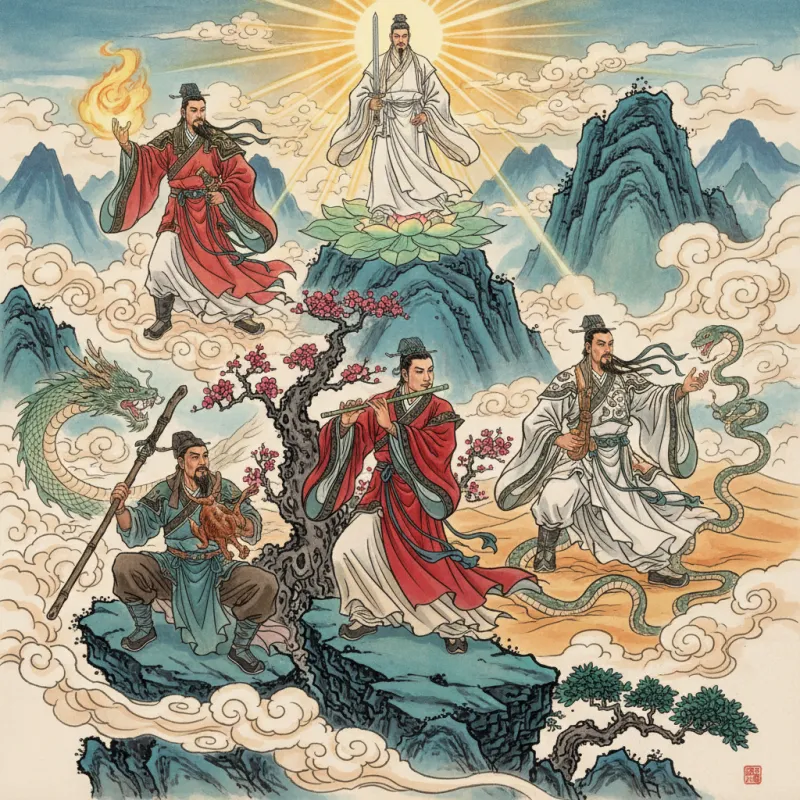
When Huang Yaoshi smashed his jade flute against the rocks of Peach Blossom Island, he wasn't just having a tantrum — he was demonstrating why Jin Yong's Five Greats system remains the most sophisticated power hierarchy in martial arts fiction. Unlike the crude "who would win in a fight" rankings that plague modern fantasy, the 五绝 (Wǔjué, Five Greats) represents something far more nuanced: a recognition that supreme mastery takes radically different forms, and that true greatness cannot be reduced to a single dimension.
The Genius of Directional Identity
Jin Yong didn't invent the Five Greats by accident. The system draws from classical Chinese cosmology, where the five cardinal directions (east, west, south, north, and center) correspond to elements, seasons, colors, and philosophical principles. But here's what makes it brilliant: Jin Yong took this ancient framework and used it to encode personality, fighting style, and moral philosophy into a single elegant structure.
Eastern Heretic (东邪 Dōng Xié) — Huang Yaoshi — embodies the unconventional genius of the east, associated with wood, spring, and growth. His martial arts are improvisational, artistic, unpredictable. Western Poison (西毒 Xī Dú) — Ouyang Feng — represents the harsh, metallic ruthlessness of the west, where autumn brings death and metal cuts through pretense. Southern Emperor (南帝 Nán Dì) — Duan Zhixing — channels the fire and passion of the south, later transforming into the compassionate monk Yideng. Northern Beggar (北丐 Běi Gài) — Hong Qigong — is the water that flows everywhere, the winter that strips away luxury to reveal essential truth. And Central Divine (中神通 Zhōng Shéntōng) — Wang Chongyang — stands at the axis, the earth element, the balanced center that holds everything together.
This isn't just clever naming. Each character's martial arts, personality flaws, and narrative arc flow directly from their directional identity. Huang Yaoshi's techniques involve music, mathematics, and the Five Elements — all expressions of creative transformation. Ouyang Feng practices the Toad Stance and Venom Palm, techniques that embody western metal's cutting, penetrating nature. The system gives Jin Yong a framework for creating characters who are simultaneously archetypal and deeply individual.
The First Hua Mountain Contest: Myth and Reality
The first 华山论剑 (Huáshān Lùnjiàn, Hua Mountain Sword Contest) happened approximately twenty years before the events of Legend of the Condor Heroes (射雕英雄传 Shèdiāo Yīngxióng Zhuàn). According to the novels, these five supreme masters fought for seven days and nights atop Mount Hua to determine who would possess the Nine Yin Manual (九阴真经 Jiǔyīn Zhēnjīng), the most complete compendium of martial arts knowledge in existence.
Wang Chongyang won. But here's what readers often miss: he won not because he was definitively stronger than the other four, but because his Quanzhen internal energy gave him slightly better endurance over seven days of continuous combat. The contest wasn't designed to crown an absolute champion — it was designed to prevent the Nine Yin Manual from falling into the wrong hands. Wang Chongyang, as the founder of the Quanzhen Sect and a former resistance fighter against the Jin dynasty, was the only one trusted to keep the manual safe rather than use it for personal gain.
This distinction matters enormously. The Five Greats aren't ranked 1-2-3-4-5. They're five peaks of roughly equal height, each supreme in their own domain. In a different format — say, a pure speed contest, or a battle of poison techniques, or a test of musical martial arts — the winner would change. The genius of Jin Yong's system is that it acknowledges this complexity rather than flattening it.
Why the System Works: Narrative Architecture
The Five Greats give Jin Yong something that most martial arts fiction lacks: a stable power ceiling. In too many wuxia novels, each new villain must be stronger than the last, leading to absurd power inflation where characters eventually destroy mountains with a finger flick. The Five Greats prevent this. They establish that there exists a level of mastery beyond which further advancement is essentially impossible within a human lifetime.
This creates fascinating narrative possibilities. When Guo Jing and Huang Rong encounter these figures in Legend of the Condor Heroes, they're not facing opponents they can defeat through training montages. They're meeting forces of nature, and survival depends on wit, circumstance, and the complex web of relationships between the Greats themselves. Huang Yaoshi won't kill Guo Jing because he respects the boy's character. Hong Qigong takes Guo Jing as a student partly to annoy Huang Yaoshi. Ouyang Feng's obsession with defeating Hong Qigong makes him manipulable. The power dynamics are social and psychological, not just martial.
Moreover, the Five Greats system allows Jin Yong to explore what happens after you reach the peak. These aren't young heroes on the rise — they're middle-aged or elderly masters dealing with the consequences of their life choices. Huang Yaoshi's brilliance isolated him and led to his wife's death. Ouyang Feng's ruthless ambition poisoned his relationship with his own son. Duan Zhixing's political responsibilities conflicted with his Buddhist inclinations. Hong Qigong's carefree nature meant he never built lasting institutions. Wang Chongyang died young, his potential unfulfilled. The Five Greats are as much a study in the costs of greatness as its achievements.
The Second Contest: Everything Changes
The second Hua Mountain Sword Contest, held at the climax of Legend of the Condor Heroes, reveals the system's deeper purpose. Wang Chongyang is dead. The remaining four Greats gather again, along with the rising generation — Guo Jing, Huang Rong, Yang Guo's father Yang Kang (though he dies before the contest), and others.
What happens is remarkable: the old order doesn't simply perpetuate itself. Ouyang Feng has gone mad from practicing the reversed Nine Yin Manual, transforming from Western Poison into a tragic figure who can't remember his own name. Hong Qigong and Ouyang Feng fight their final battle, both dying together on Peach Blossom Island. Huang Yaoshi and Duan Zhixing (now the monk Yideng) survive, but they're clearly entering their twilight years. The title of "Central Divine" passes to Zhou Botong, Wang Chongyang's junior martial brother — a choice that seems absurd (Zhou Botong is essentially a martial arts savant with the emotional maturity of a child) until you realize it represents a fundamental shift in values.
The second contest doesn't crown new Greats in the old mold. Instead, it suggests that the age of the Five Greats is ending. The next generation — represented by Guo Jing and Huang Rong — will face different challenges requiring different virtues. Guo Jing's stubborn integrity and Huang Rong's brilliant adaptability matter more than pure martial supremacy in the coming Mongol invasion.
The Third Contest: Deconstruction
By the time of the third Hua Mountain Sword Contest in Return of the Condor Heroes (神雕侠侣 Shén Diāo Xiálǚ), the Five Greats system has essentially dissolved. Huang Yaoshi and Yideng are ancient. Zhou Botong is still around but increasingly irrelevant to the main plot. The contest itself becomes almost a formality, a ritual honoring a bygone era.
The real power in this generation belongs to figures who don't fit the Five Greats mold: Yang Guo, the Divine Eagle's student who creates his own supreme martial art; Xiaolongnü, whose Ancient Tomb Sect techniques exist outside the mainstream martial world; Guo Jing and Huang Rong, who have become more important as military strategists than martial artists. The message is clear: the Five Greats represented a specific historical moment, and that moment has passed.
This is sophisticated storytelling. Jin Yong could have simply created a new set of Five Greats for each generation, maintaining the system indefinitely. Instead, he lets it fade, suggesting that different eras require different forms of greatness. The rigid hierarchy of the Five Greats made sense in the relatively stable world of the early Southern Song dynasty. But as the Mongol invasion intensifies and China faces existential crisis, individual martial supremacy matters less than collective resistance, strategic thinking, and moral courage.
What the Five Greats Teach Us About Power
The enduring appeal of the Five Greats lies in what they reveal about Jin Yong's philosophy of power. First, true mastery is multidimensional. You can't reduce Huang Yaoshi and Ouyang Feng to a simple ranking because they excel in completely different domains. Second, power without wisdom leads to tragedy. Every one of the Five Greats suffers because of their martial abilities — they attract enemies, they become isolated, they make choices that haunt them. Third, no system lasts forever. The Five Greats themselves are replaced, their titles becoming historical curiosities rather than living realities.
This stands in sharp contrast to most martial arts fiction, where power is treated as an unambiguous good and rankings are treated as eternal truths. Jin Yong understands that power is contextual, that greatness is temporary, and that the most important question isn't "who is strongest" but "what do you do with your strength?"
The Five Greats also demonstrate Jin Yong's genius for creating memorable characters through systematic constraints. By limiting himself to five supreme masters, each associated with a direction and a two-character title, he forced himself to make each one distinctive and essential. There's no redundancy, no filler. Each of the Five Greats could carry their own novel (and in some ways, they do — Huang Yaoshi's backstory, Ouyang Feng's relationship with his son, Duan Zhixing's transformation into Yideng, Hong Qigong's adventures with the Beggar Clan, Wang Chongyang's resistance against the Jin dynasty). The system generates narrative abundance from structural simplicity.
Legacy and Influence
The Five Greats have become so iconic that they've transcended Jin Yong's novels. They appear in countless adaptations, video games, and derivative works. Other wuxia authors have created their own directional power systems, though few with Jin Yong's elegance. The phrase "华山论剑" (Hua Mountain Sword Contest) has entered Chinese popular culture as a metaphor for any high-level competition between masters of a field.
But the deeper influence is structural. Jin Yong showed that you could create a martial arts universe with clear rules and hierarchies without sacrificing narrative flexibility or character depth. The Five Greats are powerful enough to seem unbeatable, yet human enough to fail, suffer, and die. They're archetypal enough to be instantly recognizable, yet individual enough to surprise us. They provide a stable framework that allows Jin Yong to tell stories about change, succession, and the passage of time.
In The Heaven Sword and Dragon Saber (倚天屠龙记 Yǐtiān Túlóng Jì), set a century after the Condor novels, the Five Greats are distant legends. Characters invoke their names the way medieval Europeans invoked classical heroes. This historical depth — the sense that the martial world has a past, a present, and a future — is part of what makes Jin Yong's universe feel real despite its fantastic elements.
The Five Greats remind us that in the best martial arts fiction, fighting prowess is never just about fighting. It's about philosophy, personality, and the choices that define a life. Eastern Heretic, Western Poison, Southern Emperor, Northern Beggar, Central Divine — five titles that contain entire worldviews, five characters who show us different ways of being supreme, and five cautionary tales about the price of greatness. That's why, decades after Jin Yong first conceived them, the Five Greats remain the gold standard for power systems in Chinese martial arts fiction.
Related Reading
- Wudang vs. Shaolin: The Great Rivalry of Chinese Martial Arts
- Eighteen Dragon-Subduing Palms: The Ultimate Technique
- Understanding Jin Yong's Martial Arts Ranking System
- The Nine Yin Manual: Most Coveted Martial Arts Text
- Six Meridian Divine Sword: Invisible Blade
- Ouyang Feng: The Western Venom
- Buddhism and Martial Arts: Spiritual Themes
- Exploring the Rich Tapestry of Jin Yong's Wuxia Novels and Their Enduring Legacy