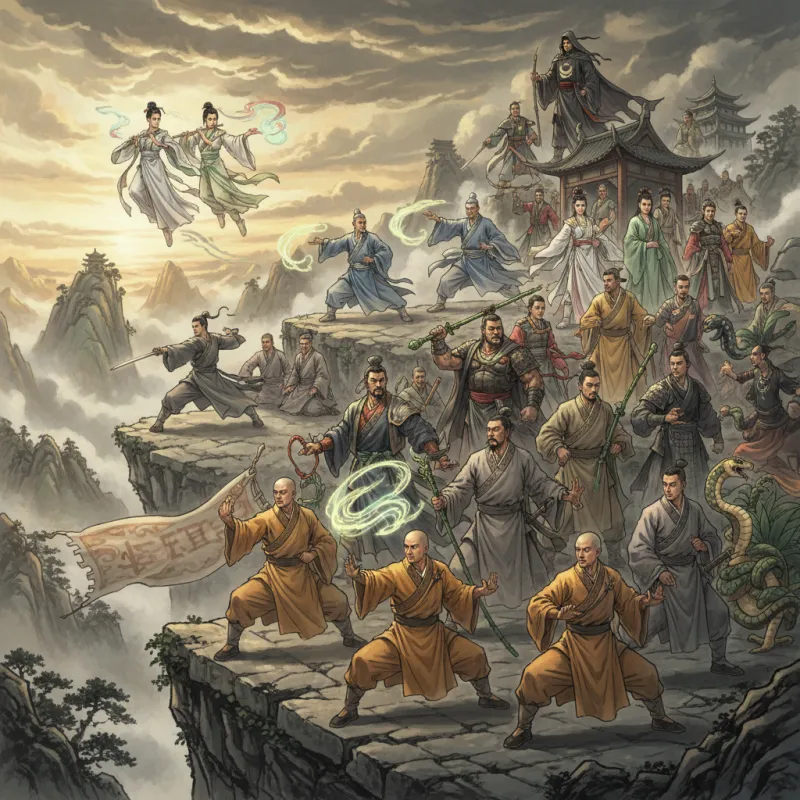
The old monk sits cross-legged in the Sutra Repository, dust motes dancing in the afternoon light. He hasn't moved in three days. A young disciple whispers that this is the legendary Yi Jin Jing (易筋经 Yì Jīn Jīng) — the Muscle-Tendon Change Classic — in action. But across the mountain, in a hidden valley, a Wudang swordsman executes a technique so fluid it seems to bend time itself. Which school is truly supreme? Jin Yong (金庸 Jīn Yōng) spent five decades answering this question, and the answer is: it depends on who's asking.
The 门派 (ménpài) — martial arts sects — aren't just dojos with fancy names. They're dynasties of knowledge, each guarding techniques that took centuries to refine. They're also political machines, philosophical laboratories, and the closest thing to family most jianghu (江湖 jiānghú) wanderers will ever know. Your sect determines which techniques you'll master, which enemies you'll inherit, and whether you'll die with honor or in disgrace. Here are the ten schools that matter most, ranked not by raw power (that's a fool's game) but by their narrative weight and influence on Jin Yong's martial world.
Shaolin Temple: The Immovable Mountain
Shaolin (少林派 Shàolín Pài) is the sun around which all other sects orbit. Located on Song Mountain in Henan Province, Shaolin Temple (少林寺 Shàolín Sì) claims 1,500 years of history and a martial arts library so vast it includes the legendary seventy-two special skills (七十二绝技 qīshí'èr juéjì). In Demi-Gods and Semi-Devils (天龙八部), the Sutra Repository alone contains enough forgotten techniques to make Xu Zhu (虚竹) — a talentless monk — into a grandmaster overnight.
But Shaolin's real power isn't its technique count. It's institutional legitimacy. When Shaolin speaks, the jianghu listens. When Shaolin closes its gates, wars pause. The temple's Buddhist foundation gives it moral authority that purely martial sects can never match. Even villains like Jiu Mozhi (鸠摩智) covet Shaolin's approval more than its techniques.
The irony? Shaolin's greatest weakness is also its strength: orthodoxy. The temple's rigid adherence to Buddhist precepts means its monks often arrive at conflicts too late, bound by rules that more pragmatic sects ignore. Abbot Xuan Ci's (玄慈) tragic arc in Demi-Gods shows how institutional righteousness can become institutional paralysis.
Wudang Sect: The Daoist Alternative
If Shaolin is the mountain, Wudang (武当派 Wǔdāng Pài) is the river — adaptable, flowing, and deceptively powerful. Founded by Zhang Sanfeng (张三丰 Zhāng Sānfēng) in The Heaven Sword and Dragon Saber (倚天屠龙记), Wudang represents the Daoist counterpoint to Shaolin's Buddhist orthodoxy. Where Shaolin emphasizes external strength and endurance, Wudang cultivates internal energy (内功 nèigōng) and the principle of overcoming hardness with softness (以柔克刚 yǐ róu kè gāng).
Zhang Sanfeng's Taiji Sword (太极剑 Tàijí Jiàn) and Taiji Fist (太极拳 Tàijí Quán) aren't just techniques — they're philosophical statements. The circular movements embody the Daoist concept of returning to the source, of using an opponent's force against them. When Zhang Wuji (张无忌) finally masters the Taiji principles, he doesn't just become stronger; he becomes wiser.
Wudang's influence extends beyond its mountain gates. The sect's emphasis on internal cultivation inspired countless derivative schools and influenced how Jin Yong conceptualized advanced martial arts techniques throughout his later novels. By The Smiling, Proud Wanderer (笑傲江湖), internal energy has become the gold standard for measuring martial prowess.
Emei Sect: The Feminine Power
Emei (峨眉派 Éméi Pài), based on Mount Emei in Sichuan, is Jin Yong's most complex female-led institution. Founded by the nun Guo Xiang (郭襄) after her unrequited love for Yang Guo (杨过) in The Return of the Condor Heroes (神雕侠侣), Emei carries a melancholic undercurrent beneath its martial excellence.
The sect's signature technique, the Emei Sword Style (峨眉剑法 Éméi Jiànfǎ), emphasizes speed and precision over raw power — a practical adaptation for practitioners who might face physically stronger opponents. But Emei's real contribution is institutional: it proved that women could lead major sects and command respect in the male-dominated jianghu.
Abbess Miejue (灭绝师太) in The Heaven Sword and Dragon Saber is Emei's most controversial leader — ruthless, uncompromising, and deeply scarred by past betrayals. She's a cautionary tale about what happens when institutional power meets personal trauma. Yet even in her cruelty, she demonstrates Emei's formidable capabilities. Her students, particularly Zhou Zhiruo (周芷若), inherit both her skills and her psychological complexity.
Beggar Clan: The People's Army
The Beggar Clan (丐帮 Gàibāng) is Jin Yong's most democratic institution. With branches in every city and members from every social class, it's less a martial arts school than a shadow government. The clan's signature techniques — the Dog Beating Staff Method (打狗棒法 Dǎ Gǒu Bàng Fǎ) and the Eighteen Dragon-Subduing Palms (降龙十八掌 Xiáng Lóng Shíbā Zhǎng) — are passed only to clan leaders, creating a meritocratic succession system.
Hong Qigong (洪七公) in The Legend of the Condor Heroes (射雕英雄传) embodies the clan's ethos: unpretentious, righteous, and fiercely protective of the common people. His decision to teach Guo Jing (郭靖) the Eighteen Palms isn't just martial instruction; it's a political statement about who deserves power.
The clan's decline in later novels reflects Jin Yong's growing pessimism about collective institutions. By The Duke of Mount Deer (鹿鼎记), the Beggar Clan has become a shell of its former self, corrupted by internal politics and disconnected from its grassroots origins. It's a sobering reminder that even the most egalitarian institutions can calcify.
Huashan Sect: The Tragic Idealists
Huashan (华山派 Huàshān Pài) is where Jin Yong explores the cost of perfectionism. The sect's split into the Sword Sect (剑宗 Jiàn Zōng) and Qi Sect (气宗 Qì Zōng) in The Smiling, Proud Wanderer represents the eternal debate between technical mastery and internal cultivation. Both sides are right. Both sides are wrong. The resulting civil war nearly destroys the school.
Yue Buqun (岳不群), the "Gentleman Sword," is one of Jin Yong's most chilling villains precisely because he starts as a genuine idealist. His transformation into a hypocritical tyrant shows how institutional pressure and personal ambition can corrupt even the most righteous intentions. The Huashan Sect becomes a cautionary tale about the dangers of orthodoxy and the violence lurking beneath civilized facades.
Yet Huashan also produces Linghu Chong (令狐冲), whose rejection of sectarian politics and embrace of individual freedom represents Jin Yong's mature philosophy. Linghu's mastery of the Dugu Nine Swords (独孤九剑 Dúgū Jiǔ Jiàn) — a technique that transcends sectarian boundaries — suggests that true martial arts wisdom lies beyond institutional walls.
Kunlun Sect: The Forgotten Giant
Kunlun (昆仑派 Kūnlún Pài) suffers from being overshadowed by Shaolin and Wudang, but its influence on Jin Yong's martial world is substantial. Based in the remote Kunlun Mountains, the sect represents geographical isolation and the preservation of ancient techniques. He Taichong (何太冲) in The Heaven Sword and Dragon Saber is petty and vindictive, but his Kunlun Sword Style demonstrates the sect's technical sophistication.
The sect's real significance is symbolic: it represents the schools that exist on the jianghu's periphery, neither fully orthodox nor heterodox, maintaining traditions that the central plains have forgotten. Kunlun's techniques often incorporate elements from Western Regions martial arts, reflecting the cultural exchange along the Silk Road.
Ming Cult: The Revolutionary Force
The Ming Cult (明教 Míng Jiào), also known as the Persian Manichaean religion, is Jin Yong's most politically charged institution. In The Heaven Sword and Dragon Saber, it's simultaneously a religious organization, a revolutionary movement, and a martial arts powerhouse. The cult's Heaven and Earth Great Shift (乾坤大挪移 Qiánkūn Dà Nuóyí) is one of Jin Yong's most conceptually ambitious techniques — a method for redirecting and amplifying force that borders on physics manipulation.
Zhang Wuji's leadership of the Ming Cult represents Jin Yong's ambivalence about revolutionary movements. The cult fights against Mongol oppression and corrupt orthodox sects, but its internal factions and ideological rigidity constantly threaten to tear it apart. The cult's eventual role in founding the Ming Dynasty (historically accurate, though the martial arts elements are fictional) shows how revolutionary energy can be channeled into institutional power — for better and worse.
Ancient Tomb Sect: The Outsider's Path
The Ancient Tomb Sect (古墓派 Gǔmù Pài) is Jin Yong's most romantic and isolated school. Founded by Lin Chaoying (林朝英) after her heartbreak over Wang Chongyang (王重阳), the sect exists in deliberate opposition to mainstream jianghu values. Its techniques, particularly the Jade Maiden Sword Style (玉女剑法 Yùnǚ Jiànfǎ), are designed to counter Quanzhen Sect methods — a martial arts expression of romantic rejection.
Yang Guo and Xiao Longnü's (小龙女) story in The Return of the Condor Heroes uses the Ancient Tomb Sect to explore themes of isolation, unconventional love, and the price of rejecting social norms. The sect's physical location — literally underground, in a tomb — is a perfect metaphor for its relationship with the jianghu: present but hidden, powerful but withdrawn.
Quanzhen Sect: The Daoist Establishment
The Quanzhen Sect (全真教 Quánzhēn Jiào), founded by Wang Chongyang, represents Daoist orthodoxy in its most institutional form. The sect's Big Dipper Formation (天罡北斗阵 Tiāngāng Běidǒu Zhèn) demonstrates how collective coordination can overcome individual weakness — seven mediocre martial artists become formidable when fighting in formation.
But Quanzhen's real importance is historical. Jin Yong based the sect on the actual Quanzhen School of Daoism, founded during the Jin Dynasty. By incorporating real religious history into his martial arts fiction, Jin Yong grounded his fantasy in cultural authenticity. The sect's emphasis on internal alchemy (内丹 nèidān) and spiritual cultivation influenced how later wuxia authors conceptualized the relationship between martial arts and spiritual practice.
Peach Blossom Island: The Individualist's Paradise
Peach Blossom Island (桃花岛 Táohuā Dǎo) barely qualifies as a sect — it's more like one genius's private laboratory. Huang Yaoshi (黄药师), the "Eastern Heretic," created a martial arts system that incorporates music, mathematics, medicine, and strategy. His techniques, like the Jade Flute Swordplay (玉箫剑法 Yùxiāo Jiànfǎ) and Finger Flicking Divine Skill (弹指神通 Tánzhǐ Shéntōng), are as much artistic performances as combat methods.
Huang Yaoshi represents Jin Yong's ideal of the Renaissance man — someone who refuses to be constrained by sectarian boundaries or orthodox thinking. His island is a utopia of individual creativity, but also a cautionary tale about isolation. His daughter Huang Rong (黄蓉) must leave the island to find her place in the world, suggesting that even the most perfect individualist paradise can become a prison.
The Sect You Choose
Jin Yong's genius lies in making each sect feel necessary and insufficient. Shaolin has moral authority but lacks flexibility. Wudang has philosophical depth but sometimes seems detached from worldly concerns. The Beggar Clan has democratic ideals but struggles with corruption. Every school is a compromise, a particular answer to the question of how to live and fight in a chaotic world.
The best characters in Jin Yong's novels eventually transcend their sectarian origins. Guo Jing combines Beggar Clan techniques with Quanzhen internal energy. Linghu Chong masters the Dugu Nine Swords, which has no sect. Zhang Wuji learns from everyone. The message is clear: sects provide foundation and identity, but wisdom requires looking beyond institutional walls. In the end, the jianghu belongs not to any single school, but to those brave enough to forge their own path.
Related Reading
- Understanding Jin Yong's Martial Arts Ranking System
- The Nine Yin Manual: Most Coveted Martial Arts Text
- Eighteen Dragon-Subduing Palms: The Ultimate Technique
- The Five Greats Explained: Understanding Jin Yong's Power Elite
- Six Meridian Divine Sword: Invisible Blade
- Four-Word Martial Arts Idioms from Jin Yong's Novels
- The Unsung Heroes of Jin Yong's Wuxia Novels: Side Characters That Steal the Spotlight
- The Art of Duels in Jin Yong's Wuxia Novels: A Journey Through Martial Valor