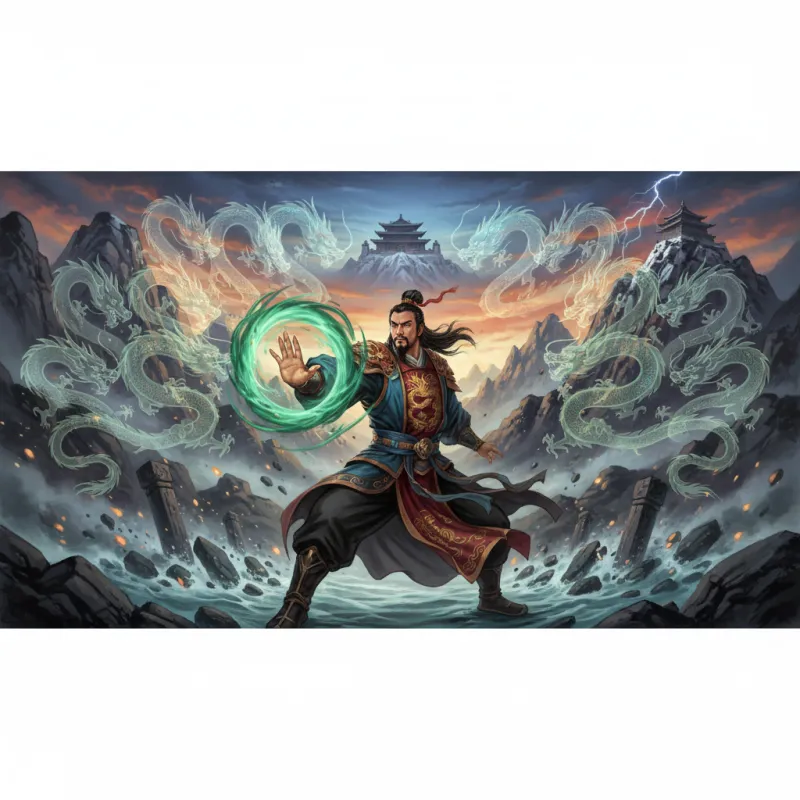
When Qiao Feng stands atop Juxian Manor, surrounded by hundreds of enemies, he doesn't draw a sword or unleash some mystical internal energy blast. He simply raises his palms—and the world trembles. The Eighteen Dragon-Subduing Palms (降龍十八掌, Xiáng Lóng Shíbā Zhǎng) isn't just another martial art in Jin Yong's universe. It's the technique that defines what it means to fight with pure, overwhelming force tempered by righteous spirit.
The Philosophy of Yang Over Yin
What makes the Eighteen Dragon-Subduing Palms fundamentally different from techniques like the Nine Yin Manual is its uncompromising commitment to yang energy. While most advanced martial arts in Jin Yong's novels balance hard and soft, external and internal, the Dragon-Subduing Palms reject subtlety entirely. Each strike channels maximum force in the most direct path possible. There's no deception, no hidden needles, no poison—just raw power that announces itself like thunder.
This philosophical approach mirrors the personalities of its most famous practitioners. Qiao Feng (乔峰) in "The Legend of the Condor Heroes" and Hong Qigong (洪七公) in "The Return of the Condor Heroes" both embody this straightforward, honorable approach to combat. They don't ambush enemies or use tricks. When they fight, everyone knows exactly what's coming—and still can't stop it. That's the terrifying beauty of this technique.
The yang nature also means the palms demand tremendous internal energy reserves. Unlike the Six Meridians Divine Sword, which can be executed with precision and minimal energy expenditure, each Dragon-Subduing Palm strike drains the practitioner significantly. It's a technique for decisive battles, not prolonged engagements. You either end the fight quickly, or you exhaust yourself trying.
The Eighteen Moves and Their Meanings
Jin Yong didn't just name these techniques randomly—each of the eighteen palms references specific hexagrams from the I Ching (易經, Yìjīng) or classical Chinese imagery. The first palm, "Seeing the Dragon in the Field" (亢龍有悔, Kàng Lóng Yǒu Huǐ), actually translates more accurately as "The Arrogant Dragon Has Regrets," warning against overextension even in overwhelming power. This philosophical depth separates Jin Yong's martial arts from simple power fantasies.
"Divine Dragon Wags Its Tail" (神龍擺尾, Shén Lóng Bǎi Wěi) demonstrates the technique's adaptability despite its straightforward nature. While the palms emphasize frontal assault, this move allows the practitioner to generate devastating force from an awkward position, sweeping enemies who attempt to flank. When Hong Qigong uses this against Ouyang Feng on Peach Blossom Island, he's literally sitting down, yet still generates enough power to send the Western Poison flying.
The most devastating technique, "Haughty Dragon Repents" (亢龍有悔, Kàng Lóng Yǒu Huǐ), appears both as the first and final palm, creating a philosophical circle. The repetition isn't redundancy—it represents the practitioner's journey from raw power to understanding that true strength requires restraint. When Qiao Feng finally masters this principle, he becomes nearly invincible not because he hits harder, but because he knows when not to strike.
The Beggar Clan Legacy
The Eighteen Dragon-Subduing Palms serves as the signature technique of the Beggar Clan (丐幫, Gài Bāng) chief, passed down through generations as both martial inheritance and symbol of leadership. This isn't coincidental—Jin Yong deliberately chose the most straightforward, honest technique for a clan that values righteousness above all else. Beggars can't afford elaborate weapons or secret manuals. They need something that works with bare hands and indomitable spirit.
Hong Qigong's decision to teach the technique to Guo Jing rather than keeping it exclusively within the clan hierarchy shows the palms' true nature. They can't be learned through mere memorization or political maneuvering. Guo Jing, despite being somewhat slow-witted, possesses the honest, straightforward character the technique demands. His simple nature becomes an advantage—he doesn't overthink the moves or try to add unnecessary flourishes.
The contrast with Yang Guo's learning experience is instructive. Yang Guo, brilliant but complicated, struggles more with the Dragon-Subduing Palms than the simpler Guo Jing. His tendency toward cleverness and emotional complexity actually hinders his mastery of a technique that demands directness. Eventually, Yang Guo develops his own style, the Dismal Ecstasy Palm (黯然銷魂掌, Ànrán Xiāohún Zhǎng), which better suits his melancholic personality.
Power Scaling and Limitations
In Jin Yong's carefully balanced martial arts hierarchy, the Eighteen Dragon-Subduing Palms occupies a fascinating position. It's undeniably top-tier—Hong Qigong ranks among the "Five Greats" of his era largely because of this technique. Yet it's not invincible. Against opponents who emphasize speed and evasion, like Huang Yaoshi's Jade Flute Swordsmanship, the palms' straightforward nature becomes a weakness.
The technique also requires specific physical and internal energy prerequisites that not everyone can meet. You need robust health, substantial internal power reserves, and the physical constitution to withstand the recoil from your own strikes. When Hong Qigong teaches Guo Jing, he emphasizes building foundation first—the palms will destroy your own meridians if attempted prematurely. This realistic limitation grounds the technique in Jin Yong's more physics-aware martial arts system.
Interestingly, the palms prove most effective against multiple opponents or in situations requiring overwhelming force. Qiao Feng's famous battle at Juxian Manor showcases this perfectly—surrounded by hundreds of martial artists, his Dragon-Subduing Palms create a zone of devastation that no one can penetrate. Against a single, highly skilled opponent with complementary techniques, however, the fight becomes more nuanced.
The Reduction to Eighteen
Here's a detail many readers miss: the technique wasn't always eighteen palms. Originally, the Beggar Clan possessed the "Twenty-Eight Dragon-Subduing Palms" (降龍二十八掌, Xiáng Lóng Èrshíbā Zhǎng). During the Southern Song Dynasty, a particularly wise clan leader analyzed the twenty-eight moves and realized ten were redundant or inferior. Rather than preserve tradition for tradition's sake, he refined the technique down to its essential eighteen palms.
This reduction represents Jin Yong's philosophy about martial arts evolution. More isn't always better. The streamlined eighteen palms became more powerful precisely because they eliminated waste. Each remaining move served a distinct purpose with no overlap. It's a lesson about efficiency and the courage to discard what doesn't work, even when it's part of your heritage.
The historical parallel is intentional—Jin Yong often used martial arts development to comment on cultural and intellectual progress. Just as Chinese philosophy evolved by refining and debating classical texts rather than simply accumulating more commentary, the Dragon-Subduing Palms improved through critical analysis and elimination. The unnamed clan leader who performed this reduction deserves recognition as one of the technique's true masters, even though he never appears in the novels.
Cultural Impact and Modern Interpretations
The Eighteen Dragon-Subduing Palms has transcended Jin Yong's novels to become a cultural touchstone in Chinese-speaking communities. When someone describes a straightforward, powerful solution to a problem, they might reference "using the Dragon-Subduing Palms"—meaning no tricks, just direct force. The technique represents an ideal of honest strength that resonates beyond martial arts fiction.
Modern adaptations struggle with the palms because their power is conceptual as much as visual. Film and television versions often add elaborate special effects—CGI dragons, energy blasts, shockwaves that crater the ground. These additions miss the point. The palms' terror comes from their simplicity, not spectacle. The best adaptation remains the 1982 TVB series, where the technique looks almost mundane—just palm strikes—yet the camera work and acting convey their devastating impact.
Video games face similar challenges. How do you make a straightforward palm strike feel more powerful than elaborate sword techniques or mystical abilities? The most successful game implementations give the palms superior range and impact, treating each strike as a small-scale explosion. This captures the spirit if not the letter—these aren't fancy moves, but when they connect, the fight ends.
Why It Endures
Sixty-seven years after "The Legend of the Condor Heroes" first introduced the Eighteen Dragon-Subduing Palms, the technique remains Jin Yong's most iconic martial art. Not the most powerful—that distinction probably belongs to the Nine Yang Manual or similar internal energy techniques. Not the most versatile or mysterious. But the most memorable, because it embodies values that transcend wuxia fiction.
In a genre often obsessed with secret techniques, hidden masters, and elaborate conspiracies, the Dragon-Subduing Palms stand as a reminder that sometimes the best answer is the obvious one, executed with overwhelming commitment. They reward honesty, straightforwardness, and moral clarity—the same virtues Jin Yong celebrated in his heroes. When Qiao Feng faces his tragic fate, he does so with the same directness his martial arts embody, refusing to hide or scheme his way out.
That's why readers remember these palms decades later. They're not just a fighting technique—they're a statement about how to live. Face your problems directly. Don't overcomplicate what should be simple. Build your strength honestly rather than seeking shortcuts. And when you must fight, do so with such overwhelming righteousness that even your enemies respect you. The Eighteen Dragon-Subduing Palms teach these lessons with every strike, which is why they'll remain legendary long after we've forgotten more elaborate techniques from lesser novels.
Related Reading
- Understanding Jin Yong's Martial Arts Ranking System
- The Timeless Appeal of Jin Yong's Wuxia Novels: Martial Arts, Characters, and Storylines
- Top 10 Martial Arts Schools in Jin Yong's Novels
- Six Meridian Divine Sword: Invisible Blade
- The Enduring Legacy of Jin Yong’s Wuxia Novels: Characters, Martial Arts, and Cultural Influence
- The Martial Arts Ranking Debate: Who Is Actually the Strongest in Jin Yong?
- Jin Yong's Villains: Why the Bad Guys Are Often the Best Characters
- How the Condor Trilogy Connects: Characters, Weapons, and Secrets Across 155 Years