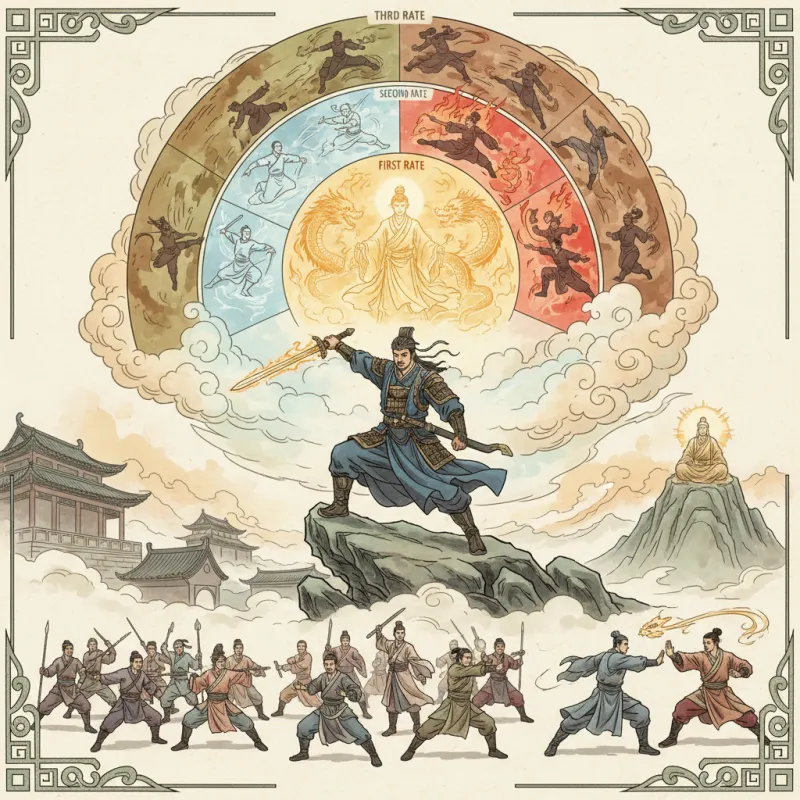
The old beggar's palm strike looked lazy, almost careless. His opponent — a master swordsman who'd spent thirty years perfecting the Huashan techniques — raised his blade to counter. Three seconds later, the swordsman was embedded in a wall twenty feet away, alive but utterly bewildered. Welcome to Jin Yong's martial arts universe, where a drunk beggar can demolish a sect leader, and the rankings that seem obvious on paper dissolve into chaos the moment actual combat begins.
Jin Yong (金庸 Jīn Yōng) didn't just create a power system — he built a deliberately unstable hierarchy that mirrors real martial philosophy. Unlike Western fantasy's neat level progressions, his framework operates on multiple axes simultaneously: raw internal energy (内力 nèilì), technical mastery, combat intelligence, psychological state, and that indefinable quality the Chinese call 悟性 (wùxìng) — martial comprehension. The result? A system sophisticated enough to support genuine analysis, yet ambiguous enough to fuel five decades of fan arguments.
The Sect Foundation: Where Everyone Starts
Every martial artist in Jin Yong's world begins within a 门派 (ménpài) — a sect that functions as school, family, and political faction rolled into one. The sect hierarchy provides the first crude sorting mechanism. At the top sit the 五大门派 (wǔ dà ménpài) — the Five Great Sects of The Heaven Sword and Dragon Saber: Shaolin, Wudang, Emei, Kunlun, and Kongtong. Their prestige isn't just reputation; it's accumulated martial knowledge spanning centuries.
But here's where Jin Yong gets interesting: sect ranking doesn't equal individual power. Zhang Sanfeng (张三丰 Zhāng Sānfēng) of Wudang could probably defeat the entire Kongtong sect single-handedly, despite Kongtong's "Great Sect" status. The sect provides the foundation — the basic internal energy cultivation methods, the fundamental techniques, the sparring partners — but individual achievement varies wildly. Think of it like universities: Harvard's brand matters, but the dropout in the garage might still change the world.
The sect system also creates natural power ceilings. Minor sects like the Qingcheng School possess limited martial knowledge, meaning even their most talented disciples hit a wall. This explains why so many protagonists are orphans or outcasts who learn from multiple sources — they're not constrained by a single sect's limitations. Yang Guo (杨过 Yáng Guò) in The Return of the Condor Heroes learns from the Ancient Tomb Sect, studies Quanzhen techniques, and eventually creates his own style. His power trajectory would've been impossible within a single orthodox sect.
Internal Energy: The Foundation That Isn't Everything
Internal energy — 内力 (nèilì) — forms the bedrock of Jin Yong's power system. It's the cultivated life force that amplifies techniques, enables superhuman feats, and generally determines whether your palm strike tickles or kills. Decades of cultivation matter enormously. When Xiao Feng (萧峰 Xiāo Fēng) from Demi-Gods and Semi-Devils fights, his internal energy is so overwhelming that even mediocre techniques become devastating.
The cultivation timeline is brutally realistic by wuxia standards. Most masters need 20-30 years of dedicated practice to reach the first tier. Shortcuts exist — the 九阳真经 (Jiǔ Yáng Zhēn Jīng, Nine Yang Manual) or 北冥神功 (Běi Míng Shén Gōng, Northern Darkness Divine Art) can accelerate progress — but they're rare and often dangerous. Zhang Wuji (张无忌 Zhāng Wújì) gets lucky with the Nine Yang Manual, but most characters grind it out the hard way.
Yet internal energy alone doesn't determine victory, and this is where Jin Yong's system becomes genuinely sophisticated. Yue Buqun (岳不群 Yuè Bùqún) in The Smiling, Proud Wanderer possesses decades of internal cultivation but loses to younger, more creative fighters. Why? Because he's technically rigid, psychologically brittle, and lacks combat adaptability. Internal energy is like having a powerful engine — it matters, but you still need to know how to drive.
The most revealing example: Duan Yu (段誉 Duàn Yù) from Demi-Gods and Semi-Devils accidentally absorbs massive internal energy from multiple masters, giving him power that should make him invincible. Instead, he remains mid-tier because he lacks martial comprehension and combat instinct. He's all engine, no steering wheel.
Technical Mastery and the Martial Arts Hierarchy
Jin Yong categorizes martial techniques into rough tiers, though he's deliberately vague about the boundaries. At the bottom sit common techniques (普通武功 pǔtōng wǔgōng) — the basic sword forms and palm strikes that any competent martial artist knows. Mid-tier includes sect signature techniques like Huashan's 华山剑法 (Huáshān Jiànfǎ, Huashan Sword Techniques) or Beggar's Sect's 降龙十八掌 (Xiáng Lóng Shíbā Zhǎng, Eighteen Dragon-Subduing Palms).
At the apex sit the legendary techniques: the 九阴真经 (Jiǔ Yīn Zhēn Jīng, Nine Yin Manual), 独孤九剑 (Dúgū Jiǔ Jiàn, Dugu Nine Swords), and 乾坤大挪移 (Qiánkūn Dà Nuóyí, Heaven and Earth Great Shift). These aren't just powerful — they're conceptually advanced, requiring martial comprehension that most fighters never develop. The Dugu Nine Swords doesn't rely on internal energy at all; it's pure technique, a sword style that counters all other sword styles by understanding their fundamental principles.
But here's the twist: mastery level matters more than technique tier. A master wielding basic techniques often defeats a novice with legendary ones. Feng Qingyang (风清扬 Fēng Qīngyáng) demonstrates this repeatedly in The Smiling, Proud Wanderer — his understanding is so deep that he can defeat elaborate techniques with simple counters. It's the martial arts equivalent of a chess grandmaster beating an amateur who memorized fancy openings.
Jin Yong also introduces the concept of 武学境界 (wǔxué jìngjiè) — martial comprehension levels. The highest level is 无招胜有招 (wú zhāo shèng yǒu zhāo) — "no technique defeats technique" — where the martial artist transcends fixed forms entirely. This isn't mystical nonsense; it's the difference between following a recipe and understanding cooking principles. Zhang Sanfeng reaches this level, as does Dugu Qiubai (独孤求败 Dúgū Qiúbài), the legendary swordsman who appears only in backstory but influences multiple novels.
The X-Factors: Psychology, Strategy, and Circumstance
This is where Jin Yong's system becomes genuinely brilliant — and where most power-scaling arguments collapse. Combat outcomes depend heavily on psychological state, tactical intelligence, and environmental factors. A fighter's mental state can swing their effective power level by 30-40%. Guo Jing (郭靖 Guō Jìng) from The Legend of the Condor Heroes fights significantly better when protecting others; his sense of righteousness literally amplifies his abilities.
Conversely, internal conflict weakens fighters dramatically. Yang Guo's power fluctuates wildly based on his emotional state — when he's psychologically stable, he's near-invincible; when he's conflicted about Xiaolongnü, he makes rookie mistakes. This isn't plot convenience; it reflects actual martial philosophy about the connection between mental clarity and physical performance.
Strategic intelligence matters enormously. Huang Yaoshi (黄药师 Huáng Yàoshī), the "Eastern Heretic," often defeats stronger opponents through preparation, environmental manipulation, and psychological warfare. He's not the strongest fighter in The Legend of the Condor Heroes, but he's arguably the most dangerous because he thinks three moves ahead. Jin Yong consistently shows that martial arts isn't just physical — it's a chess game played at high speed.
Environmental factors create massive power swings. Water-based fighters like the Ancient Tomb Sect's techniques gain advantages near rivers. Poison specialists like the Five Poison Sect become far more dangerous in their home territory. Even time of day matters — some internal energy cultivation methods align with specific hours, making practitioners stronger or weaker depending on when they fight.
The Protagonist Problem: Plot Armor or Legitimate Growth?
Jin Yong's protagonists typically start weak and end god-tier, which raises the obvious question: is this earned progression or plot armor? The answer is both, but Jin Yong handles it more skillfully than most. His protagonists follow recognizable growth patterns that, while accelerated, remain internally consistent.
The typical trajectory: start with either exceptional talent (Yang Guo, Linghu Chong) or exceptional luck (Zhang Wuji, Duan Yu), encounter multiple masters or legendary manuals, survive life-threatening situations that force rapid improvement, and eventually synthesize various techniques into a personal style. The timeline is compressed — protagonists achieve in 5-10 years what normal masters need 30 years for — but the progression stages feel earned.
What separates Jin Yong's protagonists from pure Mary Sues is that they pay costs. Yang Guo loses an arm. Linghu Chong (令狐冲 Lìng Hú Chōng) suffers from conflicting internal energies that nearly kill him. Zhang Wuji's power comes with the burden of leading the Ming Cult during a civil war. The power isn't free, and the psychological weight of their abilities creates genuine character development.
The most interesting case is Wei Xiaobao (韦小宝 Wéi Xiǎobǎo) from The Deer and the Cauldron, who barely learns any martial arts at all yet survives in a world of masters through pure cunning, luck, and social intelligence. He's Jin Yong's deliberate subversion of his own power system — proof that martial strength isn't the only path to success, even in a martial arts world.
Cross-Novel Comparisons: The Impossible Rankings
Fans love ranking characters across Jin Yong's fourteen novels, but this is where the system's ambiguity becomes most apparent. Jin Yong himself refused to provide definitive rankings, and for good reason — his novels span different time periods, different power scales, and different thematic focuses.
Demi-Gods and Semi-Devils operates at the highest power level, with characters like Xiao Feng, Duan Yu, and Xu Zhu (虚竹 Xū Zhú) performing feats that would be impossible in more grounded novels like Fox Volant of the Snowy Mountain. Is this because Song Dynasty martial arts were stronger, or because Jin Yong was writing in a more fantastical mode? The text doesn't say, leaving fans to argue endlessly.
The general consensus places Zhang Sanfeng, Dugu Qiubai, and Sweeping Monk (扫地僧 Sǎodì Sēng) at the absolute apex, but even this is debatable. Zhang Sanfeng appears as an elderly master in The Heaven Sword and Dragon Saber, but we never see him at full power. Dugu Qiubai exists only in legend. The Sweeping Monk appears for one scene in Demi-Gods and Semi-Devils, casually demonstrating abilities that seem to break the established rules.
What's fascinating is that Jin Yong deliberately maintains this ambiguity. He could have written definitive showdowns between top-tier characters but chose not to. The uncertainty is the point — it keeps readers engaged, debating, and returning to the texts for new evidence. It's a feature, not a bug.
Why the System Works: Ambiguity as Design
Jin Yong's martial arts ranking system succeeds precisely because it resists simple quantification. Unlike modern cultivation novels with their rigid numerical levels, Jin Yong's framework acknowledges that combat is messy, contextual, and unpredictable. A fighter's effective power level shifts based on dozens of variables, making every fight genuinely uncertain.
This ambiguity serves the narrative. If power levels were fixed and transparent, fights would be boring — we'd know the outcome before they started. Instead, Jin Yong creates situations where weaker characters can win through strategy, where psychological factors swing battles, where environmental advantages matter. The system is sophisticated enough to feel real while remaining flexible enough to serve the story.
For readers trying to understand the system, the key is accepting that there is no single ranking. There are multiple hierarchies operating simultaneously — sect prestige, internal energy cultivation, technical mastery, combat experience, psychological stability, strategic intelligence — and they don't always align. The beggar who defeats the sect leader isn't breaking the rules; he's demonstrating that the rules are more complex than they first appeared.
That's what makes Jin Yong's martial arts world endlessly fascinating. It's not a video game with clear levels and stats. It's a rich, ambiguous system that rewards careful reading, supports genuine analysis, and still leaves room for mystery. Just like real martial arts, come to think of it.
Related Reading
- Wudang vs. Shaolin: The Great Rivalry of Chinese Martial Arts
- Eighteen Dragon-Subduing Palms: The Ultimate Technique
- The Five Greats Explained: Understanding Jin Yong's Power Elite
- The Enduring Legacy of Jin Yong’s Wuxia Novels: Characters, Martial Arts, and Cultural Influence
- The Timeless Appeal of Jin Yong's Wuxia Novels: Martial Arts, Characters, and Storylines
- The Enigmatic Hidden Techniques in Jin Yong’s Wuxia Novels Explored
- The Unsung Heroes of Jin Yong's Wuxia Novels: Side Characters That Steal the Spotlight
- Exploring Legendary Weapons in Jin Yong’s Wuxia Novels: Symbolism and Martial Arts Mastery