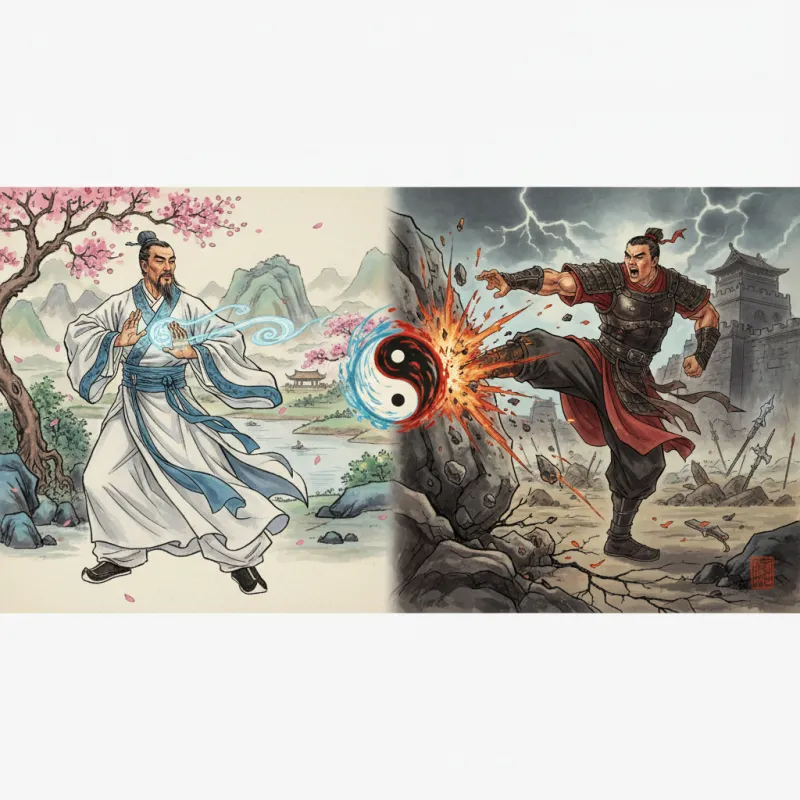
Zhang Wuji stood before the Shaolin abbot, barely twenty years old, and casually deflected a palm strike that had taken the old master sixty years to perfect. The abbot's external kung fu was flawless — his stance, his technique, his decades of conditioning. But Zhang Wuji's internal energy, cultivated through the Nine Yang Divine Skill (九阳神功 Jiǔyáng Shéngōng), made the contest laughably one-sided. This scene from The Heaven Sword and Dragon Saber (倚天屠龙记 Yǐtiān Túlóng Jì) captures the essential truth of Jin Yong's martial arts philosophy: in his universe, internal power doesn't just complement external technique — it renders it almost obsolete.
The Fundamental Divide
Jin Yong's martial arts world operates on a deceptively simple binary: 内功 (nèigōng, internal skill) versus 外功 (wàigōng, external skill). External martial arts are what most people imagine when they think of kung fu — the physical techniques, the forms, the conditioning. A Shaolin monk spending years hardening his Iron Head skill, striking his skull against increasingly harder surfaces until he can shatter stone. The acrobatic staff techniques of the Beggar Clan. The precise finger strikes of the Dian Xue (点穴 diǎnxué) pressure point attacks.
Internal martial arts, by contrast, cultivate 内力 (nèilì) — internal energy or force. This is Jin Yong's adaptation of the traditional Chinese concept of 气 (qì), but weaponized and systematized into something more concrete. Internal energy flows through the body's meridians (经脉 jīngmài), can be projected outward to strike enemies at a distance, and most importantly, amplifies every physical technique to superhuman levels.
The critical difference? External skills have a ceiling. No matter how much you train, your muscles can only get so strong, your reflexes only so fast. You're bound by biology. Internal energy, however, is theoretically unlimited. A master with deep internal cultivation can perform feats that defy physics — and in Jin Yong's novels, they regularly do.
The Mathematics of Power
Here's where Jin Yong's system gets interesting: internal and external skills don't just add together. Internal energy multiplies the effectiveness of external techniques. Consider Guo Jing from The Legend of the Condor Heroes (射雕英雄传 Shèdiāo Yīngxióng Zhuàn). He's famously slow-witted and takes years to learn techniques that others master in months. His external kung fu, taken alone, is merely competent. But once he develops profound internal energy through the Nine Yin Manual (九阴真经 Jiǔyīn Zhēnjīng), those same mediocre techniques become devastating. His Eighteen Dragon-Subduing Palms (降龙十八掌 Xiángláng Shíbā Zhǎng), powered by deep internal cultivation, can shatter stone and repel multiple opponents simultaneously.
The reverse doesn't hold true. Qiu Qianren, the Iron Palm Gang leader, spent decades perfecting his external Iron Palm technique. His physical conditioning was extraordinary — he could strike through several inches of wood. But when he faced Guo Jing, who had both technique and internal power, the contest wasn't even close. External mastery without internal cultivation is like having a sports car with no engine.
This creates Jin Yong's fundamental power hierarchy: a mediocre technique powered by profound internal energy beats a perfect technique with shallow internal cultivation. Every time. The novels prove this repeatedly. The role of martial arts manuals in Jin Yong's world reflects this — the most coveted texts aren't technique manuals but internal cultivation methods.
The Time Investment Problem
But there's a catch, and it's a brutal one: developing internal energy takes time. Decades, usually. The traditional path requires sitting in meditation, circulating qi through the meridians, gradually accumulating internal force drop by drop. It's boring, it's slow, and it requires the kind of patience that most young martial artists don't have.
This is why Shaolin, with its monastic tradition and emphasis on lifelong cultivation, produces so many top-tier masters. The monks have the discipline and the institutional support to spend twenty, thirty, forty years building their internal foundation. Contrast this with the jianghu (江湖 jiānghú) wanderers who need to survive immediate threats. They can't afford to spend decades meditating — they need skills that work now.
Jin Yong understood this tension and built it into his plots. His protagonists almost never develop internal energy the traditional way. Instead, they stumble into shortcuts: Zhang Wuji absorbs energy from the Nine Yang Divine Skill inscribed on Xie Xun's back. Duan Yu accidentally cultivates the Northern Darkness Divine Skill (北冥神功 Běimíng Shéngōng) while trying to avoid learning martial arts entirely. Linghu Chong has the Yijin Jing (易筋经 Yìjīn Jīng) used to cure his injuries, which coincidentally grants him profound internal power.
These aren't just plot conveniences — they're Jin Yong's commentary on the impracticality of traditional cultivation in a world of immediate dangers. The old masters who spent fifty years meditating are impressive, but they're also kind of foolish. The smart martial artists find force multipliers.
The Orthodox vs. Unorthodox Dimension
The internal-external divide maps onto another crucial distinction in Jin Yong's world: orthodox (正派 zhèngpài) versus unorthodox (邪派 xiépài) martial arts. Orthodox schools like Shaolin and Wudang emphasize slow, steady internal cultivation through meditation and proper technique. Their methods are safe, reliable, and agonizingly slow.
Unorthodox methods offer faster results but with serious risks. The Star Absorbing Great Method (吸星大法 Xīxīng Dàfǎ) from The Smiling, Proud Wanderer (笑傲江湖 Xiàoào Jiānghú) lets you absorb other people's internal energy directly — decades of cultivation stolen in minutes. The catch? The absorbed energy is chaotic and can drive you insane or cripple you if you can't control it. The Beiming Divine Skill works similarly but requires exceptional talent to master.
Jin Yong's sympathies are clear: he respects the orthodox path but finds it narratively boring. His protagonists almost always use unorthodox methods, or at least unorthodox applications of orthodox skills. Linghu Chong learns the Dugu Nine Swords (独孤九剑 Dúgū Jiǔjiàn), which explicitly rejects internal cultivation in favor of pure technique and adaptability. Yet even this "external" style proves devastatingly effective because it's so unorthodox that orthodox masters can't counter it.
The message seems to be that orthodoxy, for all its moral superiority, breeds predictability. The truly great martial artists are those who understand both paths and choose their own way.
The Gender Politics of Internal Power
Here's something Jin Yong's critics often miss: internal cultivation is one of the few areas in his novels where women compete on equal footing with men. External martial arts favor physical strength and size — biological advantages that his male characters typically possess. But internal energy cultivation is gender-neutral. A woman who meditates for thirty years develops the same internal power as a man who does the same.
This is why Jin Yong's most formidable female characters — Huang Rong, Xiao Longnu, Ren Yingying — tend to rely heavily on internal skills and technique rather than raw physical power. Xiao Longnu's Jade Maiden Heart Sutra (玉女心经 Yùnǚ Xīnjīng) emphasizes internal cultivation and precise technique over brute force. It's explicitly designed to let a smaller, weaker practitioner defeat larger, stronger opponents.
The Ancient Tomb Sect's martial arts, created by Lin Chaoying specifically to counter Wang Chongyang's techniques, represent Jin Yong's most explicit statement on this: skill and internal power can overcome physical disadvantages. It's not a coincidence that the Ancient Tomb Sect was founded by a woman and passed down through female disciples.
The Endgame: When Everyone Has Internal Power
By the late stages of most Jin Yong novels, the protagonist has developed profound internal energy and the playing field shifts again. When everyone at the top level has deep internal cultivation, external technique suddenly matters again. The final confrontations in Jin Yong's novels are rarely pure internal energy contests — they're battles of technique, strategy, and adaptability between opponents with roughly equivalent internal power.
This is where the philosophy of martial arts becomes crucial. Dugu Qiubai's progression through five swords — from heavy iron to wooden sword to no sword — represents the ultimate synthesis. At the highest level, the distinction between internal and external dissolves. The technique becomes the internal power; the internal power becomes the technique.
Zhang Sanfeng, founder of Wudang, demonstrates this when he creates Taiji Quan (太极拳 Tàijí Quán) in his old age. It's simultaneously the most internal and most external of martial arts — pure technique that requires profound internal cultivation to execute, yet appears effortless and natural. The circle completes itself.
The Real Lesson
Jin Yong's internal-external framework isn't really about martial arts at all — it's about talent versus effort, shortcuts versus discipline, innovation versus tradition. His protagonists succeed not because they choose internal over external or vice versa, but because they refuse to be bound by the binary. They steal techniques, combine incompatible styles, and break every rule their teachers laid down.
The martial artists who fail in Jin Yong's novels are those who become dogmatic — the Shaolin monks who insist their seventy-two techniques are supreme, the Wudang masters who look down on unorthodox methods, the evil cultivators who think absorbing others' energy is a sustainable path to power. They've mistaken the map for the territory.
Zhang Wuji defeats the Shaolin abbot not because internal power is inherently superior to external technique, but because he understood something the abbot didn't: in a world of rigid categories, flexibility is the ultimate advantage. The internal-external divide is real and important, but the moment you treat it as absolute, you've already lost.
That's the genius of Jin Yong's system. It appears to be about supernatural kung fu powers, but it's actually about how we think about mastery, tradition, and progress. The martial arts are just the vehicle. The real fight is always about something deeper.
Related Reading
- Top 10 Martial Arts Schools in Jin Yong's Novels
- The Five Greats Explained: Understanding Jin Yong's Power Elite
- Six Meridian Divine Sword: Invisible Blade
- Understanding Jin Yong's Martial Arts Ranking System
- The Enduring Legacy of Jin Yong’s Wuxia Novels: Characters, Martial Arts, and Cultural Influence
- Exploring the Enigmatic Worlds of Jin Yong's Wuxia Novels
- The Most Complex Villains in Jin Yong Fiction
- Jin Yong's Locations: The Real Places Behind the Fictional Battles