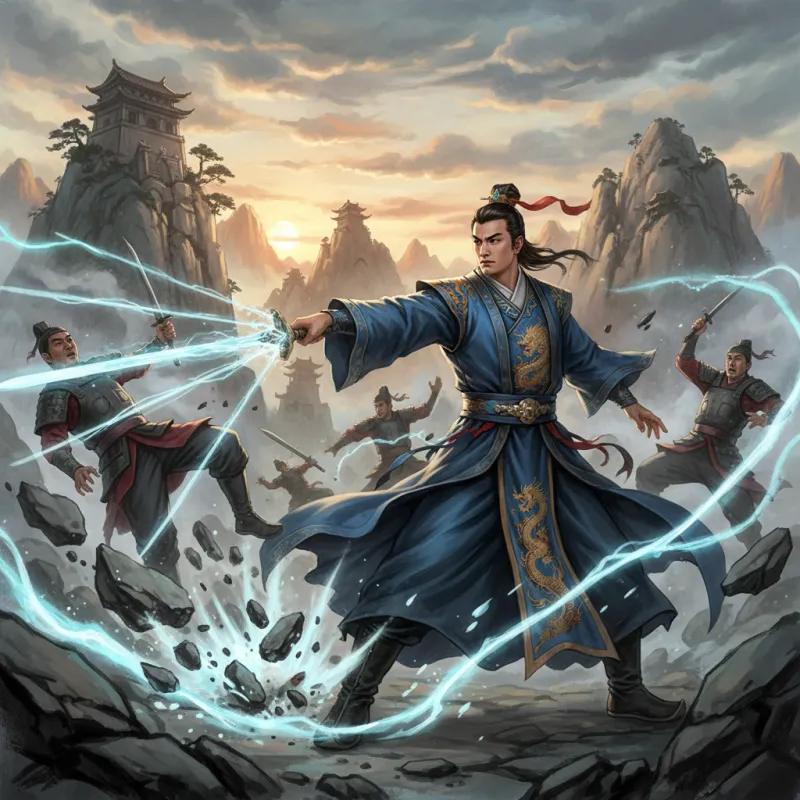
When Duan Yu first unleashes the Six Meridian Divine Sword (六脉神剑, Liù Mài Shén Jiàn) in Demi-Gods and Semi-Devils, he doesn't even realize what he's done. One moment he's cowering before enemies, the next, invisible sword energy shoots from his fingertips, piercing through armor and flesh like they're paper. It's the kind of moment that makes you put down the book and think: "Wait, did that just happen?" This isn't your typical wuxia weapon—no gleaming blade, no dramatic unsheathing. Just pure internal energy transformed into an invisible, unstoppable force.
The Duan Family's Supreme Technique
The Six Meridian Divine Sword represents the pinnacle of the Duan family's martial arts legacy in Dali Kingdom. Created by the monks of Tianlong Temple (天龙寺, Tiānlóng Sì), this technique transforms internal energy into sword qi that shoots from the six major meridian points in the fingers. Each finger corresponds to a different sword style, creating six distinct variations that can be used individually or in devastating combinations.
What makes this technique particularly fascinating is its connection to Buddhist philosophy and traditional Chinese medicine. The six meridians—Shaoyang, Taiyang, Yangming, Shaoyin, Taiyin, and Jueyin—aren't just anatomical concepts. They represent the flow of qi through the body, and mastering the Six Meridian Divine Sword requires understanding this flow at a profound level. It's not enough to have powerful internal energy; you need the wisdom to channel it correctly.
The technique's scrolls were kept in Tianlong Temple, and even among the Duan family, few could master it. Duan Yu's uncle, Emperor Duan Zhengming, studied it for years without success. The irony? Duan Yu, who abhors violence and stumbles into martial arts by accident, becomes one of its greatest practitioners.
Invisible Death: How the Technique Works
Unlike the Eighteen Dragon-Subduing Palms which relies on overwhelming physical force, or the Nine Yin Manual with its diverse techniques, the Six Meridian Divine Sword is pure refinement. The practitioner projects sword energy from their fingertips—invisible blades that travel at incredible speed and can pierce through almost anything.
Each of the six variations has distinct characteristics. The Shaoyang Sword is swift and aggressive, perfect for rapid attacks. The Taiyang Sword is powerful and direct, capable of breaking through defenses. The Yangming Sword is flexible and unpredictable, changing direction mid-flight. The three yin swords—Shaoyin, Taiyin, and Jueyin—are more subtle, designed for defense and counterattacks.
What's brilliant about Jin Yong's conception is that the technique isn't just about power—it's about precision and control. A master can adjust the intensity from a gentle tap to a lethal strike. They can curve the sword energy around obstacles, strike multiple targets simultaneously, or focus all six swords on a single point for maximum penetration. In Duan Yu's hands, the technique becomes almost playful at times, as he uses it to cut ropes, deflect projectiles, or simply intimidate opponents without actually harming them.
The Unreliable Genius: Duan Yu's Mastery
Here's where Jin Yong shows his genius as a storyteller: he gives this ultimate technique to someone who can barely control it. Duan Yu's relationship with the Six Meridian Divine Sword is hilariously inconsistent. Sometimes it works perfectly, other times it fails completely, and he never quite knows which it'll be. This isn't a flaw in the writing—it's deliberate characterization.
Duan Yu learned the technique by memorizing the scrolls while imprisoned in a cave, but he lacks the years of internal cultivation that should precede such advanced training. His internal energy comes from accidentally absorbing the powers of others, giving him immense raw power without the refined control. It's like giving a teenager the keys to a Formula One race car—sure, they might do something amazing, but they're just as likely to stall at the starting line.
This unreliability creates some of the novel's most memorable moments. During the battle at Shaolin Temple, Duan Yu's Six Meridian Divine Sword suddenly stops working, leaving him defenseless. Later, when facing the villain Jiumozhi, it returns at the perfect moment. The technique becomes a metaphor for Duan Yu himself—brilliant potential hampered by incomplete understanding and reluctant commitment.
Buddhist Philosophy and Martial Arts
The Six Meridian Divine Sword embodies a distinctly Buddhist approach to martial arts. Unlike techniques focused on domination or revenge, it was created by monks as a means of protecting the dharma. The scrolls themselves are filled with Buddhist sutras and philosophical teachings, suggesting that true mastery requires spiritual cultivation, not just physical training.
This connects to a broader theme in Demi-Gods and Semi-Devils: the relationship between violence and enlightenment. Can a Buddhist monk justify using deadly force? The Six Meridian Divine Sword represents an attempt to reconcile these contradictions—a weapon so refined and controlled that it can defend without necessarily killing, yet powerful enough to stop any threat.
Duan Yu, despite his martial prowess, maintains his Buddhist principles throughout the novel. He refuses to kill, even when using the Six Meridian Divine Sword. This creates fascinating combat scenarios where he's simultaneously one of the most powerful fighters in the story and one of the most reluctant. Jin Yong seems to be asking: what's the point of ultimate power if you're unwilling to use it?
Legacy and Influence in Jin Yong's Universe
The Six Meridian Divine Sword appears primarily in Demi-Gods and Semi-Devils, but its influence echoes through Jin Yong's other works. The concept of projecting internal energy as an invisible weapon becomes a benchmark for supreme martial arts. Later novels feature similar techniques, but few match the elegance and mystique of the original.
In the chronology of Jin Yong's fictional universe, the Six Meridian Divine Sword represents a peak that's never quite reached again. By the time of The Legend of the Condor Heroes and The Return of the Condor Heroes, set centuries later, the technique has been lost. The Duan family still exists, but their supreme skill has vanished into legend. This gives the technique a poignant quality—we're watching something magnificent that's doomed to disappear.
The technique has also influenced countless wuxia novels, films, and games that came after. The idea of invisible sword energy shot from fingertips has become a staple of the genre, though rarely executed with Jin Yong's combination of philosophical depth and narrative purpose.
Why It Still Captivates Readers
Decades after Demi-Gods and Semi-Devils was first published in 1963, the Six Meridian Divine Sword remains one of Jin Yong's most iconic creations. Part of its appeal is pure wish fulfillment—who hasn't imagined having invisible weapons at their fingertips? But there's more to it than that.
The technique represents Jin Yong's ability to ground fantastical elements in believable systems. The connection to meridians and qi gives it a pseudo-scientific foundation that makes it feel almost plausible. The Buddhist philosophy adds depth beyond simple power fantasy. And Duan Yu's unreliable mastery keeps it from becoming boring or overpowered.
Most importantly, the Six Meridian Divine Sword embodies a central tension in Jin Yong's work: the relationship between power and responsibility, violence and morality, tradition and innovation. It's not just a cool technique—it's a lens through which Jin Yong explores what it means to be powerful in a world where power can corrupt, destroy, or enlighten.
When you read about Duan Yu's invisible blades cutting through the air, you're not just reading about martial arts. You're reading about a young man struggling with abilities he never wanted, trying to stay true to his principles in a world that constantly tests them. That's why, among all of Jin Yong's legendary techniques, the Six Meridian Divine Sword continues to strike straight to the heart.
Related Reading
- The Timeless Appeal of Jin Yong's Wuxia Novels: Martial Arts, Characters, and Storylines
- Top 10 Martial Arts Schools in Jin Yong's Novels
- The Nine Yin Manual: Most Coveted Martial Arts Text
- Understanding Jin Yong's Martial Arts Ranking System
- The Five Greats Explained: Understanding Jin Yong's Power Elite
- The Allure of Jin Yong's Wuxia: Exploring Martial Arts, Characters, and Legendary Storylines
- Exploring the Intricate Sects within Jin Yong's Iconic Wuxia Novels
- Exploring Jin Yong's Wuxia Novels: Characters, Martial Arts, and Storylines