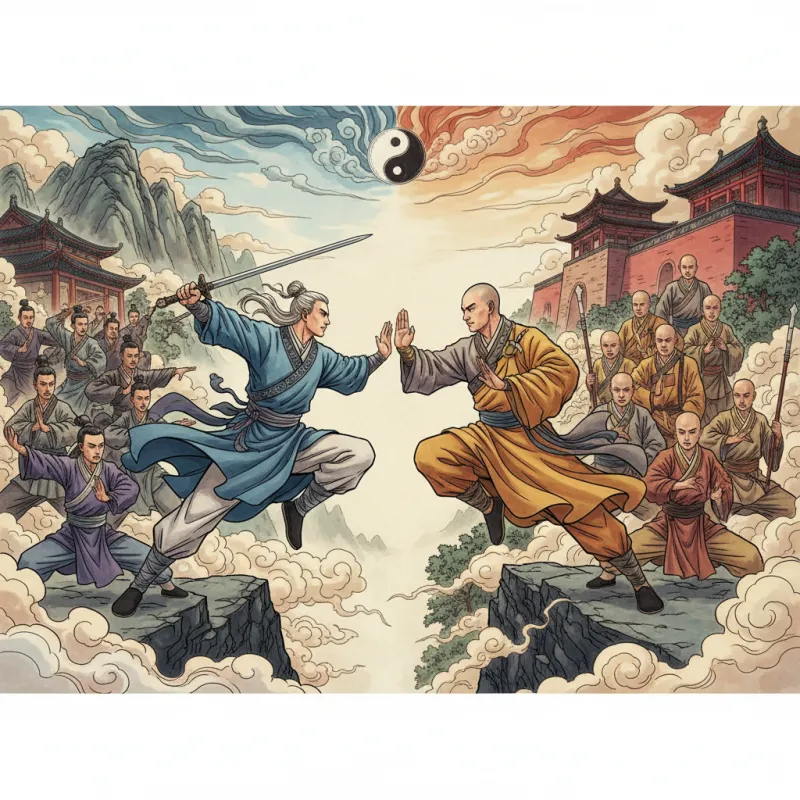
Zhang Sanfeng stood at the edge of the cliff, watching a snake and a crane fight. The crane struck with sharp, direct jabs. The snake coiled, yielded, and struck from impossible angles. In that moment, according to legend, the founder of Wudang martial arts understood something that would challenge Shaolin's 1,500-year dominance: hardness isn't the only path to victory.
This scene — whether it happened or not — captures the essence of Chinese martial arts' greatest rivalry. And Jin Yong understood this better than anyone. Across his fifteen novels, he returned again and again to the tension between Shaolin and Wudang, using it to explore questions far deeper than "who would win in a fight?"
The Historical Foundation: Buddhism vs. Daoism
Shaolin Temple (少林寺 Shàolín Sì) was established in 495 CE in Henan Province, making it over a millennium older than Wudang as a martial arts institution. When the Indian monk Bodhidharma (达摩 Dámó) arrived in the 6th century, he found monks too weak to meditate properly. His solution? Physical training that evolved into Shaolin kung fu. The Buddhist philosophy was clear: discipline the body to free the mind, use martial arts to protect the dharma.
Wudang Mountain (武当山 Wǔdāng Shān) in Hubei Province became a martial arts center much later, during the Song and Yuan dynasties. The semi-legendary Zhang Sanfeng (张三丰 Zhāng Sānfēng) — who may have lived in the 13th or 14th century, or may be an amalgamation of several historical figures — supposedly created Wudang martial arts by applying Daoist principles of yin-yang balance and qi cultivation to combat. Where Shaolin said "train harder," Wudang said "train smarter."
Jin Yong didn't invent this rivalry, but he crystallized it. In The Heaven Sword and Dragon Saber (倚天屠龙记 Yǐtiān Túlóng Jì), he gives us the most detailed exploration of both schools, showing how their philosophical differences create fundamentally different martial artists.
External vs. Internal: More Than Just Fighting Styles
The distinction between external (外家 wàijiā) and internal (内家 nèijiā) martial arts is central to understanding this rivalry. Shaolin's external approach focuses on physical conditioning — iron palm training, wooden dummy practice, stance work that builds leg strength capable of supporting a horse stance for hours. The 72 Shaolin Arts (少林七十二艺 Shàolín Qīshí'èr Yì) include techniques like Iron Head Skill and Golden Bell Cover, where monks condition their bodies to withstand tremendous punishment.
Wudang's internal approach emphasizes qi (气 qì) cultivation and the principle of using four ounces to deflect a thousand pounds (四两拨千斤 sì liǎng bō qiān jīn). Taijiquan (太极拳 Tàijíquán), Wudang's most famous art, looks gentle but conceals devastating power. The difference isn't that Shaolin ignores internal energy or Wudang ignores physical training — it's about emphasis and philosophy.
In Demi-Gods and Semi-Devils (天龙八部 Tiānlóng Bābù), Jin Yong shows this through Xuzhu, who masters Shaolin's external arts before accidentally acquiring massive internal power. The contrast nearly tears him apart. Meanwhile, Zhang Wuji in The Heaven Sword and Dragon Saber learns Wudang's internal arts first, then struggles when forced to use more direct, Shaolin-like approaches.
The Personality of Power: What Each School Creates
Here's what Jin Yong understood brilliantly: martial arts schools don't just teach techniques, they shape personalities. Shaolin produces warriors like Xuan Ci and Kong Wen — disciplined, righteous, sometimes rigid. They believe in clear moral lines and direct action. When Shaolin faces evil, they confront it head-on with overwhelming force.
Wudang produces figures like Zhang Sanfeng and Song Qingshu — adaptable, philosophical, sometimes too clever for their own good. They understand nuance, see multiple sides of conflicts, and prefer indirect solutions. When Wudang faces evil, they often try to redirect it, transform it, or wait for it to defeat itself.
This creates fascinating dramatic tension. In The Heaven Sword and Dragon Saber, the six major sects besiege Wudang Mountain, and Shaolin leads the charge. They're not wrong to be suspicious — Xie Xun, a mass murderer, has connections to Wudang. But their direct, confrontational approach nearly destroys an innocent school. Zhang Sanfeng's response? He doesn't fight back with equal force. He demonstrates Taiji principles, showing how aggression can be neutralized without matching it.
The tragedy of Song Qingshu illustrates Wudang's weakness: too much flexibility can become moral relativism. He betrays his school not through lack of skill but through lack of the clear moral framework that Shaolin drilling might have instilled.
The Rivalry in Jin Yong's Novels: Key Confrontations
Jin Yong stages the Shaolin-Wudang rivalry across multiple novels, each time revealing new dimensions. In The Smiling, Proud Wanderer (笑傲江湖 Xiàoào Jiānghú), both schools are sidelined by Huashan's internal politics, suggesting that rigid adherence to tradition — whether Shaolin's or Wudang's — can't adapt to changing times.
The Heaven Sword and Dragon Saber gives us the most direct confrontation. When Zhang Cuishan (Zhang Sanfeng's student) returns after ten years, Shaolin's Kong Wen leads the interrogation. The scene is masterful: Kong Wen is genuinely trying to uphold justice, but his inflexibility drives Zhang Cuishan to suicide. Zhang Sanfeng's grief-stricken response — creating the Taiji Sword specifically to counter Shaolin's techniques — shows how rivalry can drive innovation.
The novel's climax features Zhang Wuji, trained in Wudang arts, infiltrating Shaolin Temple. He defeats Shaolin's masters not through superior force but through understanding their techniques well enough to neutralize them. It's the ultimate validation of Wudang's philosophy: know your enemy, adapt, overcome.
But Jin Yong doesn't let Wudang claim complete victory. In Demi-Gods and Semi-Devils, Shaolin's Sweeping Monk demonstrates that true mastery transcends the external-internal divide. His Buddhist compassion and devastating martial arts suggest that the rivalry itself might be the limitation.
Why the Rivalry Matters: Beyond Martial Arts
The Shaolin-Wudang rivalry resonates because it maps onto fundamental human tensions. Do you meet force with force or redirect it? Do you follow strict rules or adapt to circumstances? Do you cultivate external discipline or internal awareness? These aren't just martial arts questions — they're life questions.
Jin Yong uses this rivalry to explore Chinese cultural identity itself. Shaolin represents the imported (Buddhism came from India), the institutional, the orthodox. Wudang represents the indigenous (Daoism is native to China), the individualistic, the heterodox. Their coexistence and competition mirror China's historical pattern of absorbing foreign influences while maintaining distinct identity.
The rivalry also reflects different approaches to power and leadership. Shaolin's abbots lead through moral authority and institutional position. Wudang's Zhang Sanfeng leads through personal charisma and demonstrated wisdom. Both work, both have limitations.
Modern readers might see parallels to contemporary debates: structure vs. flexibility, tradition vs. innovation, collective discipline vs. individual cultivation. The rivalry endures because these tensions endure.
The Synthesis: When Rivals Become Complements
Jin Yong's most sophisticated insight is that the rivalry is ultimately false. The greatest martial artists in his novels transcend the Shaolin-Wudang divide. Dugu Qiubai, the legendary swordsman mentioned across multiple novels, studied everything and belonged to no school. Zhang Wuji masters both Shaolin's Dragon Claw Hand and Wudang's Pure Yang Skill. The Sweeping Monk combines Shaolin's external power with profound internal cultivation.
In The Return of the Condor Heroes (神雕侠侣 Shéndiāo Xiálǚ), Yang Guo creates the Dismal Ecstasy Palm by synthesizing techniques from multiple schools, including both Shaolin and Wudang influences. His genius lies in recognizing that the categories are human constructs, useful for teaching but limiting for mastery.
Zhang Sanfeng himself, in his final appearance in The Heaven Sword and Dragon Saber, seems to suggest this. When Zhang Wuji asks about the ultimate martial arts, Zhang Sanfeng doesn't point to Wudang superiority. Instead, he demonstrates a principle: true mastery means having no fixed form, adapting to any situation. It's a Daoist answer, yes, but one that acknowledges what Shaolin has always known — you need a strong foundation before you can transcend it.
The Legacy: What We Learn From the Rivalry
The Shaolin-Wudang rivalry in Jin Yong's novels teaches us that opposition can be productive. These schools pushed each other to excellence. Shaolin's external power forced Wudang to develop more sophisticated internal techniques. Wudang's adaptability forced Shaolin to recognize that brute strength has limits.
For readers and martial artists today, the rivalry offers a framework for understanding different approaches to any discipline. Are you a Shaolin person — disciplined, direct, building strength through repetition? Or a Wudang person — flexible, strategic, seeking efficiency over force? Most of us are some combination, and that's exactly Jin Yong's point.
The rivalry also reminds us that philosophical differences don't require enmity. In Jin Yong's novels, Shaolin and Wudang fight, yes, but they also respect each other. They recognize that the martial arts world needs both approaches. When real evil appears — the Mongol invasion in The Heaven Sword and Dragon Saber, the Qing conquest in The Deer and the Cauldron (鹿鼎记 Lùdǐng Jì) — Shaolin and Wudang stand together.
That might be the deepest lesson: rivalry is healthy, but remember who your real opponents are. The snake and the crane can fight, but they're both better off if they learn from each other's techniques. Zhang Sanfeng understood this watching them on that cliff. Jin Yong understood it writing about them. And we understand it reading his novels, seeing how two different paths can both lead to mastery.
Related Reading
- Understanding Jin Yong's Martial Arts Ranking System
- The Timeless Appeal of Jin Yong's Wuxia Novels: Martial Arts, Characters, and Storylines
- The Nine Yin Manual: Most Coveted Martial Arts Text
- The Enduring Legacy of Jin Yong’s Wuxia Novels: Characters, Martial Arts, and Cultural Influence
- Internal vs. External Martial Arts in Jin Yong's Novels
- Exploring the Rich Tapestry of Jin Yong's Wuxia Novels and Their Enduring Legacy
- Villains of Jin Yong's Wuxia Novels: Complexity, Motives, and Legacy
- Unveiling the Wisdom and Philosophy in Jin Yong's Wuxia Novels