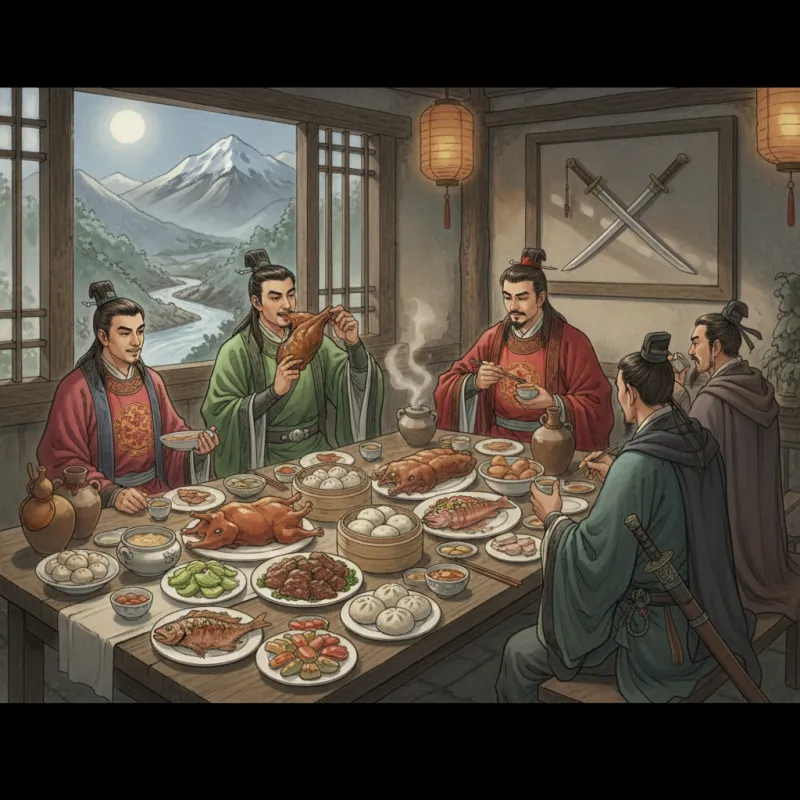
Picture this: Hong Qigong, one of the Five Greats who could flatten mountains with his palm strikes, sits cross-legged by a campfire, drooling. Not over a legendary martial arts manual. Not over a priceless sword. Over a chicken wrapped in lotus leaves and baked in clay. When Huang Rong unveils her Beggar's Chicken (叫花鸡, jiàohuā jī) in The Legend of the Condor Heroes (射雕英雄传, Shèdiāo Yīngxióng Zhuàn), she doesn't just feed a hungry old beggar—she buys herself the greatest martial arts teacher in the world. Jin Yong understood something fundamental: in the jianghu (江湖, the martial arts world), a perfect meal can be as powerful as a perfect sword technique.
The Beggar's Banquet
Hong Qigong's obsession with food isn't a character quirk—it's Jin Yong's thesis statement. The leader of the Beggars' Sect (丐帮, Gàibāng), the largest martial arts organization in the jianghu, could demand tribute from emperors. Instead, he wanders the land hunting for the next great dish. When Huang Rong prepares her famous "Twenty-Four Bridges on a Moonlit Night" (二十四桥明月夜, Èrshísì Qiáo Míngyuè Yè)—tofu stuffed with minced ham shaped like bridges—Hong Qigong literally weeps with joy.
Jin Yong devotes entire chapters to Huang Rong's cooking lessons. She doesn't just cook; she performs culinary alchemy. Her Five-Treasure Mandarin Duck (五珍鸳鸯, Wǔzhēn Yuānyāng) requires precise timing, rare ingredients, and the kind of focused attention most heroes reserve for deadly duels. The message is clear: mastery is mastery, whether you're wielding a spatula or a sword. Hong Qigong trades the Dog-Beating Staff Technique (打狗棒法, Dǎgǒu Bàngfǎ)—the Beggars' Sect's most sacred martial art—for a few more meals. In Jin Yong's universe, this isn't foolishness. It's wisdom.
Wine, Blood, and Brotherhood
If food represents civilization and refinement in Jin Yong's novels, wine (酒, jiǔ) represents raw emotion and masculine bonding. Heroes don't sip wine—they gulp it from bowls, slam the empty vessels on tables, and roar for more. When Qiao Feng drinks in Demigods and Semi-Devils (天龙八部, Tiānlóng Bābù), he's not just consuming alcohol; he's performing his identity as a northern warrior, a man of the grasslands where subtlety is weakness.
The contrast with southern drinking culture is deliberate. Linghu Chong in The Smiling, Proud Wanderer (笑傲江湖, Xiào'ào Jiānghú) drinks with a different energy—melancholic, artistic, tinged with the refined culture of Jiangnan. When he meets the wine-loving monks and nuns who teach him the Dugu Nine Swords, their drinking sessions become philosophical debates disguised as parties. Jin Yong, who grew up in Zhejiang province, knew both drinking cultures intimately and used them to paint regional identities with remarkable precision.
The most famous drinking scene in all of Jin Yong's work might be Qiao Feng's final drink before the Battle of Yanmen Pass. He knows he's going to die. He drinks anyway—not to forget, but to remember everything that brought him to this moment. The wine doesn't dull his senses; it sharpens his resolve. This is drinking as ritual, as preparation for death, as a final act of defiance against fate itself.
The Politics of Eating
Jin Yong uses food to expose power dynamics with surgical precision. When Wei Xiaobao in The Deer and the Cauldron (鹿鼎记, Lùdǐng Jì) eats with the Kangxi Emperor, every dish carries political weight. Imperial cuisine isn't just about taste—it's about demonstrating the emperor's control over resources from every corner of the empire. Bird's nest from the south, sea cucumber from the coast, mushrooms from the mountains: each ingredient is a province rendered edible.
But Jin Yong also shows us the reverse. When heroes eat simple food—a bowl of noodles, a steamed bun—they're rejecting the corruption of wealth and power. Guo Jing, the ultimate righteous hero, never develops sophisticated tastes. He's happy with plain food, which signals his moral purity. Huang Rong, despite her culinary genius, cooks elaborate meals not for herself but for others. The act of cooking becomes an expression of love and care, not status-seeking.
The most subversive food politics appear in the Beggars' Sect gatherings. These are feasts where social hierarchy is temporarily inverted. The lowest members of society eat like kings, sharing whatever they've begged or stolen. Jin Yong, writing in the 1950s-70s during periods of political upheaval, understood the revolutionary potential of a shared meal. The Beggars' Sect isn't just a martial arts organization—it's a utopian vision of community where everyone eats together, regardless of rank.
Poison and Medicine: When Food Kills
Jin Yong's food isn't always benevolent. Poison (毒, dú) lurks in wine cups and soup bowls throughout his novels. The most memorable poisoning might be in The Book and the Sword (书剑恩仇录, Shūjiàn Ēnchóu Lù), where a seemingly innocent banquet becomes a death trap. Heroes must develop not just martial arts skills but also the ability to detect poison—a kind of gustatory martial art.
The line between poison and medicine is razor-thin in Jin Yong's world, reflecting traditional Chinese medical philosophy. Huang Yaoshi, Huang Rong's father, is both a master physician and a master poisoner. He understands that the same substance can heal or kill depending on dosage, preparation, and timing. This ambiguity extends to food itself: eating the wrong thing at the wrong time can be as dangerous as any sword strike.
The most fascinating food-as-medicine subplot involves the Ice Silkworms in Demi-Gods and Semi-Devils. These creatures, when consumed, grant immunity to poison but also cause excruciating pain. The hero must literally eat suffering to gain protection. Jin Yong, ever the moralist, suggests that true power always comes with a price—even the power to survive poison requires poisoning yourself first.
Regional Flavors, Regional Identities
Jin Yong's novels span the entire Chinese cultural landscape, and food becomes his primary tool for establishing regional identity. Northern characters eat lamb, wheat noodles, and hearty stews. Southern characters prefer fish, rice, and delicate preparations. This isn't just atmospheric detail—it's characterization through cuisine.
When Guo Jing travels from the Mongolian steppes to Jiangnan, his food journey mirrors his cultural education. He starts eating roasted meat with his hands and gradually learns to appreciate Huang Rong's sophisticated southern cooking. But he never fully abandons his northern roots—he remains a man who can enjoy both a simple bowl of mutton soup and an elaborate banquet. This culinary flexibility represents his ability to bridge different worlds, which becomes crucial to his role as a hero who unites different factions against foreign invasion.
The most detailed regional food writing appears in The Deer and the Cauldron, where Wei Xiaobao's travels take him from Beijing to Yangzhou to Tibet to Russia. Each location has its distinctive cuisine, and Jin Yong describes them with the enthusiasm of a food blogger centuries before food blogs existed. His descriptions of Yangzhou's refined snacks, Beijing's imperial cuisine, and Tibetan butter tea aren't just setting—they're arguments about cultural diversity and the richness of Chinese civilization.
The Last Meal
Jin Yong's heroes often face death, and their final meals reveal their true characters. Yang Guo in The Return of the Condor Heroes (神雕侠侣, Shéndiāo Xiálǚ) doesn't eat elaborately before his suicide attempt—he's too consumed by grief over Xiaolongnü's disappearance. Qiao Feng drinks heavily before his death but doesn't eat at all, suggesting that food represents life and connection, while wine represents solitary contemplation.
The most moving final meal might be in The Heaven Sword and Dragon Saber (倚天屠龙记, Yǐtiān Túlóng Jì), where Zhang Cuishan and Yin Susu share a simple meal before their joint suicide. They don't feast—they eat the kind of ordinary food that married couples share every day. The ordinariness is the point. They're choosing to end their lives not in dramatic fashion but as they lived: together, sharing everything, including their last bowl of rice.
Jin Yong understood that food is never just food. It's memory, culture, love, power, and mortality all mixed together. When his heroes eat, they're not just refueling for the next fight—they're participating in the most fundamental human ritual. Between the sword fights and the political intrigue, between the secret manuals and the legendary weapons, Jin Yong's characters stop to eat. And in those moments, they're most fully alive.
Why It Matters
Modern wuxia adaptations often skip the food scenes. Directors cut Huang Rong's cooking montages to make room for more CGI sword fights. This is a mistake. The food scenes aren't filler—they're the heart of Jin Yong's humanism. His heroes are great not because they can kill efficiently but because they can appreciate a perfect meal, share wine with friends, and understand that martial arts mastery without human connection is worthless.
Jin Yong wrote during periods when China experienced devastating famines. His detailed food descriptions weren't escapism—they were acts of cultural preservation and hope. He was documenting a cuisine and a way of life that was under threat, insisting that these traditions mattered as much as any martial arts technique. When Hong Qigong trades deadly secrets for delicious meals, he's making a profound statement: the things that make life worth living—friendship, beauty, flavor—are more valuable than the things that make you powerful.
The next time you read a Jin Yong novel, pay attention to what the characters eat. Notice how the righteous heroes appreciate simple food while the villains obsess over rare delicacies. Observe how shared meals create bonds stronger than sworn brotherhood. Watch how characters reveal themselves through their relationship with food and drink. Jin Yong's genius wasn't just in his fight choreography or plot twists—it was in understanding that a perfectly cooked chicken could change the course of martial arts history.
Related Reading
- Food in Jin Yong's Novels: When Cooking Is a Martial Art
- Eating and Drinking in Jin Yong: A Culinary Guide
- Wine Culture in Jin Yong's Wuxia World
- Tea and Martial Arts: The Quiet Moments Between Fights
- The Allure of Jin Yong's Wuxia: Exploring Martial Arts, Characters, and Legendary Storylines
- The Art of Duels in Jin Yong's Wuxia Novels: A Journey Through Martial Valor
- The Unsung Heroes of Jin Yong's Wuxia Novels: Side Characters That Steal the Spotlight