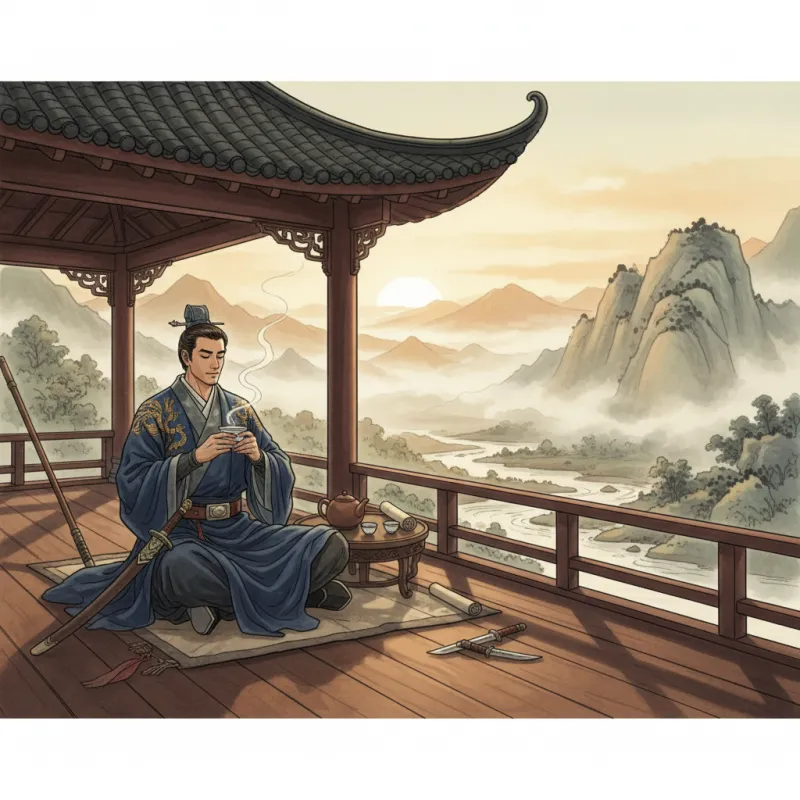
The old beggar and the young swordsman sit across from each other in silence. Steam rises from two chipped cups. Outside, a dozen corpses cool in the snow — the aftermath of an ambush that failed spectacularly. Inside, Hong Qigong (洪七公 Hóng Qīgōng) pours tea with hands that just moments ago crushed a man's skull with the Eighteen Dragon-Subduing Palms. Guo Jing (郭靖 Guō Jìng) watches, still trembling with adrenaline, and learns something no martial arts manual could teach him: that the space between violence matters more than the violence itself.
This is Jin Yong's (金庸 Jīn Yōng) genius in miniature. His novels are remembered for their spectacular fight choreography, but they're built on something quieter — the tea scenes, the moments of stillness where characters reveal who they actually are when the swords are sheathed. Tea culture (茶道 chádào) permeates his work not as decoration but as philosophy, a counterweight to martial prowess that separates the true masters from mere killers.
The Philosophy in the Teacup
Chinese tea culture operates on principles that mirror the highest levels of martial arts mastery: presence, patience, precision, and the ability to find stillness within motion. The tea ceremony isn't about the beverage — it's about the state of mind required to prepare and serve it properly. You cannot rush tea. You cannot force it. You must pay attention to temperature, timing, the quality of water, the season of the leaves. Sound familiar? It's the same discipline required to master the Dugu Nine Swords (獨孤九劍 Dúgū Jiǔ Jiàn) or achieve the mental clarity needed for the Nine Yin Manual (九陰真經 Jiǔ Yīn Zhēn Jīng).
Jin Yong makes this connection explicit throughout his novels. In The Legend of the Condor Heroes (射鵰英雄傳 Shè Diāo Yīngxióng Zhuàn), Hong Qigong — arguably the most powerful martial artist in the jianghu (江湖 jiānghú, the martial arts world) — is equally obsessed with fine cuisine and proper tea. This isn't comic relief. It's characterization. Hong's mastery of tea and food demonstrates the same attention to detail, the same respect for process, that makes him a grandmaster. He understands that excellence in any discipline requires the same fundamental qualities.
Compare this to Ouyang Feng (歐陽鋒 Ōuyáng Fēng), the Western Venom, who drinks wine and scorns such refinements. Ouyang is powerful, brilliant even, but he's also brittle — his martial arts are aggressive, his mind is obsessive, and he ultimately descends into madness. The contrast isn't accidental. Jin Yong is showing us that martial arts without the balancing philosophy of tea culture — without patience, presence, and inner peace — leads to destruction.
Tea as Truth Serum
The tea scene is where Jin Yong's characters drop their masks. In combat, everyone performs — they bluff, they feint, they hide their true capabilities. Over tea, the truth emerges. It's a space of vulnerability that the jianghu rarely permits.
Consider the famous scene in Demi-Gods and Semi-Devils (天龍八部 Tiān Lóng Bā Bù) where Qiao Feng (喬峰 Qiáo Fēng) shares tea with Duan Zhengchun (段正淳 Duàn Zhèngchún). These are two men who could kill each other in seconds, yet they sit peacefully, discussing philosophy and personal regrets. The tea creates a temporary truce, a space where they can be honest about their failures and fears. Qiao Feng, the most physically imposing character in Jin Yong's entire corpus, reveals his deepest insecurities not in battle but over tea.
Or look at The Smiling, Proud Wanderer (笑傲江湖 Xiào Ào Jiānghú), where Linghu Chong (令狐沖 Línghú Chōng) and Yilin (儀琳 Yílín) share tea in a mountain temple. Nothing dramatic happens — no confessions of love, no plot revelations. Just two people being genuinely present with each other. It's one of the most emotionally resonant scenes in the novel precisely because it's so quiet. The tea ceremony forces them to slow down, to actually see each other rather than playing their usual roles.
This is what tea does in Jin Yong's world: it creates pockets of authenticity in a society built on deception and performance. The jianghu is a place where everyone has secrets, where alliances shift like sand, where today's ally might be tomorrow's assassin. Tea offers a temporary reprieve from all that exhausting vigilance.
The Master's Paradox
Here's what separates Jin Yong's true masters from the merely skilled: the greatest fighters are the ones who least want to fight. And they're almost always the ones who appreciate tea.
Zhang Sanfeng (張三豐 Zhāng Sānfēng), founder of the Wudang Sect (武當派 Wǔdāng Pài) and creator of Taiji Quan (太極拳 Tàijí Quán), appears in The Heaven Sword and Dragon Saber (倚天屠龍記 Yǐ Tiān Tú Lóng Jì) as an elderly man more interested in tea and meditation than combat. He's also the most dangerous person in the novel. His martial arts philosophy — soft overcoming hard, yielding to overcome force — is literally the philosophy of tea. You don't force tea leaves to release their flavor; you coax it out with the right temperature and timing.
Dugu Qiubai (獨孤求敗 Dúgū Qiúbài), the legendary swordsman who never appears directly in the novels but whose legacy haunts them, reportedly spent his final years in mountain seclusion, presumably drinking tea and contemplating the void. He'd mastered every form of combat and found it all meaningless. The tea, one imagines, was more interesting than another duel.
Even Guo Jing, who starts as a simple-minded boy, evolves into a master who values tea and contemplation. By the end of The Return of the Condor Heroes (神鵰俠侶 Shén Diāo Xiá Lǚ), he's defending Xiangyang (襄陽 Xiāngyáng) not through constant fighting but through strategic patience — the same patience required for proper tea preparation. He's learned that knowing when not to fight is more important than knowing how to fight.
The Economics of Attention
There's a practical reason Jin Yong uses tea scenes so effectively: pacing. You cannot sustain high-intensity action for an entire novel. The reader's nervous system needs breaks. But Jin Yong doesn't just insert random downtime — he uses tea scenes to accomplish multiple narrative goals simultaneously.
First, they provide character development. We learn more about Huang Yaoshi (黃藥師 Huáng Yàoshī), the Heretical East, from watching him prepare tea on Peach Blossom Island (桃花島 Táohuā Dǎo) than from any of his fights. His tea ceremony is eccentric, unconventional, slightly wrong by orthodox standards — exactly like his martial arts and his personality. The tea is characterization.
Second, they build relationships. The wine culture in Jin Yong's novels creates camaraderie and chaos — people bond over wine, but they also fight over it. Tea creates a different kind of connection: quieter, more intimate, more lasting. When Yang Guo (楊過 Yáng Guò) and Xiaolongnü (小龍女 Xiǎolóngnǚ) share tea in the Ancient Tomb, it's more romantic than any love scene could be. The ritual creates a shared space of attention and care.
Third, they establish stakes. Before a major battle, Jin Yong often includes a tea scene where characters discuss what they're fighting for, what they stand to lose. These scenes make the subsequent violence meaningful rather than gratuitous. We care about the outcome because we've seen these people as humans, not just as martial arts machines.
Tea and Mortality
One of the most poignant uses of tea in Jin Yong's work is as a reminder of mortality and the passage of time. Tea leaves are picked, dried, aged. They have seasons, peak moments, periods of decline. Like martial artists. Like everyone.
In The Deer and the Cauldron (鹿鼎記 Lù Dǐng Jì), Wei Xiaobao (韋小寶 Wéi Xiǎobǎo) — who knows nothing about martial arts and cares even less — becomes obsessed with expensive tea as a status symbol. But the novel's true tea master is the Kangxi Emperor (康熙帝 Kāngxī Dì), who understands that tea, like power, is temporary. The best tea in the world still becomes bitter if you steep it too long. The most powerful emperor still ages and dies. The tea ceremony is a meditation on impermanence.
This theme reaches its apex in the final scenes of The Book and the Sword (書劍恩仇錄 Shū Jiàn Ēnchóu Lù), where aging heroes gather to share tea and reminisce about battles fought decades ago. The tea is good, but not as good as they remember from their youth. Or perhaps their palates have changed. Or perhaps the tea is the same, but they're different. The scene is suffused with melancholy — the recognition that even the greatest martial artists cannot defeat time.
The Anti-Tea Character
Jin Yong's villains often reveal themselves through their relationship with tea — or lack thereof. They're impatient, they rush, they don't appreciate subtlety. They want results now.
Yue Buqun (岳不群 Yuè Bùqún) in The Smiling, Proud Wanderer performs the tea ceremony correctly, but it's all performance. He's learned the motions without understanding the philosophy. He serves tea to demonstrate his refinement, not because he values the moment of stillness. This is why, despite his technical skill, he's ultimately a fraud — he's mastered the external forms of both martial arts and tea culture while missing the entire point of both.
Contrast this with Feng Qingyang (風清揚 Fēng Qīngyáng), the reclusive Huashan (華山 Huàshān) master who teaches Linghu Chong the Dugu Nine Swords. Feng lives in a cave and drinks rough tea from a cracked pot, but he understands tea philosophy better than Yue Buqun with all his expensive implements. The quality of the tea doesn't matter; the quality of attention does.
What Tea Teaches Swords
The final lesson of tea in Jin Yong's novels is this: the highest martial arts are indistinguishable from art, from meditation, from tea ceremony. They all require the same state of mind — what Buddhists call mindfulness (正念 zhèngniàn) and what tea masters call presence.
When Linghu Chong finally masters the Dugu Nine Swords, he describes it as a state where thought and action become one, where he responds to his opponent without conscious decision. This is exactly the state a tea master enters during the ceremony — not thinking about the steps, but flowing through them naturally. The sword becomes an extension of the body; the teapot becomes an extension of the hand.
Jin Yong's greatest martial artists are the ones who understand this connection. They practice their forms with the same attention they bring to preparing tea. They approach combat with the same mindfulness they bring to appreciating a good oolong (烏龍 wūlóng). They know that mastery in any discipline is really mastery of the self — the ability to be fully present, fully attentive, fully alive in each moment.
The tea scenes in Jin Yong's novels aren't breaks from the action. They're the point of the action. The fights are just the test of what's been learned in the quiet moments between them. And what's been learned, always, is this: that the quality of your tea ceremony and the quality of your martial arts are the same thing, because they both depend on the quality of your attention, your patience, your presence. The sword and the teacup are two paths to the same destination — a mind that's fully awake, fully here, fully human.
Related Reading
- Wine Culture in Jin Yong's Wuxia World
- Food in Jin Yong's Novels: When Cooking Is a Martial Art
- Eating and Drinking in Jin Yong: A Culinary Guide
- The Food and Drink of Jin Yong: What Heroes Eat Between Sword Fights
- Jin Yong's Writing Career: From First Novel to Final Retirement
- Ren Yingying: Love and Freedom
- 25 Most Famous Jin Yong Quotes That Every Chinese Person Knows