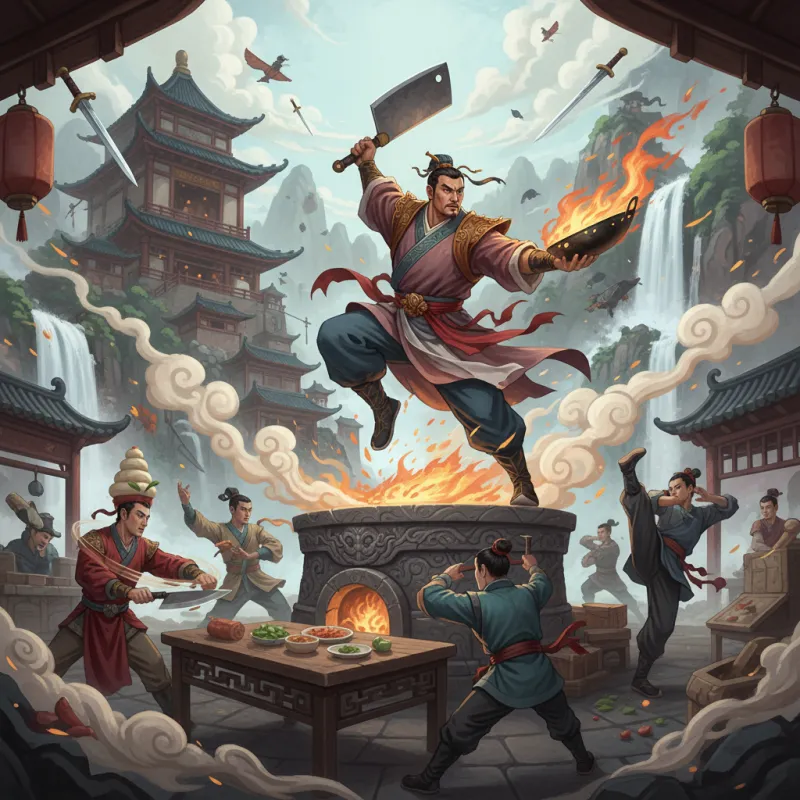
When Huang Rong prepares the "Twenty-Four Bridge Moonlit Night" (二十四桥明月夜 Èrshísì Qiáo Míngyuè Yè) for Hong Qigong in The Legend of the Condor Heroes, she's not just cooking dinner — she's executing a strategic operation that would make Sun Tzu proud. The dish, a hollowed-out ham stuffed with tofu and steamed to perfection, wins over the leader of the Beggars' Sect and changes the entire trajectory of the novel. This is Jin Yong's genius: in his hands, a kitchen becomes a battlefield, and a meal becomes a plot device as powerful as any secret manual.
The Philosophy of Food as Character Development
Jin Yong didn't scatter food scenes randomly through his novels like garnish on a plate. Every meal tells you something essential about who's eating it, who's preparing it, and what's really happening beneath the surface of polite conversation. When Duan Yu stumbles into fine dining situations in Demi-Gods and Semi-Devils, his refined palate and appreciation for culinary arts immediately mark him as educated nobility, even when he's pretending to be a commoner. Contrast this with Guo Jing, who can barely tell good food from bad and would happily eat the same roasted meat every day — his indifference to cuisine reflects his straightforward, uncomplicated nature.
The preparation of food reveals even more. Huang Rong's cooking isn't just skilled; it's creative, playful, and strategic. She names dishes after poetry, understands the psychology of her audience, and uses food as both gift and weapon. When she cooks for Hong Qigong, she's demonstrating intelligence, cultural refinement, and tactical thinking — all the qualities that make her one of Jin Yong's most formidable characters, despite never being the strongest fighter in any room.
Beggar's Chicken and Class Warfare
The most famous dish in Jin Yong's entire corpus is probably Beggar's Chicken (叫化鸡 Jiàohuā Jī), and its appearance in The Legend of the Condor Heroes is a masterclass in using food to explore social hierarchy. The dish — a whole chicken wrapped in lotus leaves and clay, then baked in hot coals — supposedly originated with beggars who had no cooking vessels. Hong Qigong, leader of the Beggars' Sect, considers it the ultimate delicacy, superior to any imperial banquet food.
This isn't just Jin Yong being whimsical. He's making a pointed argument about authenticity versus pretension, substance versus appearance. The Beggars' Sect, despite being society's lowest class, possesses wisdom and martial arts that rival any palace. Their food, born from necessity and cooked with skill, surpasses the elaborate but often hollow cuisine of the wealthy. When Huang Rong prepares Beggar's Chicken for Hong Qigong, she's not just feeding him — she's acknowledging his values and demonstrating that she understands what matters to him.
The scene also reveals Jin Yong's deep knowledge of actual Chinese culinary history. Beggar's Chicken is a real Hangzhou specialty, and the clay-baking technique does produce extraordinarily tender, flavorful meat. By anchoring his fiction in genuine culinary tradition, Jin Yong makes his fantasy world feel grounded and believable.
The Peach Blossom Island Banquet: Food as Power Display
When characters visit Huang Yaoshi's Peach Blossom Island (桃花岛 Táohuā Dǎo), the meals they're served function as demonstrations of their host's wealth, sophistication, and subtle menace. Huang Yaoshi doesn't just feed his guests; he overwhelms them with rare ingredients, complex preparations, and presentations that border on intimidation. This is food as psychological warfare.
The banquet scenes on Peach Blossom Island also showcase Jin Yong's understanding of Song Dynasty (960-1279 CE) culinary culture, when Chinese cuisine reached new heights of refinement. The elaborate multi-course meals, the attention to seasonal ingredients, the integration of medicinal herbs — these weren't invented by Jin Yong but carefully researched and incorporated into his fictional world. Readers familiar with Chinese food history recognize the authenticity, which makes the fantasy elements more convincing.
Compare this to the meals in the Shaolin Temple, which are deliberately simple, vegetarian, and uniform. The contrast isn't accidental. Jin Yong uses food to illustrate different philosophical approaches to life: Huang Yaoshi's individualistic aestheticism versus Shaolin's collective discipline and spiritual focus.
Drunken Immortals and Poisoned Wine
Alcohol in Jin Yong's novels deserves its own analysis. Wine isn't just a beverage; it's a truth serum, a social lubricant, a poison delivery system, and a test of character. The "Drunken Immortal" (醉八仙 Zuì Bāxiān) wine that appears in several novels is so potent that even martial arts masters can't resist its effects — which is precisely the point. In the jianghu (江湖 jiānghú), the world of martial artists, letting your guard down is dangerous, and drinking to excess is a calculated risk.
Linghu Chong's relationship with alcohol in The Smiling, Proud Wanderer is particularly revealing. His heavy drinking marks him as someone who doesn't fit into conventional society, who rejects orthodox rules, and who finds freedom in intoxication. When he drinks with various characters throughout the novel, the scenes reveal alliances, test loyalties, and expose hidden agendas. The famous scene where he drinks with the Sun Moon Holy Cult members isn't just about getting drunk — it's about finding unexpected common ground with supposed enemies.
Jin Yong also understood that in Chinese culture, refusing to drink with someone can be an insult, while sharing wine creates bonds. The elaborate toasting rituals, the games played while drinking, the poetry recited — these aren't decorative details but essential social mechanisms that his characters must navigate.
Medicinal Cuisine and the Blurred Line
One of Jin Yong's most sophisticated uses of food involves medicinal cuisine (药膳 yàoshàn), where the boundary between eating and healing disappears. In The Return of the Condor Heroes, various characters prepare dishes that are simultaneously delicious and therapeutic, using ingredients like ginseng, goji berries, and exotic mushrooms that have genuine medicinal properties in Traditional Chinese Medicine.
This reflects a fundamental principle of Chinese food culture: food and medicine share the same origin (药食同源 yàoshí tóngyuán). A properly prepared meal doesn't just satisfy hunger; it balances the body's qi (气 qì), adjusts yin and yang, and prevents illness. When Jin Yong's characters eat, they're often unknowingly consuming medicine, or sometimes knowingly consuming poison disguised as food.
The poisoning attempts through food in Jin Yong's novels are numerous and creative. From the poisoned wine that nearly kills Linghu Chong to the various toxic dishes served to unsuspecting victims, food becomes a weapon precisely because it's so trusted and intimate. You can defend against a sword, but defending against a meal prepared by someone you trust is nearly impossible.
The Social Architecture of Eating
Jin Yong understood that in Chinese culture, how you eat is as important as what you eat. The seating arrangements at a banquet, who serves whom, who eats first, who gets the best portions — these details encode entire social hierarchies. When Guo Jing awkwardly navigates formal banquets in The Legend of the Condor Heroes, his discomfort reveals his outsider status. When Wei Xiaobao manipulates banquet seating in The Deer and the Cauldron, he's exercising political power.
The contrast between eating alone and eating communally appears repeatedly. Solitary meals often mark moments of isolation, defeat, or contemplation. Communal feasts represent alliance, celebration, and social integration. The massive banquets in the Beggars' Sect, where thousands eat together regardless of rank, embody their egalitarian ideals — though even there, subtle hierarchies persist.
Jin Yong also captured the specific rituals of different social classes. Imperial banquets follow rigid protocols. Merchant family meals display wealth through ingredient quality. Martial artists eating at roadside inns reveal the rough camaraderie of jianghu life. Each setting has its own food culture, and characters who can navigate multiple settings demonstrate social intelligence.
Street Food and the Authentic Jianghu
Some of Jin Yong's most memorable food scenes happen not in palaces or on mystical islands but at humble street stalls and country inns. The beef noodles, the steamed buns, the simple stir-fried vegetables — these everyday foods ground his fantasy world in recognizable reality. When characters travel through different regions, the changing local cuisines mark their journey as effectively as any map.
The street food scenes also serve a democratic function. In these moments, the social hierarchies temporarily dissolve. A beggar and a prince might eat the same noodles at the same stall, and the quality of the food depends only on the cook's skill, not the customer's status. This aligns with Jin Yong's recurring theme that true worth comes from character and ability, not birth or wealth.
Wei Xiaobao's love of street food in The Deer and the Cauldron is particularly telling. Despite gaining access to imperial cuisine, he never loses his taste for the simple foods of his Yangzhou childhood. This keeps him connected to his origins and prevents him from becoming completely absorbed into the corrupt elite he infiltrates. Food becomes a marker of authentic identity that survives social transformation.
The Unspoken Language of Hospitality
In Jin Yong's novels, offering food is never neutral. It's an invitation, a peace offering, a declaration of alliance, or sometimes a trap. The elaborate rules of Chinese hospitality — insisting guests eat more, refusing food to show politeness, the host serving guests personally — create a complex dance that characters must perform correctly or risk giving offense.
When Huang Rong cooks for Hong Qigong, she's not just demonstrating skill; she's offering service, showing respect, and requesting his teaching in return. The food becomes the medium of negotiation. When various characters share their rations during journeys, they're building trust and camaraderie. When enemies refuse to eat together, the rejection carries weight precisely because sharing a meal is such a fundamental gesture of peace.
The most poignant food scenes in Jin Yong's work often involve characters cooking for loved ones. These moments of domestic intimacy — rare in action-packed wuxia fiction — reveal emotional depths that fight scenes cannot. When a character who has mastered deadly martial arts carefully prepares a simple meal for someone they care about, the contrast between their capacity for violence and their capacity for tenderness becomes almost unbearably moving.
Jin Yong's food scenes remind us that martial arts novels, despite their fantasy elements, are ultimately about human relationships, social structures, and the small rituals that bind people together or drive them apart. In his world, a perfectly prepared dish can be as powerful as any secret technique, and knowing how to share a meal is as important as knowing how to wield a sword.
Related Reading
- Wine Culture in Jin Yong's Wuxia World
- The Food and Drink of Jin Yong: What Heroes Eat Between Sword Fights
- Tea and Martial Arts: The Quiet Moments Between Fights
- Eating and Drinking in Jin Yong: A Culinary Guide
- Why Every Chinese Person Knows Jin Yong
- The Enigmatic Hidden Techniques in Jin Yong’s Wuxia Novels Explored
- How the Condor Trilogy Connects: Characters, Weapons, and Secrets Across 155 Years