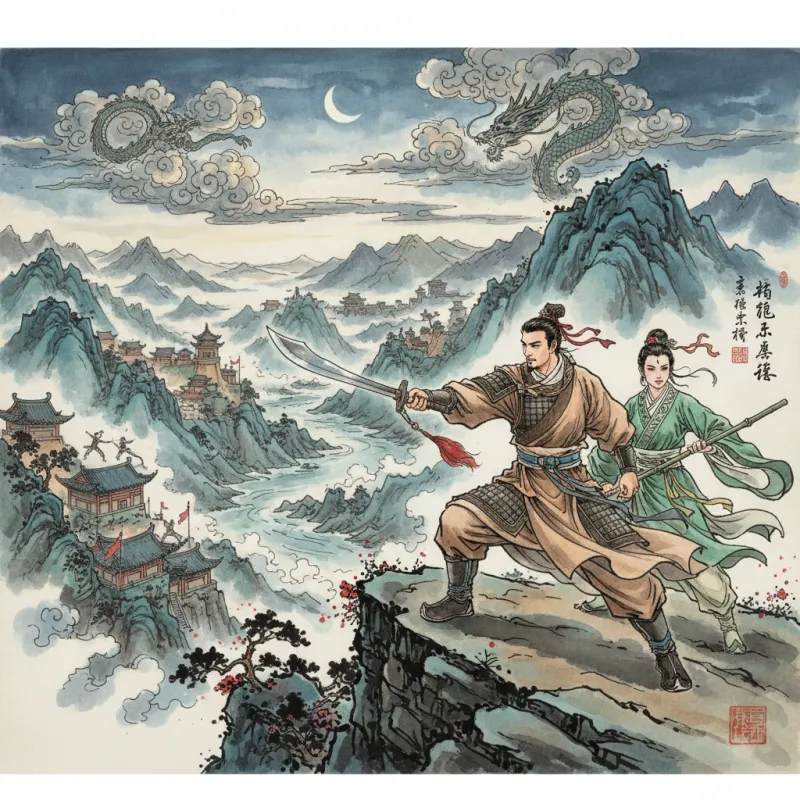
Ask any Chinese person over the age of 25 to name a Jin Yong character. They won't hesitate. They might name Guo Jing, Huang Rong, Xiao Feng, Linghu Chong, or Wei Xiaobao — but they'll name someone, instantly, without thinking. Ask them to describe that character, and they'll talk for twenty minutes.
Now try the same experiment with any other novelist. You won't get the same result. Not with Lu Xun (鲁迅, Lǔ Xùn), not with Mo Yan (莫言, Mò Yán), not with any writer in any language. Jin Yong occupies a unique position in Chinese culture: he's not just widely read, he's universally known. His fifteen novels have sold over 300 million copies, been adapted into countless films and TV series, and shaped the moral imagination of multiple generations. But numbers alone don't explain the phenomenon. There are specific, identifiable reasons why Jin Yong became the closest thing modern Chinese culture has to a shared mythology.
The Serialization Machine
Jin Yong's novels were originally published as newspaper serials in Hong Kong's Ming Pao (明报, Míng Bào) and New Evening Post (新晚报, Xīn Wǎn Bào). This wasn't just a publishing strategy — it was a cultural delivery system that made his work inescapable.
From 1955 to 1972, Jin Yong wrote almost daily, producing chapters that appeared in newspapers the next morning. Readers didn't choose to engage with his work the way you choose to buy a novel. They encountered it while reading the news, checking sports scores, scanning classified ads. The barrier to entry was zero. You didn't need to visit a bookstore, spend money, or make a conscious decision to start reading. Jin Yong simply appeared in your daily routine.
This created a reading habit that spanned social classes. Factory workers, university professors, housewives, businessmen — everyone read the same newspaper, followed the same stories, waited for the same cliffhangers. When The Return of the Condor Heroes (神雕侠侣, Shén Diāo Xiá Lǚ) revealed that Yang Guo had lost his arm, the entire city of Hong Kong knew about it the same morning. There was no spoiler culture because everyone was on the same page, literally.
The serialization format also shaped Jin Yong's writing style. He mastered the art of the chapter-ending hook, the mid-story revelation, the perfectly timed character entrance. Each installment had to be satisfying on its own while propelling the larger narrative forward. This made his novels compulsively readable in a way that more "literary" works often aren't. Lu Xun wrote important books. Jin Yong wrote books you couldn't put down.
The Television Amplification
If serialization made Jin Yong widely read, television made him universal. Starting in the 1970s, Hong Kong's TVB and later mainland Chinese networks began adapting his novels into serialized dramas. These weren't prestige productions shown once and archived. They were broadcast repeatedly, sometimes annually, becoming as much a part of the cultural calendar as Spring Festival.
The 1983 TVB adaptation of The Legend of the Condor Heroes (射雕英雄传, Shè Diāo Yīng Xióng Zhuàn) starring Felix Wong and Barbara Yung achieved a 62% viewership rating in Hong Kong — meaning nearly two-thirds of the entire population watched it. The theme song became so iconic that people who never read the novel still know every word. When Barbara Yung died in 1985, the entire city mourned not just an actress but Huang Rong herself.
Mainland China's relationship with Jin Yong adaptations is even more intense. The 1994 version of The Return of the Condor Heroes starring Louis Koo and Carman Lee, the 1997 Demi-Gods and Semi-Devils (天龙八部, Tiān Lóng Bā Bù) with Huang Rihua, the 2003 The Smiling, Proud Wanderer (笑傲江湖, Xiào Ào Jiāng Hú) — these shows aired during summer and winter breaks when students were home from school. Entire families watched together. Grandparents, parents, and children all knew the same stories, debated the same character choices, quoted the same lines.
This created a rare phenomenon in modern culture: genuine cross-generational literacy. A teenager in 2024 and their grandmother can have a detailed conversation about whether Linghu Chong should have ended up with Yue Lingshan or Ren Yingying. They might disagree, but they're arguing about the same text, the same characters, the same moral dilemmas. How many other cultural products can claim that?
The Moral Education System
Chinese schools don't teach Jin Yong the way Western schools teach Shakespeare, but his novels function as a kind of informal moral curriculum anyway. His characters embody ethical principles that Chinese culture values: loyalty (忠, zhōng), righteousness (义, yì), filial piety (孝, xiào), and the complex concept of jianghu honor that has no direct English translation.
Guo Jing from The Legend of the Condor Heroes is the archetypal example. He's not particularly smart or talented, but he's honest, hardworking, and absolutely committed to protecting his country and people. When he chooses to defend Xiangyang against the Mongol invasion, knowing it will likely cost him his life, he's demonstrating a principle that Chinese parents want their children to understand: personal sacrifice for the greater good. You don't need to lecture a child about patriotism when you can just say, "Remember what Guo Jing did at Xiangyang."
But Jin Yong's moral universe isn't simplistic. Wei Xiaobao from The Deer and the Cauldron (鹿鼎记, Lù Dǐng Jì) is a liar, a con artist, and a shameless opportunist — yet he's also loyal to his friends, kind to the powerless, and ultimately more honest about human nature than many "righteous" characters. Jin Yong understood that real morality is complicated, that good people make terrible choices, and that sometimes the system itself is corrupt.
This moral complexity is why adults keep returning to these novels. They're not children's stories with simple lessons. They're explorations of how to live ethically in an imperfect world, how to balance competing loyalties, how to maintain integrity when everyone around you is compromising. These are questions that don't have easy answers, which is why people keep discussing them decades later.
The Language Accessibility
Here's something that often gets overlooked: Jin Yong's Chinese is remarkably accessible. He wrote in vernacular Chinese (白话文, báihuà wén), not classical Chinese (文言文, wényán wén), but he incorporated just enough classical elements to give his prose elegance and historical flavor without making it incomprehensible.
Compare this to Lu Xun, whose work is brilliant but dense, or classical novels like Dream of the Red Chamber (红楼梦, Hóng Lóu Mèng), which requires extensive footnotes for modern readers. Jin Yong found a sweet spot: sophisticated enough to feel literary, simple enough that a middle school student can read it without a dictionary.
This accessibility extends to his storytelling structure. Jin Yong plots are complex but never confusing. He introduces characters clearly, establishes their motivations, and follows through on narrative promises. When he sets up a mystery in chapter five, he resolves it by chapter fifty, not in some ambiguous literary way but with actual answers. This respect for the reader's investment is part of why people trust him enough to commit to 1,000-page novels.
His dialogue is equally accessible — characters speak in ways that feel natural and period-appropriate without being archaic. When Huang Rong teases Guo Jing, when Linghu Chong jokes with his martial brothers, when Wei Xiaobao cons his way out of trouble, the conversations feel real. You can hear these people talking. This makes the characters memorable in a way that more stylized dialogue often isn't.
The Timing Was Perfect
Jin Yong wrote during a specific historical window that made his work uniquely resonant. Post-1949 mainland China was closed off, undergoing political upheavals that made traditional culture suspect. Hong Kong and Taiwan became repositories of Chinese cultural continuity, and Jin Yong's novels — set in historical China, celebrating martial arts and traditional values — satisfied a hunger for connection to that heritage.
When mainland China opened up in the 1980s, Jin Yong's novels flooded in, both officially and through pirated editions. For a generation that had grown up during the Cultural Revolution, when traditional culture was suppressed and entertainment was limited to revolutionary operas, these stories of wandering heroes, romantic love, and personal honor were revelatory. They represented not just entertainment but a reconnection with a Chinese identity that had been interrupted.
The timing worked in another way too: Jin Yong wrote before the internet, before streaming services, before the fragmentation of media consumption. When his novels were adapted for television, there were only a few channels. Everyone watched the same shows because there weren't infinite alternatives. This created a shared cultural experience that's nearly impossible to replicate today.
The Diaspora Connection
For Chinese people living outside China, Jin Yong's novels serve a specific function: they're a portable piece of Chinese identity. A Chinese-American teenager might not speak fluent Mandarin, might not have visited China, might feel disconnected from their heritage — but if they've watched a Jin Yong adaptation with their parents, they have access to a shared cultural vocabulary.
This is why Jin Yong adaptations are so popular in Chinese communities worldwide. They're not just entertainment; they're cultural transmission. Parents show these series to their children as a way of saying, "This is part of who we are." The stories become a bridge across generational and geographical divides.
The martial arts world (武侠, wǔxiá) that Jin Yong created is also inherently transnational. His characters travel across China, encounter different cultures and martial arts styles, and navigate complex political landscapes. This resonates with diaspora experiences of moving between worlds, negotiating multiple identities, and finding belonging in communities rather than geography. The jianghu isn't a place — it's a set of relationships and principles that you carry with you, which is exactly how diaspora identity works.
The Enduring Questions
Ultimately, Jin Yong endures because he asked questions that don't have expiration dates. What do you owe your country versus your conscience? How do you love someone who's fundamentally different from you? What does it mean to be a hero when the world is morally ambiguous? Can you maintain your principles in a corrupt system without becoming corrupt yourself?
These aren't specifically Chinese questions — they're human questions. But Jin Yong explored them through specifically Chinese cultural frameworks, using concepts like xia (chivalry) and jianghu (martial arts world) that have deep roots in Chinese history and philosophy. This combination of universal themes and culturally specific expression is what makes his work both accessible and distinctive.
Every Chinese person knows Jin Yong because his stories became the stories Chinese people tell themselves about who they are and who they want to be. That's not just popularity — that's mythology. And mythology, once established, doesn't fade. It gets retold, reinterpreted, and passed down, which is exactly what's happening with Jin Yong's work today.
Related Reading
- How Jin Yong Changed Chinese Pop Culture Forever
- Jin Yong References in Modern Chinese Daily Life
- Jin Yong's Cultural Impact: How One Novelist Shaped Chinese Identity
- Jin Yong in Translation: Lost and Found
- Jin Yong's Fan Theories: The Debates That Never End
- The Unsung Heroes of Jin Yong's Wuxia Novels: Side Characters That Steal the Spotlight
- The Complete Guide to Jin Yong: Master of Wuxia Fiction