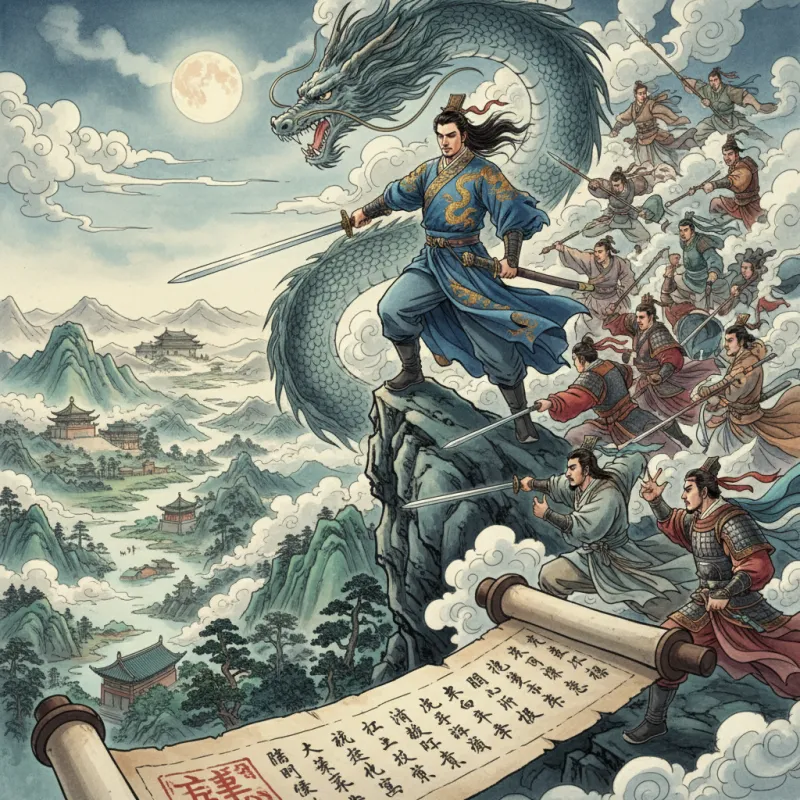
When Jin Yong (金庸, Jīn Yōng) died on October 30, 2018, the reaction across the Chinese-speaking world was something you rarely see for a novelist. Trending topics on Weibo. Memorial posts from heads of state. Grown men crying on television. A Hong Kong newspaper ran the headline: "The greatest knight-errant has departed the jianghu" (大侠已去,江湖再见). This wasn't grief for a celebrity. It was grief for the man who built the imaginative world that hundreds of millions of people grew up in.
The Scale of Jin Yong's Cultural Footprint
Let's start with numbers that sound impossible but aren't. Jin Yong wrote 15 novels and one short story between 1955 and 1972. Conservative estimates put total sales at over 300 million copies — and that's just legitimate editions. Including pirated copies (which were rampant across Southeast Asia for decades), the real number likely exceeds half a billion. To put this in perspective: more people have read Jin Yong than have read Tolkien, and he accomplished this writing exclusively in Chinese.
But raw sales figures miss the point. Jin Yong didn't just sell books. He created a shared cultural vocabulary that permeates every corner of Chinese-speaking society. Politicians quote his novels in speeches. Business leaders name their companies after his characters. Parents name their children after his heroes. The term "jianghu" (江湖, jiānghú) — the martial arts underworld that serves as the setting for his stories — has become shorthand for any competitive social sphere, from corporate boardrooms to academic circles.
Inventing Modern Wuxia
Before Jin Yong, wuxia (武侠, wǔxiá) fiction existed, but it was pulp entertainment — formulaic revenge tales with cardboard heroes and villains. Jin Yong took this despised genre and transformed it into literature. He gave his martial artists complex moral dilemmas. He embedded his stories in meticulously researched historical settings. He created female characters like Huang Rong (黄蓉) and Zhao Min (赵敏) who were as clever and capable as any male hero.
Consider "The Legend of the Condor Heroes" (射雕英雄传, Shèdiāo Yīngxióng Zhuàn), serialized starting in 1957. The protagonist Guo Jing (郭靖) is no genius swordsman. He's slow-witted, earnest, and succeeds through persistence and moral clarity. This was revolutionary. Jin Yong was saying that heroism wasn't about being the smartest or the strongest — it was about choosing the right path even when it's difficult. That message resonated in post-war Hong Kong, where millions of refugees were rebuilding their lives from nothing.
The Serialization Revolution
Jin Yong didn't just write novels. He serialized them in newspapers, creating an addiction that gripped entire cities. From 1955 to 1972, readers across Hong Kong would rush to buy the morning paper to get the latest installment. Productivity reportedly dropped on days when particularly dramatic chapters appeared. People would gather in tea houses to discuss the previous day's developments. Who would Linghu Chong (令狐冲) end up with? Would Qiao Feng (乔峰) discover his true heritage?
This serialization model created something unprecedented: a shared, real-time cultural experience that lasted for decades. It's the closest thing the pre-internet era had to a streaming series that everyone watched simultaneously. And because Jin Yong was writing as he published, he could respond to reader reactions, deepening popular characters and adjusting storylines. The result was fiction that felt alive, that belonged to its readers as much as to its author.
Creating a Moral Universe
Jin Yong's novels operate on a consistent moral framework that readers internalized: the concept of "xia" (侠, xiá) — the knight-errant who uses martial skill to uphold justice. But Jin Yong complicated this ideal in ways that made it feel real. His heroes make mistakes. They're torn between loyalty to friends and duty to country. They fall in love with the wrong people. They discover that the villains they've been fighting have legitimate grievances.
Take Yang Guo (杨过) from "The Return of the Condor Heroes" (神雕侠侣, Shéndiāo Xiálǚ). He falls in love with his teacher, violating one of society's deepest taboos. Jin Yong doesn't condemn this love or make it easy. He forces readers to grapple with the conflict between individual desire and social obligation. This moral complexity is why Jin Yong's novels remain relevant. They don't offer simple answers. They offer frameworks for thinking about difficult questions.
The influence of this moral universe extends far beyond literature. The concept of "xia" — using your abilities to help those weaker than yourself — has become a cultural ideal that shapes how Chinese people think about social responsibility. When Chinese tech entrepreneurs talk about using their wealth for social good, they often frame it in terms of "xia." The language comes directly from Jin Yong.
Shaping Visual Culture
Jin Yong's impact on Chinese cinema and television is almost impossible to overstate. His novels have been adapted into over 100 films and TV series. Some characters have been portrayed by dozens of different actors. The 1983 TVB adaptation of "The Legend of the Condor Heroes" achieved a 70% viewership rating in Hong Kong — meaning seven out of ten people watching television were watching that show.
These adaptations created a visual language for martial arts that influenced everything that came after. The wire-work flying techniques, the color-coded martial arts schools, the aesthetic of the jianghu — all of this was codified through Jin Yong adaptations. When Ang Lee made "Crouching Tiger, Hidden Dragon" in 2000, he was drawing on a visual vocabulary that Jin Yong adaptations had spent decades establishing.
The cycle is self-reinforcing. New adaptations introduce Jin Yong to new generations. A teenager in 2024 might first encounter "The Smiling, Proud Wanderer" (笑傲江湖, Xiào'ào Jiānghú) through a streaming series, then go back to read the novel, then watch older adaptations to compare interpretations. The stories remain alive because they're constantly being reimagined.
Language and Idiom
Jin Yong invented phrases that have entered everyday Chinese. When someone says "the older the ginger, the spicier it gets" (姜还是老的辣, jiāng háishì lǎo de là), they're quoting a line from his novels about how experience trumps youth. The phrase "where there are people, there is jianghu" (有人的地方就有江湖, yǒu rén de dìfāng jiù yǒu jiānghú) — meaning that politics and competition exist wherever humans gather — comes from Jin Yong and is now used in contexts from office politics to academic conferences.
His character names have become cultural touchstones. Call someone a "Guo Jing" and you're saying they're honest but not clever. Call them a "Huang Rong" and you're saying they're brilliant and resourceful. These references work because everyone knows the characters. They're part of the shared cultural operating system.
The Diaspora Connection
For Chinese communities outside mainland China, Jin Yong's novels served a special function: they were a connection to Chinese culture that wasn't mediated by the Communist Party. In Taiwan, Hong Kong, Singapore, and Chinese communities across Southeast Asia and North America, Jin Yong's jianghu became a space where Chinese identity could be explored and celebrated without political baggage.
This is why Jin Yong's death hit the diaspora so hard. His novels were what parents read to children to teach them about Chinese values. They were what teenagers read to feel connected to their heritage. They were a version of Chineseness that was accessible, exciting, and untainted by the political divisions that fractured the Chinese-speaking world in the 20th century. When Jin Yong died, it felt like losing a bridge to something essential.
The Literary Legitimacy Question
For decades, mainland Chinese literary critics dismissed Jin Yong as a popular entertainer, not a serious writer. Wuxia was genre fiction, beneath the notice of the literary establishment. This began to change in the 1990s as scholars started analyzing his work seriously. They noted his sophisticated narrative structures, his integration of historical research, his philosophical depth. In 1994, Peking University invited him to give a lecture series. In 2009, his novels were added to school curricula.
This academic acceptance matters because it reflects a broader shift in how Chinese culture values different forms of storytelling. Jin Yong proved that popular fiction could be literature, that entertainment and depth weren't mutually exclusive. He opened the door for other genre writers to be taken seriously. The current generation of Chinese science fiction writers, who are gaining international recognition, owe a debt to Jin Yong for making genre fiction respectable.
The Enduring Legacy
Jin Yong changed Chinese pop culture forever because he gave it a mythology. Every culture needs stories that everyone knows, that provide common reference points and shared values. For the Chinese-speaking world in the second half of the 20th century, Jin Yong's novels filled that role. They created a imaginative space — the jianghu — where questions of honor, loyalty, love, and justice could be explored in ways that felt both timeless and urgently relevant.
The jianghu he created continues to expand. New writers set their stories in his universe. Video games adapt his characters. His influence appears in unexpected places — in the narrative structure of Chinese video games, in the character archetypes of modern Chinese television dramas, in the way Chinese people talk about martial arts philosophy and heroism.
When that Hong Kong newspaper wrote "the greatest knight-errant has departed the jianghu," they were right. But the jianghu itself remains. Jin Yong built it too well, made it too essential to Chinese cultural imagination, for it to disappear. As long as people read his novels, watch adaptations, quote his characters, and use his language to make sense of their world, the jianghu lives on. And in that sense, Jin Yong never really left at all.
Related Reading
- Why Every Chinese Person Knows Jin Yong
- Jin Yong References in Modern Chinese Daily Life
- Jin Yong's Cultural Impact: How One Novelist Shaped Chinese Identity
- Jin Yong in Translation: Lost and Found
- Exploring Jin Yong's Wuxia Novels: Characters, Martial Arts, and Storylines
- The Humor of Jin Yong: Comedy in the Martial World
- The Timeless Appeal of Jin Yong's Wuxia Novels: Martial Arts, Characters, and Storylines