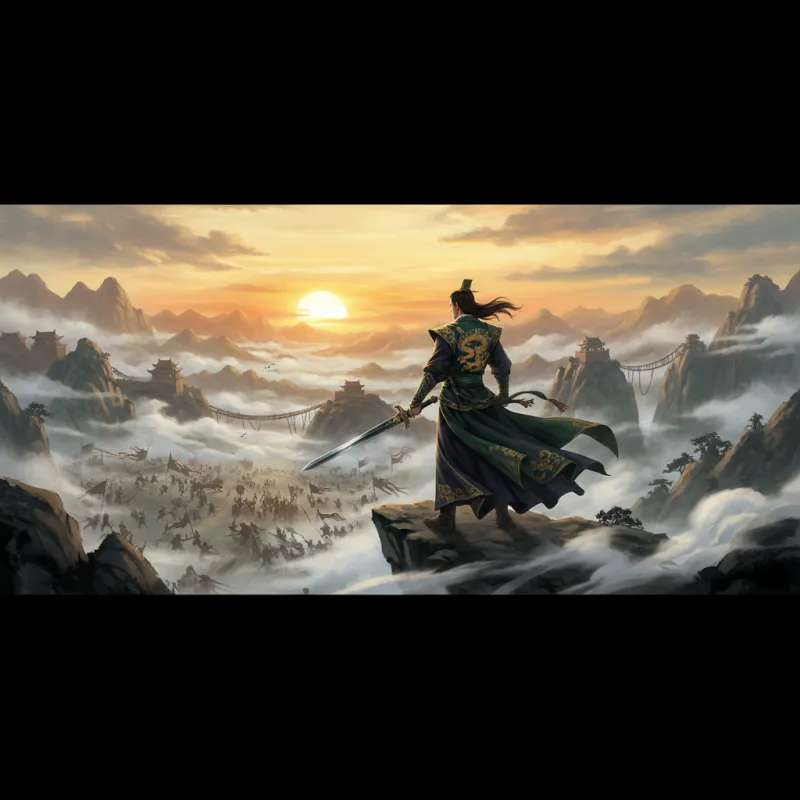
When Deng Xiaoping met with Margaret Thatcher in 1984 to negotiate Hong Kong's handover, he reportedly kept a copy of The Deer and the Cauldron (《鹿鼎记》, Lù Dǐng Jì) on his desk. The British Prime Minister was puzzled. Deng's aides explained: it's Jin Yong. She nodded politely, still confused. But every Chinese person in that room understood. Jin Yong wasn't just entertainment—he was the cultural operating system running in the background of modern Chinese consciousness.
The Writer Who Became a Language
Jin Yong didn't just write popular novels. He created a vocabulary that Chinese people use to navigate reality. When someone describes a friend as having "Guo Jing's loyalty but not his naivety," everyone knows exactly what that means. When a politician is called "Yue Buqun pretending to be righteous," the insult lands with precision. These aren't literary references—they're diagnostic tools.
The fifteen novels function as a shared reference system, a common framework for discussing character, morality, and social dynamics. This goes far beyond what most writers achieve. Shakespeare gave English speakers phrases like "to be or not to be," but Jin Yong gave Chinese culture an entire moral taxonomy. His characters aren't just memorable—they're archetypes that people use to categorize real human behavior.
Walk through any Chinese city and you'll see the evidence. Restaurants named after his characters. Businesses using his novel titles. Parents naming children after his heroes. The 2008 Beijing Olympics opening ceremony included a martial arts sequence that drew directly from wuxia aesthetics—which means, essentially, from Jin Yong's imagination. When China wanted to present itself to the world, it reached for the cultural vocabulary he had created.
Redefining Chinese Identity Across Borders
Jin Yong wrote during a fractured moment in Chinese history. The mainland was sealed behind the Bamboo Curtain, undergoing the Cultural Revolution's convulsions. Hong Kong was a British colony. Taiwan was under martial law. Overseas Chinese communities were scattered across Southeast Asia, often facing discrimination and identity crises.
His novels became the connective tissue. A teenager in 1970s Singapore, a factory worker in 1980s Guangzhou, a student in 1990s Taipei—they were all reading the same stories, arguing about the same characters, absorbing the same values. Jin Yong created a shared cultural space that transcended political boundaries. He gave fragmented Chinese communities a common mythology.
This wasn't accidental. Jin Yong deliberately set his novels across different dynasties and regions—Song Dynasty Jiangnan, Yuan Dynasty Mongolia, Ming Dynasty Beijing, Qing Dynasty Manchuria. His characters included Han Chinese, Mongols, Manchus, Khitans, and Jurchens. He was mapping out an inclusive vision of Chinese identity that wasn't based on ethnicity or political system, but on shared values: the xia (侠, xiá) ethic of righteousness, the importance of keeping your word, the duty to help the weak.
The martial arts philosophy in his novels became a framework for thinking about Chinese identity itself—flexible, adaptive, drawing strength from multiple traditions, but grounded in core principles.
The Moral Framework That Stuck
Jin Yong's most lasting impact might be moral rather than literary. He took the traditional xia ethic—the wandering hero who rights wrongs and helps the oppressed—and updated it for modern sensibilities. His heroes aren't perfect. Guo Jing is loyal but slow-witted. Yang Guo is brilliant but arrogant. Wei Xiaobao is clever but amoral. Linghu Chong is free-spirited but irresponsible.
This complexity matters. Jin Yong showed that righteousness doesn't require perfection. His heroes struggle with temptation, make mistakes, hurt people they love. But they keep trying to do the right thing. This framework—flawed people striving toward moral ideals—resonated deeply in a culture recovering from the moral chaos of the Cultural Revolution.
The phrase "xia zhi da zhe, wei guo wei min" (侠之大者,为国为民, xiá zhī dà zhě, wèi guó wèi mín—"the greatest heroes serve their country and people") from The Legend of the Condor Heroes became a cultural touchstone. It's quoted in political speeches, carved on monuments, used in school essays. Jin Yong gave modern China a moral vocabulary that felt both traditional and contemporary.
His novels also provided a framework for thinking about power and corruption. The villains in Jin Yong's world aren't always obviously evil. Yue Buqun starts as a respected sect leader. Murong Fu is driven by understandable family loyalty. The Qing court in The Book and the Sword contains both patriots and traitors. Jin Yong taught readers to look beneath surface appearances, to question authority, to recognize that righteousness and villainy can wear unexpected faces.
The Anti-Propaganda Novelist
Jin Yong's cultural impact was partly oppositional. While mainland China was producing revolutionary literature with cardboard heroes and obvious villains, Jin Yong was writing morally complex stories where the "barbarian" Mongols could be noble, where Han Chinese patriots could be misguided, where the righteous cause could be served by a scoundrel like Wei Xiaobao.
This complexity was subversive. Jin Yong's novels circulated underground in mainland China during the 1970s and early 1980s, passed hand-to-hand in battered photocopies. They offered an alternative to the simplistic moral universe of propaganda literature. They suggested that human nature was complicated, that history was messy, that righteousness required thinking rather than sloganeering.
When China began opening up in the 1980s, Jin Yong's novels flooded in officially. They were devoured. An entire generation that had been fed revolutionary realism suddenly encountered literature that treated readers as intelligent adults capable of moral nuance. The impact was profound. Jin Yong helped recalibrate Chinese culture's moral compass after decades of ideological extremism.
The Living Canon
Most writers become cultural forces after they're dead. Jin Yong did it while alive, and then spent decades watching his own mythology grow. He revised his novels multiple times, engaged with critics, wrote essays explaining his thinking. He saw his characters become household names, his phrases enter the dictionary, his moral framework shape public discourse.
This created a strange feedback loop. Jin Yong was influenced by the culture's response to his work, which then influenced his revisions, which then influenced the culture further. His novels aren't static texts—they're living documents that evolved alongside Chinese society.
The character development in his later revisions often reflected changing social values. He made his female characters more complex and independent. He added moral ambiguity to his heroes. He complicated his villains. Jin Yong was in conversation with his readers, and that conversation shaped modern Chinese culture's understanding of heroism, morality, and identity.
Beyond the Chinese World
Jin Yong's cultural impact is primarily Chinese, but it's starting to radiate outward. His novels have been translated into dozens of languages. Video games based on his stories have reached global audiences. The Netflix adaptation of The Sword of Destiny introduced his universe to Western viewers, however imperfectly.
But the real test of cultural impact isn't translation—it's whether the framework travels. Can non-Chinese readers understand why Guo Jing's loyalty matters? Can they feel the tragedy of Yang Guo's isolation? Can they grasp the moral complexity of Wei Xiaobao's choices? The jury is still out.
What's certain is that Jin Yong created something rare: a modern mythology that shaped how hundreds of millions of people think about morality, identity, and what it means to be human. He didn't just write novels. He wrote the cultural software that a civilization runs on. That's not literary achievement—that's something closer to magic.
Related Reading
- Why Every Chinese Person Knows Jin Yong
- Jin Yong References in Modern Chinese Daily Life
- How Jin Yong Changed Chinese Pop Culture Forever
- Jin Yong in Translation: Lost and Found
- Exploring the Intricate Sects within Jin Yong's Iconic Wuxia Novels
- The Most Famous Lines in Jin Yong's Novels
- Love and Sacrifice in Jin Yong's World