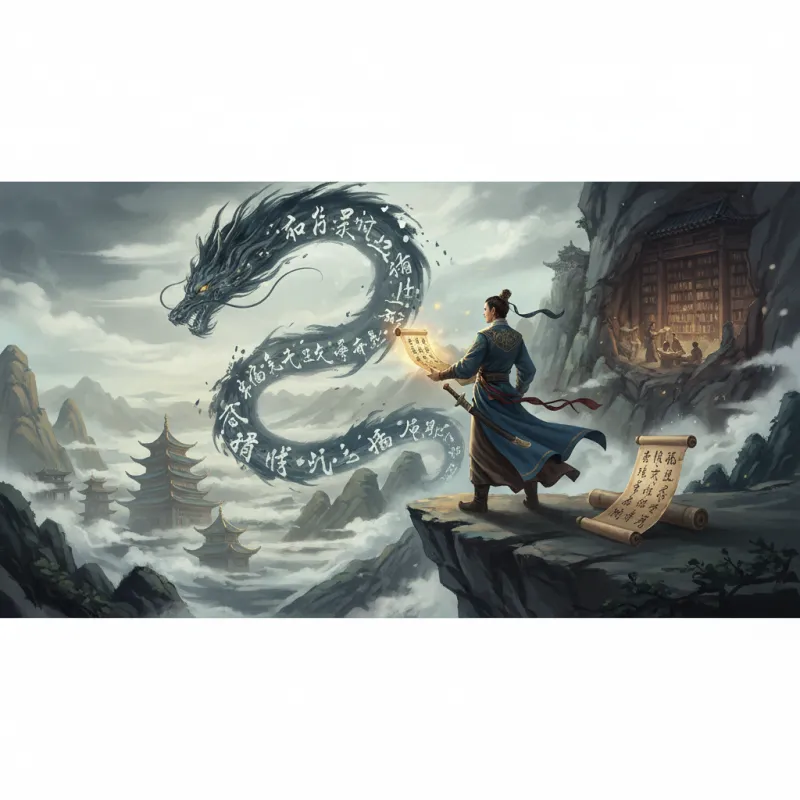
Why Jin Yong Stayed Chinese for So Long
The translation desert wasn't about difficulty — Jin Yong's Chinese is actually quite accessible compared to classical literature. The problem was commercial. Western publishers looked at wuxia and saw an unsellable mess: too Chinese, too long, too weird. Kung fu movies were one thing; thousand-page novels about Daoist internal energy cultivation were another. From the 1950s through the 1990s, Jin Yong sold hundreds of millions of copies across Asia while remaining virtually unknown in English-speaking markets. The few attempts that existed were fan translations, often stilted and incomplete, circulating on early internet forums like samizdat.
Meanwhile, Japanese manga conquered the West. Korean dramas found global audiences. But Chinese wuxia novels? Crickets. The irony is that Jin Yong's influence on Asian pop culture dwarfs almost any other writer — his characters are household names from Singapore to Seoul, his plot devices have been borrowed by countless films and games, his martial arts philosophies shape how millions think about conflict and honor. Yet for decades, if you wanted to read him in English, you were mostly out of luck.
What Gets Lost: The Untranslatable Core
Start with martial arts terminology. When Guo Jing uses 降龙十八掌 (Jiàng Lóng Shíbā Zhǎng), you can translate it as "Eighteen Dragon-Subduing Palms," but you lose the Buddhist resonance of 降龙 (subduing dragons, as in subduing one's inner demons), the numerological significance of eighteen in Chinese culture, and the way 掌 (palm) evokes a specific martial arts lineage. Some translators keep it in pinyin. Some try English equivalents. None fully work.
Then there's the poetry. Jin Yong weaves classical Chinese poetry throughout his novels — characters recite Tang dynasty verses, compose couplets, reference historical poems to convey emotion. When Yang Guo and Xiaolongnü part at the end of The Return of the Condor Heroes, the scene is saturated with allusions to classical separation poems that any educated Chinese reader recognizes. In English? You can footnote it, but you can't recreate that instant emotional resonance. The poetry becomes archaeology instead of living text.
Cultural context is even trickier. The entire moral framework of jianghu (江湖, jiānghú) — the martial arts underworld — rests on concepts like 义气 (yìqì, righteous loyalty), 恩怨 (ēnyuàn, debts of gratitude and grudges), and 面子 (miànzi, face). These aren't just words; they're entire ethical systems. When Wei Xiaobao in The Deer and the Cauldron navigates between competing loyalties, he's operating within a moral calculus that doesn't map cleanly onto Western individualism. You can explain it, but explanation isn't experience.
The Anna Holmwood Revolution
Everything changed in 2018 when Anna Holmwood's translation of Legends of the Condor Heroes: A Hero Born hit English bookstores. Not a fan translation. Not an academic curiosity. A real, professionally published, beautifully produced English edition from a major publisher. Holmwood made bold choices: she kept some terms in pinyin, invented English equivalents for others, and trusted readers to learn the vocabulary of wuxia as they went. She treated Jin Yong like literature, not like an exotic artifact requiring constant explanation.
The translation isn't perfect — no translation is. Some readers complained about the invented English terms for martial arts moves. Others felt the prose was too modern, smoothing over Jin Yong's occasionally archaic phrasing. But Holmwood understood something crucial: translation is interpretation, not transcription. She made Jin Yong readable for English audiences while preserving enough strangeness to feel authentically Chinese. The novel became a bestseller in the UK, proving that Western readers would embrace wuxia if given the chance.
Gigi Chang continued the series, translating the second and third volumes with similar skill. Suddenly, Jin Yong wasn't just a Chinese phenomenon — he was a global author. Readers who'd never heard of wuxia were arguing about whether Guo Jing was too naive or admirably principled, the same arguments Chinese readers had been having since 1957.
What Translation Adds: The Unexpected Gains
Here's the paradox: translation doesn't just lose things. It also reveals them. Reading Jin Yong in English, you notice structural elements that blur in Chinese. The way he builds suspense. His use of dramatic irony. The careful pacing of revelations. Chinese readers, immersed in the cultural context, sometimes take these craft elements for granted. English readers, lacking that automatic cultural fluency, see the architecture more clearly.
Translation also forces precision. Chinese can be wonderfully ambiguous — pronouns are often omitted, temporal markers are flexible, emotional states are implied rather than stated. English demands clarity. Who's speaking? When did this happen? What exactly is the character feeling? Translators must make interpretive choices that the original leaves open. Sometimes this clarification is a loss. Sometimes it's an illumination, making explicit what was always there but easy to miss.
And then there's the comparative dimension. Reading Jin Yong in English, you can't help but think about Western fantasy literature. The parallels to Tolkien become obvious — both created entire worlds with detailed histories, both wrote about the corruption of power, both understood that the smallest person can change the course of history. But the differences are equally striking. Jin Yong's heroes are more morally complex, his women more central to the plot, his philosophy more concerned with balance than victory. Translation makes these cross-cultural comparisons possible in ways they weren't before.
The Fan Translation Underground
While official translations were stuck in publishing limbo, fans weren't waiting. Starting in the early 2000s, online communities began translating Jin Yong themselves. Websites like Wuxia Society and later forums hosted collaborative translation projects — volunteers would tackle chapters, others would edit, and slowly, painstakingly, entire novels appeared in English. The quality varied wildly. Some translators were heritage speakers with deep cultural knowledge but shaky English. Others were English natives learning Chinese who understood the target language but missed nuances in the source.
These fan translations were crucial. They kept Jin Yong alive in English during the commercial drought. They trained a generation of readers in wuxia conventions. They proved there was an audience hungry for these stories. Many current Jin Yong fans in the West first encountered his work through these amateur translations, learning to decode awkward phrasing and cultural references through sheer determination. The fan translation community also developed its own conventions — keeping certain terms in pinyin, creating glossaries, adding cultural notes — that later influenced official translations.
The ethics of fan translation remain complicated. Technically, they're copyright violations. Practically, they filled a void that commercial publishing ignored for decades. Now that official translations exist, some fan translation sites have taken down their Jin Yong content. Others argue they're still providing access to novels that haven't been officially translated yet. It's a messy situation without clear answers, but one thing is certain: without fan translators, Jin Yong's English-language readership would be a fraction of what it is today.
The Novels That May Never Cross Over
Some Jin Yong novels translate more easily than others. The Legend of the Condor Heroes works in English because it's relatively straightforward — clear heroes and villains, linear plot, accessible themes. The Deer and the Cauldron is much harder. The entire novel is a satire of Chinese historical and literary conventions. Wei Xiaobao's humor depends on inverting wuxia tropes that English readers may not recognize. The political intrigue requires understanding Qing dynasty history. The sexual content, handled with a light touch in Chinese, can seem crude in English without the cultural context.
The Book and the Sword, Jin Yong's first novel, is deeply embedded in Qing dynasty politics and the question of Manchu versus Han Chinese identity. How do you translate a novel whose central tension is ethnic conflict in 18th-century China? You can explain the history, but can you make English readers care about it the way Chinese readers do? Similarly, Fox Volant of the Snowy Mountain plays with narrative structure in ways that assume familiarity with wuxia storytelling conventions. Without that baseline, the experimental structure might just seem confusing.
Then there's The Smiling, Proud Wanderer, which is simultaneously one of Jin Yong's most beloved novels and one of his most culturally specific. The entire story is about different philosophical approaches to life — Confucian duty, Daoist freedom, Buddhist detachment — embodied in martial arts sects. Linghu Chong's journey is about finding authentic selfhood in a world of competing ideologies. It's profound in Chinese. In English, without the cultural framework, it might read as just another martial arts adventure with a protagonist who drinks too much.
Translation as Cultural Bridge
What we're really talking about when we discuss translating Jin Yong isn't just language — it's worldview. His novels assume a universe where qi (气, qì) is real, where meditation can unlock superhuman abilities, where moral cultivation and martial skill are inseparable. Western readers come from a tradition where magic is fantasy, where physical and spiritual development are separate domains, where individualism trumps collective harmony. Bridging that gap requires more than dictionary work.
The best Jin Yong translations don't try to make him Western. They invite English readers into a Chinese imaginative space, providing enough context to navigate but preserving enough strangeness to feel genuinely foreign. This is what Jin Yong's Philosophy of Martial Arts does at its best — it presents a coherent alternative to Western assumptions about conflict, power, and human potential. Reading Jin Yong in translation should feel like visiting another culture, not like that culture has been domesticated for your comfort.
This is why translation matters beyond just making stories accessible. It's about expanding what's imaginable. English-language fantasy has been dominated by European medieval settings for decades. Jin Yong offers something different — a fantasy tradition rooted in Chinese history, philosophy, and aesthetics. His influence on Modern Wuxia and Jin Yong's Legacy shows how generative his vision has been in Asian media. Now, finally, English readers can access that tradition directly, not filtered through Hollywood adaptations or video games.
The Future of Jin Yong in English
We're still in the early days. Only a handful of Jin Yong's novels have been officially translated. The rest remain accessible only through fan translations or not at all. But the success of the Condor Heroes translations suggests there's a sustainable market. More translations are in progress. Academic interest is growing — universities are teaching Jin Yong in translation, scholars are writing about his work in English-language journals.
The next generation of translators will have advantages the pioneers didn't. There's now a established vocabulary for wuxia in English. Readers are more familiar with Chinese cultural concepts. The success of Chinese media globally — from The Three-Body Problem to Crouching Tiger, Hidden Dragon — has created more openness to Chinese storytelling. Jin Yong won't seem as alien to new readers as he did in 2018.
But challenges remain. Translation is expensive and time-consuming. Jin Yong's novels are long — some over a million characters. Publishers need to believe they'll recoup the investment. And there's the question of which novels to prioritize. Do you translate the most popular ones in China, or the ones most likely to appeal to Western readers? Do you go chronologically, or start with the masterpieces?
Whatever happens, Jin Yong in English will always be a compromise, a negotiation between source and target, between fidelity and readability, between explanation and immersion. That's not a failure of translation — it's the nature of translation. The goal isn't to replace the original but to create something new: a Jin Yong who speaks English while remaining fundamentally Chinese, who invites readers into his world while acknowledging they're visitors, who loses some things in translation but gains the possibility of being read by millions who would never encounter him otherwise. That's not a perfect solution. But it's a worthy one.
Related Reading
- How Jin Yong Changed Chinese Pop Culture Forever
- Why Every Chinese Person Knows Jin Yong
- Jin Yong References in Modern Chinese Daily Life
- Jin Yong's Cultural Impact: How One Novelist Shaped Chinese Identity
- Love Triangles in Jin Yong: When Heroes Can't Choose
- Eating and Drinking in Jin Yong: A Culinary Guide
- Exploring Jin Yong's Wuxia Novels: Characters, Martial Arts, and Storylines