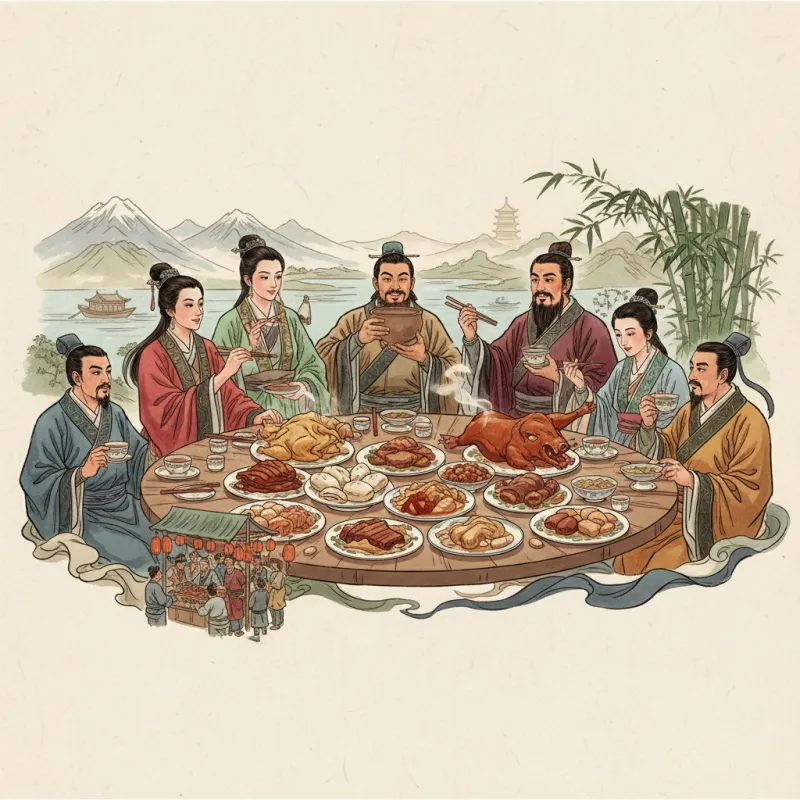
When Hong Qigong, the leader of the Beggar Clan and one of the Five Greats, abandons his disciples to follow a teenage girl around the countryside, you know the food must be extraordinary. Huang Rong doesn't defeat him in combat or impress him with martial arts philosophy — she wins him over with a perfectly executed "Twenty-Four Bridge Moonlit Night" (二十四桥明月夜, èrshísì qiáo míngyuè yè), a dish so delicate that tofu is hollowed out and stuffed with minced ham steamed inside. This is Jin Yong's genius: in his novels, a well-cooked meal can be as powerful as any secret manual.
The Strategic Importance of Culinary Knowledge
Food in Jin Yong's novels operates on multiple levels simultaneously. It's never just sustenance. When Huang Rong prepares her legendary feast for Hong Qigong in The Legend of the Condor Heroes (射雕英雄传, Shèdiāo Yīngxióng Zhuàn), she's not simply feeding a hungry beggar — she's conducting a negotiation. Each dish is a calculated move: the "Mandarin Duck and Five Treasures" (鸳鸯五珍脍, yuānyāng wǔzhēn kuài) demonstrates technical mastery, while the poetic names reveal her classical education. Hong Qigong, who has spent decades eating his way across China, recognizes both the skill and the intelligence behind it.
This pattern repeats throughout the novels. In The Smiling, Proud Wanderer (笑傲江湖, Xiào'ào Jiānghú), Linghu Chong's ability to appreciate good wine becomes a marker of his character — he drinks with abandon but never loses his principles, unlike the hypocritical orthodox sect leaders who preach temperance while hoarding rare vintages. The contrast isn't subtle, and it isn't meant to be. Jin Yong uses food and drink to expose the gap between what people claim to value and what they actually pursue.
Regional Cuisines as Character Development
Jin Yong was meticulous about matching characters to their regional food cultures. Guo Jing, raised on the Mongolian steppes, prefers simple roasted meat and mare's milk wine — foods that reflect his straightforward, unpretentious nature. When he arrives in the sophisticated culinary landscape of the Song Dynasty, his bewilderment at elaborate banquets mirrors his broader struggle to navigate complex political situations. The food gap is a culture gap.
Huang Rong, by contrast, grew up on Peach Blossom Island with a father who was both a martial arts genius and an obsessive perfectionist. Her cooking reflects this upbringing: technically flawless, creative to the point of showing off, and always with an element of performance. She doesn't just make good food — she makes food that tells a story, like her "Lotus Leaf Beggar's Chicken" (叫化鸡, jiàohuā jī), which takes a peasant dish and elevates it through technique while maintaining its rustic soul.
The novel Demi-Gods and Semi-Devils (天龙八部, Tiānlóng Bābù) showcases this regional specificity even more dramatically. Duan Yu, a prince from the sophisticated Dali Kingdom in Yunnan, has refined tastes shaped by one of China's most distinctive regional cuisines. When he encounters the rough frontier food of the northern martial arts world, his reactions reveal not just personal preference but the vast cultural distances within Jin Yong's fictional China. The martial arts philosophies of different regions are reflected in their food cultures.
The Beggar's Chicken Paradox
There's a recurring motif in Jin Yong's work: the finest dishes often have humble origins. Beggar's Chicken, which appears in multiple novels, is literally named after beggars — it was supposedly invented by someone so poor they had to cook a stolen chicken by wrapping it in mud and throwing it in a fire. Yet in Huang Rong's hands, it becomes a dish worthy of emperors. She wraps the chicken in lotus leaves before encasing it in clay, adds wine and spices, and transforms desperation into art.
This isn't just culinary trivia. It's a statement about the jianghu itself, where a beggar can be one of the world's greatest martial artists (Hong Qigong), and a girl living on a remote island can outthink the most educated scholars. The food metaphor extends Jin Yong's broader theme: true excellence comes from skill and character, not from social position. The Beggar Clan's philosophy of leadership is reflected in their appreciation for food that transcends class boundaries.
Hong Qigong embodies this paradox perfectly. As the leader of the Beggar Clan, he's technically a beggar, but his palate is more refined than any emperor's. He's eaten at the finest restaurants in every province, but he's equally enthusiastic about a perfectly grilled street skewer. His famous weakness for good food — which Huang Rong exploits so effectively — isn't a character flaw but a form of wisdom. He understands that pleasure and beauty can be found anywhere if you know how to look.
Wine Culture and Martial Arts Brotherhood
Wine in Jin Yong's novels serves as social lubricant, truth serum, and bonding ritual all at once. The drinking scenes in The Smiling, Proud Wanderer are particularly memorable: Linghu Chong and his friends from the various unorthodox sects bond over wine in a way that the rigid, hierarchical orthodox sects never could. When Linghu Chong drinks with Xiang Wentian, a senior member of the Sun Moon Holy Cult, their shared appreciation for good wine creates a friendship that crosses factional lines.
The specific wines matter too. Jin Yong mentions Shaoxing wine (绍兴酒, Shàoxīng jiǔ), Fen wine (汾酒, Fén jiǔ), and various other regional varieties, each with its own character and history. Characters who know their wines are generally portrayed as more worldly and sophisticated than those who don't. This isn't snobbery — it's cultural literacy. Understanding wine means understanding the regions where it's made, the techniques used to produce it, and the social contexts in which it's consumed.
The most poignant drinking scene might be in The Return of the Condor Heroes (神雕侠侣, Shéndiāo Xiálǚ), when Yang Guo drinks alone after losing Xiao Longnü. The wine doesn't make him forget — it makes him remember more vividly. Jin Yong understands that alcohol in Chinese culture isn't primarily about intoxication; it's about emotional expression and social connection. When Yang Guo drinks alone, his isolation is complete.
Food as Plot Device
Jin Yong uses food to advance his plots in ways that feel organic rather than contrived. Huang Rong's cooking doesn't just win Hong Qigong's friendship — it directly leads to Guo Jing learning the Eighteen Dragon-Subduing Palms (降龙十八掌, Jiàng Lóng Shíbā Zhǎng), one of the most powerful martial arts techniques in the jianghu. Without those cooking skills, the entire trajectory of The Legend of the Condor Heroes would be different. The Song Dynasty would likely have fallen even faster to the Mongol invasion.
In The Deer and the Cauldron (鹿鼎记, Lùdǐng Jì), Wei Xiaobao's survival often depends on his ability to procure good food and wine for powerful people. He's not a martial artist — he can barely fight at all — but he understands that the way to a powerful person's trust often runs through their stomach. His elaborate banquets for the Kangxi Emperor serve the same strategic purpose as Huang Rong's cooking for Hong Qigong, just in a more explicitly political context.
Even poisoning, a common plot device in wuxia fiction, is treated with culinary sophistication in Jin Yong's work. Poisons are hidden in specific dishes, administered through particular cooking methods, and countered with rare ingredients. The medical knowledge required to use poisons effectively overlaps significantly with culinary expertise — both require understanding how substances interact with the human body.
The Philosophy of Eating
Behind all the specific dishes and drinking scenes lies a coherent philosophy of consumption. Jin Yong's heroes generally eat with gusto but without greed. They appreciate fine food when it's available but don't depend on it for happiness. Guo Jing can enjoy Huang Rong's elaborate cooking, but he's equally content with simple rations on a military campaign. This flexibility marks him as someone who has mastered desire rather than being mastered by it.
The villains, by contrast, often display disordered relationships with food and drink. They either indulge to excess, like some of the corrupt officials in The Duke of Mount Deer, or they're ascetics who've suppressed natural appetites to the point of psychological damage. Jin Yong seems to suggest that the middle path — enjoying life's pleasures without becoming enslaved to them — is the mark of a balanced character.
Hong Qigong represents the ideal. His love of food is genuine and unashamed, but it doesn't control him. When he needs to focus on martial arts or clan business, he can set aside his appetite. When he has the opportunity to enjoy a great meal, he savors it completely. This ability to be fully present in the moment, whether eating or fighting, is a form of martial arts mastery in itself.
The Real China Behind the Fiction
Jin Yong's culinary references aren't invented — they're drawn from real Chinese food culture, often with impressive historical accuracy. The dishes Huang Rong prepares are actual recipes from Song Dynasty cuisine, adapted and sometimes elevated, but rooted in historical reality. When characters drink Shaoxing wine or eat Hangzhou's famous Dongpo Pork (东坡肉, Dōngpō Ròu), Jin Yong is connecting his fictional jianghu to the real culinary landscape of China.
This grounding in reality makes the fantastic elements of his novels more believable. If the food is real, if the wine is real, if the regional variations are accurate, then maybe the martial arts and the adventures are real too — or at least real enough to suspend disbelief. Jin Yong understood that fantasy needs anchoring in concrete, sensory details, and nothing is more concrete than the taste of a perfectly prepared dish.
The culinary guide hidden within Jin Yong's novels is also a geography lesson, a history lesson, and a class on Chinese culture. Every meal tells you where you are, what dynasty you're in, and what social class the characters belong to. Food is never just food — it's a complete information system, as rich and complex as the martial arts techniques that get more obvious attention.
When modern readers encounter these culinary scenes, they're not just learning about fictional characters — they're learning about a food culture that stretches back thousands of years and continues to evolve today. Huang Rong's cooking might be fiction, but the traditions she draws on are very real, and they're still being practiced in kitchens across China and the Chinese diaspora. That's the final magic trick: Jin Yong made his fantasy world so delicious that it makes you hungry for the real thing.
Related Reading
- Wine Culture in Jin Yong's Wuxia World
- The Food and Drink of Jin Yong: What Heroes Eat Between Sword Fights
- Tea and Martial Arts: The Quiet Moments Between Fights
- Food in Jin Yong's Novels: When Cooking Is a Martial Art
- The Definitive Jin Yong Martial Arts Power Ranking
- Exploring the Love Stories in Jin Yong's Wuxia Novels: Romance Amidst Adventure
- Jin Yong's Locations: The Real Places Behind the Fictional Battles