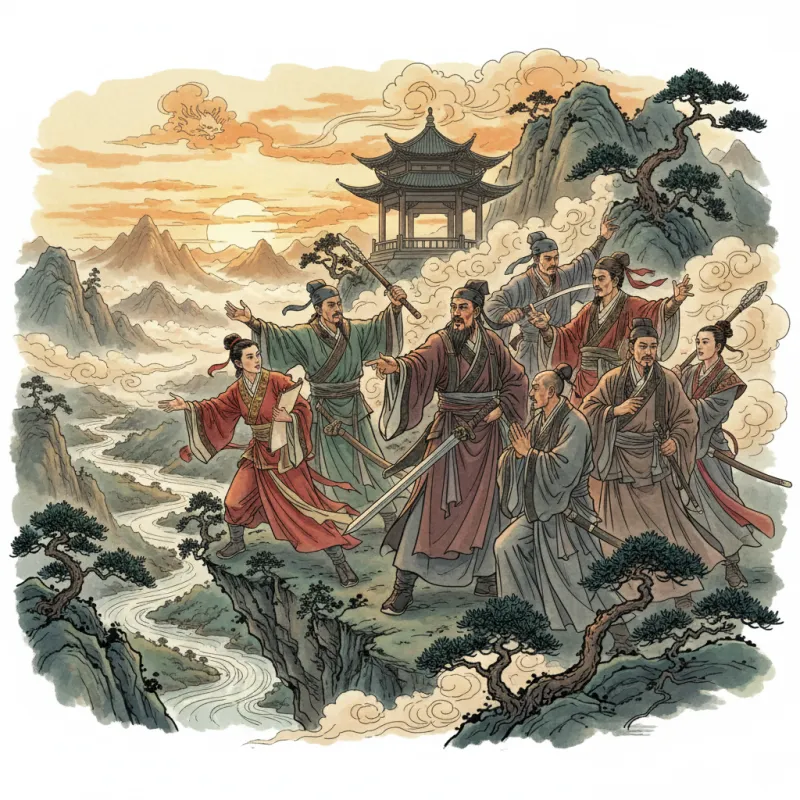
Did Duan Yu's mother really sleep with the villain? Was Wei Xiaobao's father actually the Shunzhi Emperor? Could Yang Guo and Xiaolongnü have had children despite her injuries? For decades, Jin Yong's readers have dissected every ambiguous line, every suspicious timeline, every character's unexplained absence, building elaborate theories that treat these wuxia novels like crime scenes waiting to be solved. The old master died in 2018, but the arguments rage on — and some of them are surprisingly convincing.
The Paternity Industrial Complex
The most heated debates in Jin Yong fandom revolve around who fathered whom. In Demi-Gods and Semi-Devils (天龙八部, Tiānlóng Bābù), Duan Yu (段誉) discovers his biological father isn't the womanizing Prince Duan Zhengchun (段正淳) but the villainous Duan Yanqing (段延庆), a deposed prince reduced to begging and murder. The text presents this as fact: Duan Yanqing's internal monologue confirms it, and Duan Yu's mother, Dao Baifeng (刀白凤), doesn't deny it when confronted.
But fans aren't satisfied. They've noticed that Dao Baifeng was drugged during the encounter — how could she know for certain it was Duan Yanqing and not her husband? They point out that Duan Yu inherited his father's romantic nature and his mother's fierce loyalty, traits that match Duan Zhengchun perfectly. Some argue Jin Yong deliberately left it ambiguous, that Duan Yanqing's certainty is wishful thinking from a broken man desperate for an heir.
The Duke of Mount Deer (鹿鼎记, Lùdǐng Jì) spawned an even wilder theory: that Wei Xiaobao's (韦小宝) father was the Shunzhi Emperor himself. Wei's mother was a prostitute in Yangzhou who couldn't remember which client got her pregnant. Fans note that Shunzhi abdicated in 1661 and supposedly became a monk — right around when Wei would have been conceived. They cite Wei's uncanny ability to befriend the Kangxi Emperor, his instinctive understanding of imperial politics, and his luck as evidence of hidden royal blood. It's completely unsupported by the text, but it's become so popular that some readers treat it as canon.
The Xiaolongnü Fertility Debate
When Yang Guo (杨过) and Xiaolongnü (小龙女) reunite at the end of The Return of the Condor Heroes (神雕侠侣, Shéndiāo Xiálǚ), she's been living in the Valley of Unrequited Love for sixteen years, sustained by honey and the Passionless Flower. Earlier in the novel, Gongsun Zhi (公孙止) poisoned her with the Passionless Flower's needles, and Huang Yaoshi (黄药师) warned that even if cured, she might never bear children.
Fans have spent years arguing whether this means Yang and Xiaolongnü's bloodline ends with them. Some insist Jin Yong's silence on the matter is deliberate — they had no children, and that's the tragic price of their love. Others claim the warning was about the poison, not the cure, and that sixteen years of eating the flower's honey would have reversed any damage. A third camp points to Jin Yong's 2003 revision, where he softened Huang Yaoshi's prognosis from "definitely cannot" to "might not be able to," as evidence the author wanted to leave hope.
This isn't just academic. The question matters because Yang Guo is Guo Jing's (郭靖) spiritual successor, the next generation of heroes defending襄阳 (Xiāngyáng) against the Mongols. If he has no descendants, that heroic lineage dies. Some fans have written elaborate genealogies connecting minor characters in later novels to Yang Guo, desperate to prove his legacy continued.
The Linghu Chong Succession Crisis
The Smiling, Proud Wanderer (笑傲江湖, Xiàoào Jiānghú) ends with Linghu Chong (令狐冲) becoming the leader of the Heng Shan Sect (恒山派), a position he never wanted and seems temperamentally unsuited for. He's a drunk who hates responsibility, now in charge of a sect of Buddhist nuns. The novel ends before we see how this works out.
Fans have constructed entire theories about what happened next. The optimists believe Linghu Chong reformed the sect, made it co-ed, and turned it into a haven for martial arts misfits — essentially creating the jianghu (江湖) equivalent of a liberal arts college. The pessimists think he abandoned the position within a year, leaving it to Yilin (仪琳), the nun who loved him, while he and Ren Yingying (任盈盈) wandered the world playing music and drinking wine.
The most interesting theory suggests Linghu Chong's leadership of Heng Shan was Jin Yong's commentary on institutional religion. Linghu Chong represents pure Daoist freedom — wu wei (无为), non-action, going with the flow. Putting him in charge of a Buddhist sect creates a philosophical paradox that mirrors the novel's central theme: the conflict between individual freedom and social obligation. According to this reading, Jin Yong deliberately left the ending ambiguous because there is no resolution to that conflict.
The Qiao Feng Survival Theory
Qiao Feng (乔峰) commits suicide at the end of Demi-Gods and Semi-Devils, driving a dagger into his own chest to prevent war between the Song Dynasty and the Liao Kingdom. It's one of Jin Yong's most powerful endings — a hero who cannot belong to either side choosing to belong to neither.
Except some fans refuse to accept it. They've built an elaborate theory that Qiao Feng survived. The evidence: he was a master of internal energy who could control his vital organs; the dagger might have missed his heart; his sworn brother Duan Yu was right there and could have saved him; and Jin Yong never explicitly wrote "Qiao Feng died," only that he "fell."
This theory is almost certainly wrong. Jin Yong's entire narrative arc requires Qiao Feng's death — it's the ultimate expression of his tragic heroism. But the theory persists because readers loved Qiao Feng so much they cannot let him go. It's less about textual evidence and more about emotional need, which makes it a perfect example of how fan theories work. We don't just interpret stories; we negotiate with them, trying to bend them toward the endings we want.
The Dugu Qiubai Timeline Problem
Dugu Qiubai (独孤求败), the legendary swordsman who never appears in any Jin Yong novel but whose legacy haunts several of them, has a timeline problem. In The Return of the Condor Heroes, Yang Guo finds his cave and learns his techniques. In The Smiling, Proud Wanderer, set centuries later, Feng Qingyang (风清扬) learned from Dugu Qiubai's successor. But the math doesn't work — Dugu Qiubai would have to have lived impossibly long, or there's a missing generation.
Fans have proposed solutions ranging from "Jin Yong made a mistake" to "there were two Dugu Qiubais" to elaborate theories about suspended animation and Daoist longevity techniques. The most elegant solution suggests Dugu Qiubai's "successor" wasn't a direct student but someone who found his cave generations later, just like Yang Guo did. This would make Dugu Qiubai's legacy a kind of time capsule, his techniques rediscovered by each generation's most talented swordsman.
Jin Yong never clarified this, and now he never will. Which means fans will keep arguing about it, each new generation discovering the timeline problem and proposing their own solutions. In a way, that's fitting — Dugu Qiubai's name means "Lonely Seeking Defeat," a man so skilled he could find no worthy opponent. Now his legacy is an eternal debate with no winner, which is perhaps the only opponent worthy of him.
Why We Can't Stop Arguing
These debates reveal something important about how Jin Yong's novels work. They're not airtight mystery plots where every detail clicks into place. They're sprawling epics written in serial form, revised multiple times, full of ambiguities and contradictions. Jin Yong himself said he wrote quickly and didn't always plan ahead. He was making it up as he went along, just like the storytellers in teahouses who inspired him.
But that looseness is a feature, not a bug. It creates space for readers to participate, to fill in the gaps, to argue about what really happened. The novels become living texts, reinterpreted by each generation. Mainland readers in the 1980s saw them as allegories of political oppression. Hong Kong readers in the 1960s saw them as nostalgia for a lost Chinese culture. Readers today see them through the lens of feminism, postcolonialism, and psychological realism.
The fan theories are part of this process. When we argue about whether Duan Yu is really Duan Yanqing's son, we're not just debating biology — we're debating what makes someone a father, what defines family, whether blood or love matters more. When we argue about Xiaolongnü's fertility, we're arguing about the price of romantic love and whether happy endings require children. These are the questions Jin Yong's novels raise, and the ambiguities in the text are invitations to keep thinking about them.
The Debates That Define Us
The most telling thing about Jin Yong fan theories is which ones gain traction. The Qiao Feng survival theory is popular because readers loved him. The Wei Xiaobao royal blood theory is popular because it makes a lowborn trickster into a prince, fulfilling a fantasy of hidden nobility. The Linghu Chong succession theories are popular because we all wonder what happens when free spirits are forced into institutional roles.
These theories say as much about us as they do about the novels. We project our hopes, our values, our unresolved questions onto Jin Yong's characters. We want Qiao Feng to live because we can't accept that heroism requires self-sacrifice. We want Yang Guo to have children because we believe love should be generative. We want Linghu Chong to succeed as a leader because we want to believe you can be yourself and still fulfill your responsibilities.
Jin Yong understood this. He knew his novels would outlive him, that readers would keep arguing about them long after he was gone. He revised his works twice, but he never closed all the gaps, never answered all the questions. He left room for us to argue, to theorize, to make his stories our own. The debates that never end are his final gift to us — not answers, but the pleasure of seeking them.
For more on how Jin Yong's characters challenge traditional heroism, see The Anti-Hero in Jin Yong's Works. And if you're interested in how his novels handle moral ambiguity, check out Gray Morality in the Jianghu.
Related Reading
- Fan Debates That Have Lasted Decades
- Alternative Endings Fans Wish Jin Yong Had Written
- Hidden Connections Between Jin Yong Novels
- The Biggest Unsolved Mysteries in Jin Yong Novels
- The Complete Guide to Jin Yong: Master of Wuxia Fiction
- The Enigmatic Hidden Techniques in Jin Yong’s Wuxia Novels Explored
- Exploring the Enigmatic Worlds of Jin Yong's Wuxia Novels